
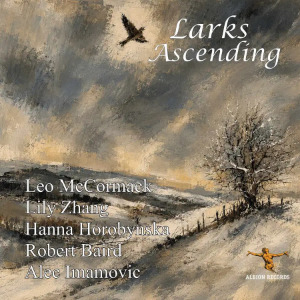
Larks Ascending
Leo McCormack
Fleeting Moments
Lily Zhang
A Lark’s Year
Hanna Horobynska
To Get Through the Winter
Robert Baird
In Memoriam Alauda Arvensis
Alec Imamovic
We Will Return
rec. live, 29 April 2026, Royal College of Music, London, UK
Albion Records ALBCD074 [46]
I’m very lucky to live close to a prime environment for skylarks. It’s easy to take for granted the way their lovely torrent of song — Meredith’s ‘silver chain of sound’ — seems an integral part of the landscape as one walks, but in fact this is an increasingly uncommon experience in the UK and Europe. When Vaughan Williams wrote The Lark Ascending in 1914, skylarks were abundant. A catastrophic plunge in their numbers began in the late 1970s with the collapse of their preferred agricultural habitats, and estimates I’ve read place the decline at between 65 and 70 per cent over the past 50 years. That decline has slowed thanks to conservation endeavours but sadly hasn’t ceased.
One notable effort to draw attention to the decrease in numbers has been an initiative by the Ralph Vaughan Williams Society, which joined forces with the Wildlife Sound Recording Society and the British Library to develop an archive of recordings of skylark song in the British countryside. In an imaginative move to link the project more closely to one of Vaughan Williams’s most famous works, the Society collaborated with the Royal College of Music to establish a competition for composition students, who were invited to use the recordings to create new works. This new CD is a recording of a concert in April this year at which the five shortlisted works were presented. It’s been a privilege to listen to the strikingly different approaches adopted by each of the composers, all caught here in fine performances.
The first work on the disc is Leo McCormack’s Fleeting Moments, a thoughtful reflection on the ephemeral. McCormack has carefully edited various lark recordings into fragments and presented them alongside similarly short phrases played by flute, clarinet, violin and cello. The effect is a remarkably integrated span of music and sound, not unlike those walks I mentioned where the larks’ song blends with disparate and random thoughts.
Lily Zhang’s A Lark’s Year consists of 12 short movements. The booklet includes what appear to be the composers’ own statements about their pieces; Zhang’s begins: ‘A Skylark’s first year, May to April, learning a voice. Hunting in borrowed light. Becoming itself against wind and wire.’ Set alongside the movement titles, Zhang’s statement reveals a real narrative, from the ‘Newborn’ in May round to the ‘Echo’ of April, where electronics and acoustic instruments (flute, horn, violin, cello) slightly confound our expectations of characterisation: the electronics, for example, are used to represent engines and mechanisation but also water and wind and the larks themselves. I loved the theatrical touch at the start of the work too, where we have a full minute of birdsong before anything else is heard.
To Get Through the Winter is a wholly electronic work by Hanna Horobynska. At the concert, lighting apparently played a significant role in the performance, but the piece is highly effective as a purely aural experience. It’s predicated on the opposition of winter and spring, with the skylark presented as a personification of hope. The treatment of sound is transfixing throughout. Horobynska’s aim is to provide an immersive and participatory experience of the dawning of spring, and she succeeds triumphantly, I think: her skilful use of fragments of sound against a background of what seems like a shimmering, gradually strengthening wind is brilliantly suggestive. I particularly liked the contrast between what sounded to me like synthetic but beautiful birdsong and the real thing, before the two were heard together.
Robert Baird’s In Memoriam Alauda Arvensis (Alauda arvensis being the scientific name for the Eurasian skylark) is in some ways the most traditional piece here, inspired by the lark recordings but instrumentally realised. He sets higher (flute, clarinet and viola) and lower (bassoon, horn and cello) voices against each other, the higher being the beautifully characterised skylark, the lower representing ‘the overbearing march of industrialisation, with obnoxious noise and mechanical drive’. Its 11 minutes make for a wonderfully dramatic and devastating sequence as the lower voices gradually become more and more dominant. It’s an accomplished and memorable modern tone poem.
The final work, We Will Return by Alec Imamovic, is fuelled by anger and observation: ‘nature will always take back what it has lost. Our beautiful songs have suffered on account of your greed. Now listen to our story, listen to what we have to say – learn from it and open your eyes and ears’, he writes. He starts with air-raid sirens and passionate, accusatory, declamatory voices and somehow ends up, at the conclusion of the piece’s almost nine-minute span, with an ingenious modern recreation of English Pastoral. I found its beginnings unsettling, almost shocking, and I wondered if its elegiac ending was deliberately ambiguous, almost illusory — will nature this time manage to take back what has been ravaged?
The works are presented in reverse order of placement (by Malcolm Riley and Nicola LeFanu): McCormack, Zhang (both unplaced), Horobynska (3rd), Baird (2nd), Imamovic (1st). I listened cold but, interestingly, would have reached the same conclusions, I think. But without hesitation I’d say that all of these works are fully worth hearing, and one can foresee very bright careers for all five composers.
This must have been a remarkable evening at the RCM, and not just for the compositions. The standards of performance are spectacularly good. I’ve been able to confirm that several of the players and conductors are RCM students, and I assume all of them are. Engineer Joel Allison has done a fine job of capturing the live sound, and there’s a palpable sense of occasion and excitement. What a testimony to a fine living institution this disc represents. And it’s not just the RCM we should thank. The Ralph Vaughan Williams Society and its label Albion have here shown how the inspiration and influence of a great composer can remain powerfully relevant.
The most noticeable quality shared by all of the works on this disc is their elegiac tone. Some go further than that into anger and warning, and all are in stark contrast to the idyll that is The Lark Ascending. Yet the composers themselves find hope inside the lament: McCormack calls his piece ‘life-affirming’, Horobynska makes the skylark a symbol of hope, and Zhang’s year ends with ‘rising again’. And McCormack’s word fits the whole disc: I’ve found it one of the most life-affirming I’ve listened to in a long time. The sheer vitality and talent of the voices on display and the attestation to what we still have that is treasurable in nature have made the deepest possible impression on this listener.
Dominic Hartley
Buying this recording via the link below generates revenue for MWI, which helps the site remain free

Performers
Fleeting Moments
Juliet Beadle (flute), Lily Hesper-Dugdale (clarinet), Anant Malpani (violin), Nok Him Chan (cello)
A Lark’s Year
Mia Davison (flute), Tommaso Rusconi (horn), Anant Malpani (violin), Nok Him Chan (cello); Daniel Hutchins (conductor)
To Get Through the Winter
Hanna Horobynska (electronics)
In Memoriam Alauda Arvensis
Juliet Beadle (flute), Lily Hesper-Dugdale (clarinet), Katharine Wing (viola), Jonathan Churchett (bassoon), Tommaso Rusconi (horn), Nok Him Chan (cello); Wooju Baik (conductor)
We Will Return
Leah Hallinon (flute), Alex Scott (clarinet), Anant Malpani (violin), Nok Him Chan (cello); Alec Imamovic (conductor)













