
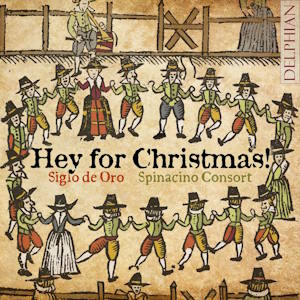
Hey for Christmas!
Siglo de Oro/Patrick Allies
Spinacino Consort / Eric Thomas
rec. 2026, Salisbury Medieval Hall, Salisbury, UK
Texts & English translations included
Delphian DCD34347 [62]
When it comes to Christmas music, though I like the traditional seasonal favourites – or some of them, anyway – I always like to hear something a bit different. This new album by Partick Allies and Siglo de Oro is a lot different.
In a booklet essay which is as entertaining as it is informative Allies invites us to imagine that we are in mid-seventeenth century London. It is dusk on Christmas Eve and we have arrived to spend Christmas at the house of relatives. After the penitential observances of Advent, he says, “twelve days of revelry lie ahead”. There’s lots to eat and drink, games to play and, of course, music and dancing. That’s the context for this album which contains music that might have been sung and played around that time. There are sung pieces, some contemplative, others downright lively. There’s also a good leavening of instrumental music – for the dancing; for these numbers the Spinacino Consort and their director Eric Thomas do the honours; they also accompany a good few of the sung items. I’ve listed the members of the Consort at the end of this review, partly to credit them but also so that you can see the range of instruments involved,
The music which is included in this imaginary family Christmas celebration is varied and covers most festive requirements. The contemplative side of the festive season is catered for by such gems as William Byrd’s O magnum mysterium. This is familiar to twenty-first century listeners, of course, but more usually we hear it as a choral item. Here, it’s sung by just four voices and as I listened I got a sense of how the music might have sounded when sung secretly – or at the very least, discreetly – in Catholic recusant households; there’s a genuine sense of intimacy to this performance. Intimate, too, is Martin Peerson’s Upon my lap my sovereign sit. I learned from Patrick Allies’ notes that Peerson was appointed Master of the Choristers at St Paul’s Cathedral (the pre-Wren church, of course) in the 1620s. I’ve heard a little of his music in the past but not, so far as I can recall, this piece. The singers are accompanied, I think, by bass viol and theorbo. It’s a rather lovely little piece and I count it as a discovery. I also liked the arrangement of Sweet was the song the Virgin sung made by Thomas Hamond, a Suffolk gentleman. The piece is simple and lovely. The sacred aspect of Christmas is also communicated in the traditional This is the truth sent from above. This is not sung to the haunting Herefordshire tune so memorably arranged by Vaughan Williams. Instead, we hear a different tune, in the Dorian mode; it’s very pleasing. The present performance is sung by Rebekah Nießer-Jones with Eric Thomas accompanying her on the lute. There are no fewer than seven verses but the way these performers vary each verse avoids any sense of tedium.
This is but one of several excellent vocal solos that I enjoyed. Another comes in the traditional Irish song, The darkest midnight in December. Hannah Ely sings this, with some instrumental support, though not in every verse. The vocal line is highly ornamented and haunting. I’ve heard choral arrangements of this tune in the past but the present very fine performance lets us hear music stripped back to the bare essentials; the results are haunting.
You may wonder why the programme includes a spoken reading from Aesop’s Fables: The Ant and the Grasshopper. The answer is that the words set by William Byrd in his secular piece In winter cold – Whereat an ant are based on the fable. The reading is done by Hannah Ely. She relates the story in a most engaging fashion, with imaginative instrumental interpolations and some sound effects. Thus is a nod given to the Christmas tradition of storytelling.
Christmas is a season for jollity and good fellowship as well as food and drink. Patrick Allies and his colleagues represent that side of the feast very successfully. We hear several dances played by the Spinacino Consort; these pieces are arranged by the Consort. I think I’m correct in saying that all the tunes come from John Playford’s collection, The Dancing Master, first published in 1651. The festivities get under way with Granny’s Delight. This is a jolly, skipping dance; you can imagine granny picking up her skirts and dancing a jig to this lively playing. Most of the dances are spirited affairs but there’s one exception. The Beggar Boy is a bit of a surprise; this, though beautiful, seems a bit slow and melancholy for a dance. On the other hand, A Wassail Tune is suitably jolly. A tune collected by Playford which has words associated with it is Drive the Cold Winter Away. Patrick Allies, who has made this arrangement, rightly describes this as a “hearty tune”. This is a multi-verse number but the singers and players vary the treatment of each verse in such a way that listening to it is most enjoyable.
Everyone, it seems, had great fun with the concluding item, Hey for Christmas! You’ll know the tune: Gustav Holst is one of the twentieth-century composers who arranged it. The words, Allies says, “tell the story of a chaotic Christmas get-together”. All the elements of the seasonal festivities – food, drink, dancing, games and the like – are celebrated in a very lively fashion by the performers. The trouble is that it’s a very long number: there are seventeen verses, each one of which is followed by a refrain; there are also a few instrumental interludes. It’s easily the longest item on the programme and it did strain my loyalty a bit. Also, I have to say there were one or two occasions when I wondered if those singers – usually male – who were responsible for the verses hadn’t perhaps exaggerated the party spirit a little. Maybe this is an item which works better in live performance than on disc?
But I mustn’t end on a Scrooge-like note. Though I’ve often admired the work of Siglo de Oro I didn’t know quite what to expect when this disc arrived. I’m glad to report, though, that I enjoyed it very much. The performances are clearly the result of a lot of careful research but such scholarship is lightly worn here. The performances, both vocal and instrumental, are excellent and the musical programme offers lots of unexpected and very varied delights.
Rightly, a secular venue was chosen for the recording. Paul Baxter has recorded the performances very successfully in Salisbury Medieval Hall. The documentation, which includes an entertaining and informative essay by Patrick Allies, is excellent.
Treat yourself to something different this Christmas! I don’t think you’ll regret it,.
John Quinn
Buying this recording via the link below generates revenue for MWI, which helps the site remain free

The Spinacino Consort
Aaron McGregor (fiddle)
Eric Thomas (lute/theorbo)
Claire Horáček bass viols)
Annamarie Klein (recorders)
Callum Armstrong (recorder/small pipes)
Tom Hollister (percussion)
Contents
Anon – collected by John Playford (c 1623 – c 1680) – Granny’s Delight
Anon – As I Outrode (Coventry Shepherd’s Carol)
William Byrd (1539/30 – 1623) – O magnum mysterium
Thomas Ravenscroft (c 1582) – Remember O Thou Man
Trad Irish – The darkest midnight in December
Anon. Arr Thomas Hamond (d 1662) – Sweet was the song the Virgin sung
Anon – collected by John Playford – Drive the Cold Winter Away
After Aesop – The Ant and the Grasshopper
William Byrd – In winter cold – Whereat an ant
Anon – collected by John Playford – The Beggar Boy
Trad. – This is the truth sent from above
Richard Smert (c 1400 – c 1479)- Sir Christèmas
Giles Farnaby (c 1560- 1651) – Paul’s Wharf
Martin Peerson (c 1572 -1640) – Upon my lap my sovereign sits
Anon – collected by John Playford – A Wassail Tune
Trad Irish – Now to conclude our Christmas mirth
Trad. – Hey for Christmas! (Dargason)













