
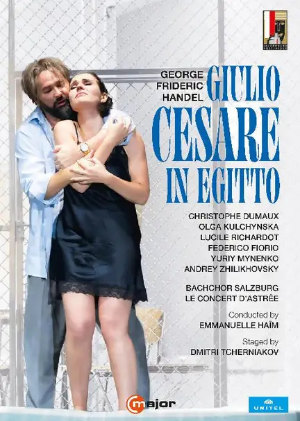
George Frideric Handel (1685-1759)
Giulio Caesar, Opera in 3 Acts
Giulio Cesar – Christophe Dumaux, (countertenor)
Cleopatra – Olga Kulchynska (soprano)
Cornelia – Lucile Richardot (mezzo-Soprano)
Tolomeo – Federico Fiorio (baritone)
Sesto – Yuriy Mynenko (countertenor)
Achille – Andrey Zhilikhovksy (countertenor)
Bachchor Salzburg & Le Concert d’Astrée/Emanuelle Haim
Staged by Dmitri Tcherniakov
rec. live, August 2025, Haus für Mozart, Salzburg Festival, Austria
C Major 773208 DVD [2 discs: 201]
There was a Monty Python Colonel character played by Graham Chapman seated behind a desk, complete with uniform and swagger stick, who used to occasionally prevent the sketch from going on because it was ‘too silly.’ Likewise, during the play within the play at the end of Shakespeare’s A Midsummer Night’s Dream, Hippolyta, more sensitive to the honest toil of the native Athenian rustics, nevertheless declares it ‘the silliest stuff that I have ever seen’.
I felt a lot like this while watching the new production of Giulio Caesar in Egitto from Salzburg, conducted from the harpsichord by Emmanuelle Haim and Le Concert d’Astrée with an all-star cast of chiefly countertenors. It was clear that what I was hearing from the start was close to sublime. Thankfully, that somewhat made up for the production idea, setting, costume and execution, which were, without wishing to be too critical, universally dire. It was at times incoherent, muddled, offensive, impractical, sexually exploitative, misguided, and it’s likely that I’ve missed a few. It was a classic case of trying to fit a struggling square peg into an incalcitrant round hole, and in this review, I’m not only going to explain why, but in total contrast also praise the singing, conductor and orchestra to the skies.
There was a time when so-called Director’s Theatre was almost all the rage, where most new productions were fresh and exciting and innovative. They didn’t just rely on the director’s latest fevered dream, or deep psychosexual secret, or a piece of elaborate and expensive stage machinery which proved on the first night that it was all but impractical by stopping at the vital scene and refusing to budge. Here I refer to Robert Lepage’s famous Met Ring cycle, and the more infamous ‘machine’, of course. However, I counted myself privileged to see Lepage’s water inspired MND at the National Theatre, and know just what he was capable of.
I have not been aware of the previous work of this director, and if this is anything to go by, nor do I wish to be. I confess also to myself having previous as a theatre director who may perhaps have perpetrated the occasional production which some might have considered ill-conceived, or even a horror. However, I never lost sight of the two most important facts that any director has to bear in mind. First and foremost, any production must honestly serve both writer and work, enhancing what is already there and in some, helping to illuminate or elaborate on that. Possibly even more important, however, is the fact that any director and production have to serve their audience. It is a priority that that audience be entertained, not just by what’s been sung or spoken, but by what is going on on-stage and how the staging and production concept is utilised. People pay a lot of money to come to these things, you know? In this case, especially. I should add a third rule which is that the director/dramaturg/dictator should not exploit his cast. More that anon.
The problems are with us right from the start when the viewer becomes aware that the stage has been set out as a bunker. I had been warned about this and was already bracing myself for the inevitable. Sure enough, the bunker appears to be in three sections. On the left is a cell, and likewise in the middle, (although this cell seems to be equipped with a remarkable amount of goods to consume after the presumably impending holocaust. Preceding the overture a long stream of German runs along the top of the stage quite slowly. My German is not enough to grasp what’s going on, plus it also sounds technical. There should be sub-titles for such an important piece of information, but there aren’t. I am playing English sub-titles, so why the hell don’t I know what’s going on? Short of an indication from anywhere else, I am guessing that in contained the warning to people to immediately descend to the bunkers until the coast is clear. It’s certainly important and drat, I’ve missed it. Perhaps the overture will clarify it. It doesn’t. All it seems to contain is people coming backwards and forwards through the mostly unused section, which is clearly both gate and security clearance. I am getting increasingly fed up, (but not surprised), when the guy with a beard in the white shirt and trousers opens his mouth and this glorious sound pours out. I am confused because I have recently seen Peter Mattei in the La Scala Don Giovanni, and it looks just like him, or maybe Roger Allam or David Mitchell, none of whom, as far as I am aware are countertenors. This character, I remember, is Giulio Cesare, and the singer is the marvellous Christophe Dumaux. His voice is an immediate plus for the production, but here’s a warning if you don’t like countertenors: there are 1-2-3-4-5 of them – and I’m sure I didn’t miscount.
I’m not a huge fan of most countertenors, and I know I’m not in the minority, by any means. Christophe Dumaux is very much of the Andreas Scholl school, the sort of womanly voice that I feel more comfortable with. It came as a bit of a shock to discover so many pesky countertenors and there is a school of thought that says that with too many – Sesto, Achille, Tolomeo, Nireno, and Curio – it simply becomes wearing (even wearying). I do know that this is an honourable attempt at authenticity in following Handel’s use of castrati, but you do long for the female voices. Happily, they are provided by Lucile Richardot as Cornelia and Olga Kulchynska as Cleopatra.
Lucile Richardot begins somewhat nervously in the first act, but when you bear in mind what happens to her in the remainder of the drama, it’s hardly surprising. Here is a character who appears to be raped at least once and likely several times, and that doesn’t count the multiple attempts and the mass of groping that goes on, mostly courtesy of Tolomeo’s sidekick Achille. As all this unfolded, I found myself both thinking and worrying about intimacy co-ordinators and whether they have them in opera productions as they do on film sets now. Cornelia is partly undressed by the odious Achille, who is played as the sort of psycho sicko, who is the last person you’d want in charge of your imprisonment and well-being. He is worryingly convincingly both played and sung by Andrei Zhilikhovsky, complete with a foppish blonde Boris Johnson style fringe which won’t lie down. Later, it is obvious that both Cornelia and Sesto, her son, have been systematically beaten, as there is a shocking scene at the start of Act Three when the two of them are sitting silent and clearly traumatised on the mattress in their cell.
If you think mother and son are poorly treated, please spare a thought for their father Pompeo. The poor fellow at least has the advantage of being dead, (by the orders of Tolomeo, but it’s the nasty hands of Achille who did the deed), but never have you seen a corpse being continually messed with or dragged about. One minute his widow and son are doing as much as they can to revere and respect the body, wrapping it up in some canvas as a winding sheet, for example and doing everything that’s expected short of washing him and putting pennies over his eyes. The next he’s been dragged around like a sack of meal by Tolomeo, Achille, or one of their henchmen, bumping his head into anything that’s sticking out. The part of Pompeo was played by a sort of extra by René Keller and I just hope he has decent health insurance.
There are probably too many other misplaced ideas to mention, but I would like to know why Cleopatra, (or more likely the director) cannot seem to make up her mind whether she is wearing her pink wig or not, or whether she is actually Lydia, a friend of Cleopatra, or the queen herself. Caesar doesn’t seem to mind either way, although it later becomes clear that he prefers the black haired original. No, I don’t mind modern productions at all, especially if they are delivered in a way which isn’t just about innovation, but some, like this, are mostly a mess.
So, let’s talk about everything else than the production then, and happily, the rest is pretty fabulous. For a start, there’s the tight controlled performance from the harpsichord by the hugely experienced Emmanuelle Haim and her Le Concert d’Astrée. The sign of a good accompanist conductor is when you don’t have to notice them apart from the moments when you realise just how well everything is going in that department. This was clear in the conducting and ensemble playing right from the start. I can’t even really pick out any individual instrumental performances due to my attention being astonished between the marvellous vocals and the appalling production. They acquitted themselves more than well – as indeed did all of the singers. You would have to select Christophe Dumaux for both the power, beauty and total security of his singing of the title role. His singing of both of his great arias, both Va tacito e nascosto in Act One, and towards the end of the final act the totally contrasting Aure deh, per pieta sounded glorious with that mixture Dumaux has of fluid, full and yes, faultless singing.I’m not sure that his Cleopatra quite matched him, but Olga Kulchynska sang very well for the most part, even if at times she seemed a little stilted on stage, for which you would probably have to blame the cramped setting. Her finest moment for me was her singing of the great aria Piangero la sorte mia in the middle of Act Three, when she and everyone else believes Caesar to be dead. She beautifully catches the two very different moods of the verses; the first continuing to show feelings for the dead tyrant, but the second threatening to haunt him as soon as she is dead.
Of the remainder of the cast, Yuriy Mynenko is a very fine baritone, with a voice full of authority that carries well and quite a relief from all of the countertenors. Chief among these after Dumaux, has to be Andrey Zhilikovsky as the dreadful Achille. This is a part often played by a bass, in which role I can certainly imagine it, but there is something about a countertenor, like a Wagnerian Mime or Mozartian Monostatos, which can bring out the sheer nastiness in the character and make you want to stamp on him and pull his hair, while at the same time repulsed and impressed all in one.
Lucie Richardot wasn’t on the best of form, I don’t think, but then the production messed about with her so much, I’m surprised she could settle. I’ve heard her in far more secure voice, for example, in Raphael Pichon’s Bach recordings, but then she is allowed to keep still. Her acting, especially in those many painful moments, was very convincing. This was complemented well both vocally and in stage presence by Sesto, her son, Federico Fiorio, who with so many countertenors ganging up to be noticed, had to possess a different voice to the rest, and so he did. Unlike both Dumaux, who showed both power and restraint with his fluidity when he needed to, and Zhilikovsky, who’s sometimes disturbing voice adds to the sense of discomfort when he is around, Fiorio is best as a mother’s boy. He does this not only physically through not being able to stray far away from the motherly breast, (something which both Achille and Tolomeo covet far too much too), but in the plangent pleading of his singing.
The remainder of the parts are sung very well by other countertenors, and Emanuelle Haim delivers a continuously fine continuo, while under-marking her aria accompaniments very well indeed. For an opera which can be unnecessarily lengthy, this performance remains tight and pacy.
My conclusion overall is that it would be best at all costs to avoid seeing the production and take any available option. This cast, conductor and orchestra, who are very fine indeed, need to have a far better thought-out vehicle to support them.
Stephen John Wray Gladwin
Buying this recording via the link below generates revenue for MWI, which helps the site remain free

Other Cast
Nireno – Jake Inbar (countertenor)
Curio – Robert Raso (countertenor)
Production Staff
Chorus Master, Michael Schneider
Conductor and Harpsichord, Emmanuelle Haim
Stage Director and Set Designer, Dmitri Tcherniakov
Lighting Designer, Gleb Filshtinsky
Fight Director, Ran Arthur Braun
Dramaturg, Tatiana Werestchagina
Video Director – Andy Sommer
Technical Details
Picture Format: NTSC 16.9 Sound Format: PCM DTS 5.1
Region Code – 0 (worldwide)
Languages – Sung in Italian; Subtitles: English, German, French, Spanish, Korean, Japanese













