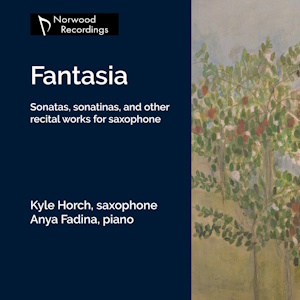
Fantasia
Kyle Horch (soprano and alto saxophones)
Anya Fadina (piano)
rec. 2024/25, Menuhin Hall, UK
Norwood Recordings NR202601 [77]
I last reviewed a disc by saxophonist Kyle Horch back in 2022 when he produced ‘Fairy Tales’, a cleverly constructed recital of (largely) rarities from Eastern Europe. Now he turns to ‘Fantasia’, six overlooked or recently composed pieces that show Horch to be an adventurous and expert exponent of his instrument. I’m also glad that this time he has found a better recorded venue for his skills, the Menuhin Hall, rather than the Recital Hall in Trinity School, Croydon.
He is accompanied by Anya Fadina, one of the two pianists who played on ‘Fairy Tales’ and they make an assured team. Australian-born but long-time British resident John Carmichael is still with us, aged 96, at the time of writing and the disc opens with his vivid, captivating 2010 work Sonata: Music Grave and Gay, for soprano saxophone and piano, cast in three nutritious movements. It possesses a Ravelian clarity as well as some splendid lyricism and ensures opportunities for the saxophone to demonstrate agile and free interplay in unaccompanied paragraphs. A quietly sombre introduction to the slow movement leads to increasingly fulsome and communicative writing before oscillating back to the initial mood, in true arc fashion. The finale offers a gentle disagreement between the two instruments in a playful, warm-hearted finale.
William Lovelock was an admired teacher in London – he became Dean of the Faculty of Music at the University of London – and then in Australia where he moved in 1956. He lived in Brisbane for many years and was Director of the Queensland Conservatorium of Music. His Sonata for Alto Saxophone and Piano was written in 1974 and is structured in three movements ‘Prokofiev Style’ –– slow, fast, slow. This is a work of unpretentious charm and elegance. It’s lyric, playful in the central Scherzo, which demands fast articulation, and free in the finale which ends with engaging, frolicsome wit.
These two sonatas form the spine of the recital but there are smaller works too that prove just as satisfying to the listener. Boris Mersson’s Fantasia, after which the disc is ostensibly named, offers a single-movement eleven-minute span of deft, occasionally drifting harmonies, rhapsodic and fanciful. The final section is ushered in by the piano and the writing here is broadly post-impressionistic and the saxophone responds with skittish runs. Harriet Steinke’s Strange Lights exudes traditional, long-breathed melodic warmth, its undulating lines finely set out for the two instruments though hinting at the static or repetitious. These hints are taken up in the finale which embraces minimalist elements, after the zesty Scherzo-like second movement.
Quietude marks out Frank William Brazinski’s 1996 Sonatina which is split into a warming Alleluia first movement and a contrasting angular and playful Scherzo though this, too, ends calmly. Finally, there is Melvin Solomon’s own Sonatina for soprano and piano. This is the zaniest of the works. It opens with puckish wit ‘à la Mozart’, as the opening movement is noted, moves onto a lyrical, rather Szymanowskian central movement marked ‘A Hymn to Andromeda’, and ends with a sequence of attractive dances that generate a madcap element. It certainly ends the recital on a note of ebullience.
Kyle Horch and his partner Anya Fadina deserve plaudits for this recital. It showcases the saxophone repertoire, for alto and soprano, in music that is communicative, direct and attractive.
Jonathan Woolf
Availability: Norwood RecordingsContents
John Carmichael (b. 1930)
Sonata: Music Grave and Gay (2010)
William Lovelock (1899-1986)
Sonata (1974)
Boris Mersson (1921-2013)
Fantasia, Op.37 (1979)
Harriet Steinke
Strange Lights (2019)
Frank William Brazinski (1932-2012)
Sonatina (1996)
Melvin Solomon (1947-2016)
Sonatina, Op.24 (1979)