
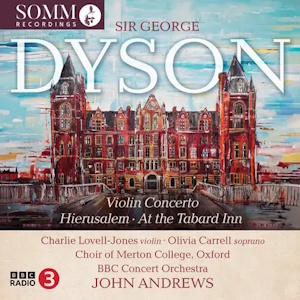
Sir George Dyson (1883-1964)
At the Tabard Inn (1943); overture to The Canterbury Pilgrims (1931)
Violin Concerto (1941)
Hierusalem (1956)
Charlie Lovell-Jones (violin)
Olivia Carrell (soprano)
Choir of Merton College, Oxford/BBC Concert Orchestra/John Andrews
rec. 20-22 April 2026, Watford Colosseum, London
Texts enclosed
SOMM SOMM0735 [63]
Sir George Dyson is represented here by three contrasting works – the overture to his large-scale choral work The Canterbury Pilgrims, the Violin Concerto and Hierusalem, all composed during the years 1941 to 1956.
In 1943 Dyson wrote At the Tabard Inn, which functions as an overture addition to the earlier The Canterbury Pilgrims, which he’d composed in 1931. It’s an eleven-minute tapestry that reflects the boisterous, fulsome vibrancy of the work but also takes in geniality and parcels of nostalgic reverie – the lyric alongside the perky. It’s a perfect entrée to the work, reflecting the rich variety of the pilgrims and introducing thematic material from the work, though it can also be performed separately. The two options for performance – independent piece or overture – are addressed imaginatively in Richard Hickox’s complete recording of the work on Chandos, whilst David Lloyd-Jones also recorded it, with the Symphony and Concerto da Chiesa for string orchestra, on Naxos. All three recordings catch the overture’s vitality.
Dyson was appointed principal of the Royal College of Music in 1937. Two years later Albert Sammons was appointed to the teaching staff at the same institution. The two men had known each other since the days of the First World War when the London String Quartet, of which Sammons was first violin, had premiered an early chamber work by Dyson. The Violin Concerto (1941) was written for Sammons and first performed by him on the BBC by its orchestra conducted by Adrian Boult on 16 February 1942 and given a public première at the Cambridge Theatre in London by the same forces a month later. The notes get this a bit mixed up, giving the February date as its public première. Despite trying very hard with Lydia Mordkovitch and Richard Hickox’s recording on Chandos, my mind has frequently wandered when listening and I decided that it was too disparate, discursive and, ultimately, unmemorable, and I’d be better off listening to the near-contemporaneous concertos of Bax, Walton, Britten and Moeran. That’s now changed with Charlie Lovell-Jones’ performance.
Partly it’s a function of relative speed. Lovell-Jones and John Andrews take the Concerto at a far faster tempo (36-minutes) than Mordkovitch and Hickox (over 43). Sammons’ Prom performance of the concerto in 1943 – and Sammons was not known for slow tempi – was timed at 39 minutes, so roughly bisecting the two performances. But it’s more a question of characterisation at incisive tempi than speeds as such and that’s where this newcomer scores so highly. He brings a sensitive youthful brio to the concerto, musing rhapsodically over the accompanying orchestral pizzicati as the concerto starts, responding immediately to its rousing dramatic panels or soaring seraphically as Dyson gives the soloist opportunities to unfold his legato; all this before the soloist returns, like an arc, to muse once again over the returning orchestral pizzicati. Quicksilver passagework animates the scurrying Scherzo; a movement perfectly scaled for Sammons’ dashing virtuosity. In the Poco andante, which is a Theme and Variations in E major, the solo violin enters languidly and rhapsodically over muted orchestral strings. Dyson risks a dance variation, but his heart is more into the extended dreamy variation with which the movement ends. It’s not a movement to plumb expressive depths – it is, after all, a Poco andante not an Adagio, but it does manage not to unsettle the expressive temperature of the concerto and keeps it relatively light. The finale is a busy, lyrical and dynamic one, reinforcing the light-hearted element that has suddenly bubbled to the surface of the music. One hazily nostalgic passage reflects on earlier themes before the triumphant close.
Structured in an old-fashioned four-movement span, and being essentially late-Romantic, Dyson’s Concerto will, in all honesty, never rival the other British Violin Concertos of the time cited above but it possesses, certainly in this performance, a real personality, a sense of lingering and of athletic thrust that have finally convinced me.
In 1956, now in his early 70s, Dyson wrote Hierusalem. It was a commission from the Royal College of Organists, of which he was the President, and came directly from Harold Darke to mark his 40 years as Director of Music. Darke also commissioned Vaughan Williams (A Vision of Aeroplanes), Herbert Howells (An English Mass) and himself (A Song of David). It’s a work of calm introspection, cast for soprano soloist, here the fine Olivia Carrell, choir, string quartet and string orchestra, though one that does also include moments of exuberance and outgoing extroversion. Andrew H. King, the booklet writer, mentions musical parallels with The Dream of Gerontius and Mahler’s Fourth Symphony but in its modal moments and writing for these individual forces, the name that comes to my mind is Vaughan Williams. One especially beautiful phrase for the soprano soloist reminded me strongly of the Serenade to Music – as well as the general aura of the Tallis Fantasia.
Dyson’s introspective and exuberant sides are celebrated in this discand sometimes, of course, these two elements are fused or exist in close conjunction. The recording quality in the Watford Colosseum, London, a much-used venue, is excellent. The Choir of Merton College, Oxford perform with admirable commitment, and the BBC Concert Orchestra is splendid throughout under Andrews. This is a truly excellent disc.
Jonathan Woolf
Buying this recording via the link below generates revenue for MWI, which helps the site remain free













