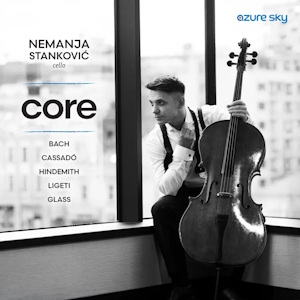
Core
Johann Sebastian Bach (1685-1750)
Suite for Solo Cello No. 1 in G major, BWV1007
Gaspar Cassadó (1897-1966)
Suite for Solo Cello (1926)
Paul Hindemith (1895-1963)
Sonata for Solo Cello, Op. 25/3 (1923)
György Ligeti (1923-2006)
Sonata for Solo Cello (1948/1953)
Philip Glass (b. 1937)
Songs and Poems for Solo Cello: Song V (2007)
Nemanja Stanković (cello)
rec. 2025, Church of the Holy Spirit, Kotor, Montenegro
Azure Sky AZ1032 [56]
Several decades ago, the aspiring young cellist that I was thoroughly enjoyed playing the opening bars of Bach’s Suite No. 1. So well is it conceived for the instrument that it sounded wonderful, even taking into account my meagre talent, and the facility with which the necessary crossing of strings can be achieved was another boost to youthful confidence. But the remainder of the suite remained a closed score, as did, sadly, most of the cello repertoire. As time passed my musical tastes evolved, to the point that I became so averse to Bach’s music for solo strings that I wondered at first if I had the right to comment on the performance that opens this recital. It was for the rest of the programme that, logically enough, I requested this disc, but I am riveted by the Bach as played here by the Serbian cellist Nemanja Stanković. The sonorous opening sounds even better than the cloudy and illusion-rich memory of my own playing; and I am struck by the extreme depth and beauty of sound Stanković produces throughout the suite, as well as his subtle mastery of phrasing and insistence on clean textures that allow the listener to hear all the strands of Bach’s ingenious counterpoint. Any fear of relentless monotony is banished. Instead we have an attractively light-footed courante, opulent chords in the sarabande, and a closing gigue that is properly heavily accented but which remains nimble and dancing. Repeats are subtly modified, and the music always breathes.
All the positive features I appreciate in Stankovic’s Bach playing enhance the rest of the programme too. Gaspar Cassadó’s Suite – which follows the Bach with too short a break – is a major work, and Stanković gives us a superb performance of it. One revels in the guitar-like textures of the first movement, the exuberant dance that is the second, and the two-part finale that closes with music of great virtuosity. Throughout we have the perfume of Spain, whose origin is sometimes obvious but which is more often hidden in the very nature of the music in such a way as defies definition. I’ll have to give the work a more analytical listen to be able to pinpoint the two quotations, one from Kodály and one from Ravel’s Daphnis et Chloé, that are mentioned in Ivana Medić’s excellent booklet note.
Hindemith’s solo sonata again follows hard on the heels of the Cassadó, yet curiously, in a work of whose five movements only one passes the two-minute mark, the silences between the movements are arguably too long. Anyone whose knowledge of Hindemith is centred around his Symphonic Metamorphoses on Themes of Carl Maria von Weber, his two brass dominated sets of Konzertmusik from 1930, or even the lovely unaccompanied Six Chansons, choral settings of texts by Rainer Maria Rilke, will be surprised by the harsh language here. The opening movement, severe and aggressive, has an introductory feel, offset by the heavily playful second movement. The central movement is melodic, emotionally rather arid, and ends on a defeated, repeated downward phrase low down in the instrument’s register. A tiny, skittering scherzo precedes the purposeful, determined finale that, without any warning, ends on a major chord.
Ligeti’s Sonata, too, is also a work that will surprise those familiar mainly with the composer’s later, experimental pieces. The first of its two short movements was composed in 1948, to which Ligeti added a second in 1953. Some sources hold that the first movement, “Dialogo”, was an expression of the composer’s feelings for a fellow cello student when they were both studying at the Liszt Academy in Budapest. It begins with a delicious pizzicato slide that alternates with a peaceable melody in Hungarian folk style. Both elements make a brief reappearance in the second movement, which is otherwise a wild, almost frenzied torrent of rapid figuration that makes the utmost technical demands on the player. In spite of the far more advanced musical language employed, the movement nonetheless ends on another unexpected major chord. Stanković is magnificent in this curious yet compelling work. Paul Griffiths, writing in the booklet accompanying Miklós Perényi’s performance (2009, ECM) claims that with a timing of 3:35 the cellist’s performance of the second movement “knocks a quarter off the composer’s reckoning of its duration”. Well, Stanković comes in at even a few seconds fewer! French cellist Emmanuelle Bertrand, on the other hand, in what was her very first recording (1999, Harmonia Mundi) adds a good minute and a half to each of the two movements. This brings a touch of unexpected melancholy to the first movement, and the second movement emerges as less feverish, making the return of the earlier music better integrated. It’s another point of view and perhaps even a preferable one.
In a thoughtful note introducing the programme, Stanković writes that “This album captures […] my core, or essence, as a cellist, revealed through works of great composers whose music inspires me and gives meaning to both my work and my life.” The album closes with Philip Glass’s Song V, extracted from the seven-piece suite entitled Songs and Poems for Solo Cello. These five minutes of music are centred around four or so minor chords that first punctuate a long-breathed melody composed largely of scale passages. This same material is later modified with shorter note values and thicker textures. The gentle, repeated pizzicato chords that close the piece provide an effective conclusion to the recital, one that, according to the booklet note, “serves as a meditative resolution – a poignant statement on the solo cello’s ability to sing across centuries and stylistic boundaries.” Whether or not one feels that this statement can be directly applied to Glass’s piece, it is surely one with which most music lovers will agree. To those who love the cello, and perhaps above all to those wary of a recital given by the cello alone, will find much to enjoy in this fine disc.
William Hedley
Buying this recording via the link below generates revenue for MWI, which helps the site remain free