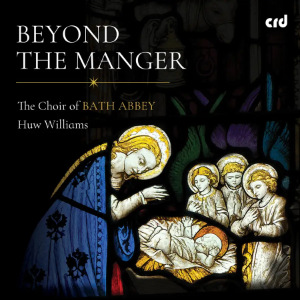
Beyond the Manger
The Choir of Bath Abbey / Huw Williams
Jeffrey Howard (organ & piano); Nia Evans (harp); Jeremy Little (percussion)
rec. 2025, Bath Abbey, Bath, UK
Texts included
CRD 3566 [69]
Bath Abbey, a very fine building in the centre of the city, is one of the most important non-cathedral churches in England,. Fittingly, it also has a very good choir; they are of a sufficient standard that they are regular participants in BBC Radio 3’s Choral Evensong broadcasts. The choir has both boy and girl choristers but, like many other churches and cathedrals with similar arrangements, the boys and girls don’t sing together; rather, they alternate, each group bringing their distinctive timbres to collaborations with the adult ATB Lay Clerks. In 2025, CRD released a disc, which I’ve not heard, entitled Everlasting Light (CRD 3556); this was issued to celebrate 150 years of the Boys’ Choir. The Girl Choristers have a shorter history – their group was established in 1997 – and this new Christmas disc puts them in the spotlight. They join forces with the Lay Clerks, conducted by the Abbey’s Director of Music, Huw Williams. There are fifteen Lay Clerks (4/6/5) and twenty-five sopranos.
Williams has devised a varied programme, with something for all tastes. The eclectic range of the programme is admirable, though the ordering of the music does produce one or two odd juxtapositions: the piece by Roderick Williams, with its complex textures, is a strange bedfellow for the lush sentimentality of Mel Tormé’s The Christmas Song, while The Little Drummer Boy beats his festive tattoo between music by Gustav Holst and by Cecilia McDowall. However, for the most part, I think the programme works well.
Let me select a few pieces for comment, including some of the more enterprising selections. The compelling O Adonai, et Dux domus Israël by Roderick Williams would certainly fall into that category. I’ve never sung it but I’ve heard it several times and it sounds to be challenging. The Bath Abbey singers make a very good job of it. In the resonant acoustic of the church, the girls’ voices carol freely and atmospherically above the chant-like material sung by the male voices. Cecilia McDowall’s setting of the so-called Great ‘O’ antiphon, O Oriens is another excellent choice. I’ve heard and admired this piece many times – it was written for Merton College, Oxford’s choir in 2012 and, I believe, it forms part of the collection The Merton Choir Book, assembled to mark the college’s 750th anniversary. The luminous harmonic language fits perfectly with the sentiments of the text (‘O Morning Star, splendour of light eternal’). The piece commands attention and respect; here, it’s very atmospherically performed.
Several pieces are sung just by the girl choristers. These include Errollyn Wallen’s haunting Peace on Earth. Beautifully accompanied by harpist Nia Evans, these young singers give a most accomplished account of the piece. The same combination of performers gives us Jeffrey Howard’s arrangement of the Welsh carol Sisialau’r Awel Fwyn. This arrangement was made specifically for this recording. The choir is divided into three parts and the choral/harp textures are light and beguiling. Much earlier in the programme, the same forces perform Edmund Rubbra‘s A Hymn to the Virgin. This is a lovely little piece and the bright, fresh sound of the girls’ voices is ideally suited to it. In a completely different vein, the girls sing John Gardner’s When Christ Was Born of Mary Free. I don’t recall hearing this before but I liked the lively, jazzy rhythms and I thought it made a refreshing alternative to the ubiquitous Tomorrow shall be my dancing day.
Huw Williams was born in Wales and is, I understand, a fluent Welsh speaker. It’s fitting, therefore, that his programme includes some acknowledgements of his Welsh roots. I’ve already mentioned one such piece. Another is the arrangement of the Welsh carol Suo Gân by a fellow Welshman, George Guest. This was new to me and I liked it very much. The music is tender and the arrangement, which involves the full choir and a discreet organ part, is highly successful. There are also some nods to Williams’ past career Among his appointments prior to Bath Abbey was a ten-year stint as Organist at St Paul’s Cathedral. His time there would have overlapped in part with the period when John Scott was Director of Music and Wiliams has selected Scott’s arrangement for upper voices of Quem pastores laudavere. The arrangement was made for the choristers of St Paul’s; it’s delightful and the Bath Abbey Girl Choristers do it very well. Williams himself arranged Buxtehude’s ‘Komm doch, Jesu, deine Kirche’ for St Paul’s but in this case it was for the male voices of the choir to sing during Advent. The arrangement is very effective. Masters in This Hall is an arrangement which Williams made when he was conductor of the Stroud Choral Society. The arrangement, with piano accompaniment, works well, not least because each verse is treated differently; I bet the Stroud singers enjoyed singing this robust music.
It’s good that Williams has included a couple of pieces with West Country associations. John Byrt, the composer of All and Some was born in Bristol. His buoyant and joyful piece opens the programme and receives a boisterous, energetic performance which gets the listener’s attention right at the start of the disc. I’ve lost count of the number of times I’ve sung Arthur Warrell’s enjoyable arrangement of We Wish You a Merry Christmas at the end of carol concerts. Until I read How Williams’ notes, though, I hadn’t realised that Warrell was born near Bath and spent most of his career as a musician in the Bristol area.
I hope I’ve given an indication of the range of this programme. I’ll confess that not every item is essential Christmas listening so far as I’m concerned – The Christmas Song and The Little Drummer Boy, for example – but that’s not the point. Ideally, a Christmas programme should cater for a wide range of tastes and that’s the case here. Furthermore, I’ve encountered one or two pieces for the first time and I’ve enjoyed them. I think I’m right in saying that Huw Williams has been in charge of the music at Bath Abbey since 2016. On the evidence of this disc, he has done a very good job. The choir sings very well and I hope the excellent professional Lay Clerks won’t mind if I say that I particularly admired the work of the girl choristers, whose singing is fresh and alert throughout; these young singers make a very pleasing sound. The three instrumentalists make very good contributions.
The recordings were engineered by Bobby Williams who has conveyed a good sense of what the choir sounds like in the resonant acoustic of Bath Abbey, Williams has chosen, I think, not to position the microphones too closely to the singers. As a result, the listener gets a good impression of how the choir sounds in situ. This approach to the recording is particularly successful in an atmospheric piece such as Jan Sandström’s arrangement of Es ist ein Ros’ Entsprungen.
The documentation is good. Huw Williams has written succinct and helpful notes about each individual piece. I mentioned earlier that I’d learned about Arthur Warrell’s background. Another nugget of information concerned John Ireland’s The Holy Boy. I’ve heard that many times but only now have I learned that the author of the words was the composer’s solicitor; truly, every day is a school day!
This is an enjoyable and varied Christmas album.
John Quinn
Buying this recording via the link below generates revenue for MWI, which helps the site remain free
Contents
John Byrt (1940-2021) – All and Some
Edmund Rubbra (1901-1986) – A Hymn to the Virgin, Op. 3 No. 2
Roderick Williams (b 1965) – O Adonai, et Dux domus Israël
Mel Tormé(1925-1999), Robert Wells (1922-1998), Arr. Peter Gritton (b 1963) – The Christmas Song
John Gardner (1917-2011) – When Christ Was Born of Mary Free
Judith Bingham (b 1952) – Corpus Christi Carol
Traditional, Arr. John Scott (1956-2915) – Quem pastores laudavere
Traditional, Arr. Bernard Massey (1927-2011) – Now Tell Us, Gentle Mary
Traditional, Arr. George Guest (1924-2002) – Suo Gân
Marin Marais, Arr. Huw Williams (b 1971) – Masters in This Hall
John Ireland (1879-1962) – The Holy Boy
Michael Praetorius (1571-1621), Arr. Jan Sandström – Es ist ein Ros’ Entsprungen
John Hughes (1896-1968), Arr. Jeffrey Howard (b1969) – Sisialau’r Awel Fwyn
Traditional, Ralph Vaughan Williams (1872-1958, Thomas Armstrong (1898-1994), Arr. Huw Williams | Dudley Holroyd (1933-1998) – O Little Town of Bethlehem
Errollyn Wallen (b 1958) – Peace on Earth
Traditional, Arr. Gustav Holst (1874-1934) Huw Williams – Personent Hodie
Katherine K. Davis, Henry V. Onorati, Harry Simeone – The Little Drummer Boy
Cecilia McDowall (b1951) – O Oriens
Peter Gritton (b 1963) – Follow That Star
Adolphe Adam (1803-1856), Arr. John West (1863-1929) – O Holy Night
Dieterich Buxtehude (1637-1707), Arr. Huw Williams – Ihr lieben Christen, freut euch nun, BuxWV 51:VII. Aria: ‘Komm doch, Jesu, deine Kirche’
Traditional, Arr. Benjamin Britten (1913-1976) – What Child Is This?
Traditional, Arr. Arthur Warrell (1882-1939) – We Wish You a Merry Christmas