
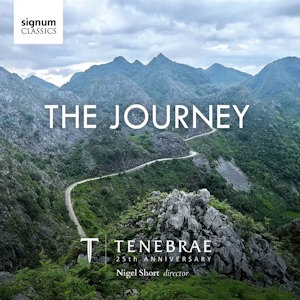
The Journey
Tenebrae/Nigel Short
rec. 2026, All Hallows Church, London
Texts included
Signum Classics SIGCD1034 [64]
This CD has been issued to celebrate the twenty-fifth anniversary of Tenebrae; I learned from the booklet that they gave their first concert on 5 December, 2001. I’m almost tempted to say ‘is it only 25 years?’ because Nigel Short and his choir seem to have been a fixture – and a leading fixture at that – on the British choral scene for as long as I can remember. I’ve reviewed a good number of their discs and have also heard them a few times in concert; I’ve always admired the quality and enterprise of their work. As Nigel Short points out in the booklet, the ensemble has consistently championed new music. It’s fitting, therefore, that for this celebratory album all but one of the pieces are by living composers; the one exception is John Tavener but I’d certainly regard him as a composer of our time. Three of the pieces – those by Jason Max Ferdinand, Joby Talbot and Joanna Marsh – have been specially commissioned for Tenebrae’s twenty-fifth anniversary season and the piece by Sarah Henderson was the winner of the Undiscovered Voices competition, established by Tenebrae to mark their anniversary.
Jason Max Ferdinand is a native of Trinidad and Tobago but I believe I’m correct in saying that he received his tertiary education in the USA; currently, he’s a member of the teaching faculty at the University of Maryland’s School of Music. The piece which he wrote for Tenebrae, entitled Journey, is a setting of his own words. In her notes, Alexandra Coghlan identifies a gospel feel to the harmonies at times. I agree with that, though it seems to me that the harmonic language ranges even more widely than that; many key changes are involved. It’s an attractive piece. The starting point for Bob Chilcott’s My Prayer is, we are told, Purcell’s anthem, Hear my prayer, O Lord. Ms Coghlan speaks of “Purcell’s theme battling through denser textures, caught in loops of repetition, truncated or inverted”. I must say that I don’t recall experiencing textures of such density in Chilcott’s music before – and that’s a comment, not a criticism. The piece gradually becomes searingly intense before achieving an ending of uneasy calm.
Sarah Henderson’s prizewinning composition, Wanderers is an ingenious piece of work, not least in the way it combines two texts. The first of these is some very familiar lines by Wordsworth (‘I wandered lonely as a cloud’); the second is a passage from The Prophet by the Lebanese-American writer, Kahil Gibran (1883-1931). Ms Henderson’s piece is interesting and I suspect it poses challenges even for singers of the calibre of Tenebrae. My only reservation is that I had the impression that because Wordsworth’s lines are mainly set for the higher voices – including a prominent solo soprano – the Wordsworth element has a tendency to obscure the words of Gibran (which are often sung simultaneously).
Joby Talbot has a long association with Tenebrae, most especially through his marvellous work Path of Miracles (2005) of which Tenebrae made a superb recording in 2005 (review). I’m not surprised, therefore, that they commissioned a new piece from him for their 25th anniversary. The Song of Wandering Aengus sets words by W B Yeats. I was intrigued by the often-mysterious harmonies. This is a most interesting, atmospheric piece. James MacMillan’s The Gallant Weaver receives a tremendous performance. It’s a hauntingly lovely piece and the sopranos of Tenebrae, who have the most important role of all, sing perfectly. It’s an inspired work and I loved this performance. I was equally impressed by Tenebrae’s account of Media vita by Kerensa Briggs. The harmonic language of this piece is sumptuous and highly inventive – Alexandra Coghlan rightly references Messiaen’s sublime O sacrum convivium as an influence.
Next, we hear an arrangement by Geoff Lawson for wordless eight-part choir of a piece by Max Richter, On the Nature of Daylight, which began life as a piece for five stringed instruments. Lawson’s arrangement seems to work well but I’ve never really understood the appeal of Richter’s music. I’m afraid that the pieces by him which I’ve heard have always struck me as limited in inspiration and tediously repetitive; the music rarely seems to go anywhere, I’m sorry to say that this particular piece is an example of that; there’s no “development” apart from the fact that the music either gets louder or quieter. I’m sure others will respond more positively than me but this item seems to be a waste of the collective talents of Tenebrae.
In When David Heard Eric Whitacre set the same Old Testament text that Thomas Tomkins so memorably set. I learned from the notes that Whitacre composed the piece for a mentor whose son had been killed in a road accident. Alexandra Coghlan writes of Whitacre’s piece that it is “an exercise in restraint, a not-outpouring [sic] of grief all the more powerful for refusing to release the howling tension at its core”. I agree with much of that, although I heard some passages of significant intensity. I don’t doubt for one moment the sincerity of the piece but I do wonder if it might have made even more of an impact had it been shorter. This performance lasts for 15:44 – about three times the length of Tomkins’ setting of the same words – and I came away feeling that Whitacre could have said just as much in half the time. Nigel Short and Tenebrae do very well to sustain the tension throughout the work’s span.
Joanna Marsh provides the third and final commissioned piece. Ms Marsh’s music has been recorded previously by Tenebrae; indeed, I think it was their recording of her Christmas piece In Winter’s House, which was my first encounter with her music (review). Since then, I’ve heard and admired a number of her pieces, including Evening Prayer, which Tenebrae included on a more recent album (review). Going to Heaven! is a setting of a poem by Emily Dickinson. The piece starts quite cheerfully, the textures bright, but in the third of the three stanzas the poem strikes a more pensive tone and Marsh reflects that in her music. It’s a very attractive piece overall.
Finally, John Tavener’s Mother of God, Here I Stand rounds off the programme in a beautiful fashion. This is a piece extracted from the composer’s The Veil of the Temple, a work which is cast on an epic scale. Here, however, in just over two minutes of music Tavener achieves a miracle of concision. The music has a touching simplicity and sincerity; here it is sung with exquisite poise. It’s hard to think of a more thoughtful or beautiful way to conclude this anniversary album.
Though I have subjective reservations about a couple of the pieces on the programme, I have no reservations whatsoever about the performance standards that are in evidence throughout this album. As usual, Tenebrae’s blend, tuning, clarity of tone and diction, dynamic range and expressiveness are beyond reproach. This album confirms their status as one of the premier chamber choirs currently before the public. We can only congratulate Nigel Short and Tenebrae on twenty-five years of sustained excellence and hope for much more of the same in the future.
The technical side of things was in the highly experienced hands of producer Nicholas Parker and engineer Mike Hatch, so it should be no surprise to find that the ensemble has been ideally recorded. The documentation, including Alexandra Coghlan’s very helpful notes, is excellent
Buying this recording via the link below generates revenue for MWI, which helps the site remain free
Contents
Jason Max Ferdinand – Journey
Bob Chilcott – My Prayer
Sarah Henderson – Wanderers
Joby Talbot – The Song of Wandering Aengus
James MacMillan – The Gallant Weaver
Kerensa Briggs – Media vita
Max Richter arr. Geoff Lawson – On the Nature of Daylight
Eric Whitacre – When David Heard
Joanna Marsh – Going to Heaven!
John Tavener – Mother of God, Here I Stand













