
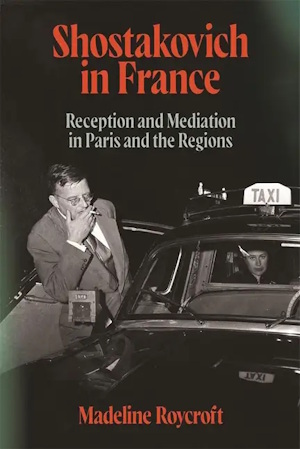
Shostakovich in France
by Madeline Roycroft
Published 2026
264 pages, 35 b/w illustrations
ISBN: 9781837652891
Boydell Press
Who do you think was the composer Dmitri Shostakovich most wanted to meet on his one and only visit to France in 1958? Francis Poulenc perhaps? Or Olivier Messiaen even? The answer, to be found on page 205 of Madeline Roycroft’s new book, is Darius Milhaud. In one of many excellent photographs that accompany the text, Shostakovich is on the left, sitting bolt upright, notes on his lap. Milhaud is on the right, looking very relaxed. A slightly stressed looking interpreter crouches between them. One wonders of course what was said. Was Milhaud perhaps curious about the reports in French newspapers about the heaviness of Shostakovich’s luggage, weighed down by scores representing twenty-five years of work, and keen to have a look at some of them? Was Shostakovich eager to acknowledge Milhaud’s influence, not least that of Le bœuf sur le toit on his Piano Concerto No. 1? What is certain is that the latter work would have been on Shostakovich’s mind at the time. He recorded it a few days later with the Orchestre national de la RTF and André Cluytens along with the Piano Concerto No. 2 and also worked with conductor and orchestra during their recording of the Symphony No. 11. This was the first commercial recording of a Shostakovich symphony made in France, and the sessions were the lasting memorials of a trip which reflected a growing interest in the composer’s music in that country.
That 1958 visit is the centrepiece of Roycroft’s fascinating narrative tracing the reception of Shostakovich in France from the 1930s to the end of the 20th century. Her perspectives are sometimes surprising, always informative. Whilst Shostakovich was enjoying celebrity status in the French media during that visit, for example, she documents how not all intellectuals were won over. One Pierre Boulez had developed a belief by the late 1950s in the ‘necessity’ of atonality, and as Roycroft drolly puts it, ‘from the perspective of critics, it did not go unnoticed that Shostakovich’s aesthetic had little in common with the avant-garde experiments described as “dodecaphony”’.
Over twenty years before his visit, Shostakovich’s name was, however, well known in some circles in Paris — and not those typically associated with classical music. Roycroft details at the start of her story how the Parti communiste français adapted a short song of the composer’s from the film Counterplan as Au-devant de la vie and used it widely (including as part of the campaign of the Front populaire) during the 1930s.
The First and Fifth symphonies were given in Paris in the 1930s too, and along with Au-devant de la vie represented the totality of the country’s exposure to Shostakovich until after the Second World War (performances of Soviet music not being favoured under the Occupation). The composer’s most widely performed work of the 1930s, Lady Macbeth of the Mtsensk District, was not heard in France until 1964 and then in its revised form as Katerina Izmailova. And it was heard in the beautiful Opéra Nice Côte d’Azur, not in Paris. Roycroft is good on the reasons for this: a strong presence of displaced Russians in Nice and the completely unfavourable climate at the time for ‘modern’ works at the Opéra de Paris being amongst them. Indeed, there’s a rewarding thread in the book following the Lady Macbeth performance history. Despite the critically acclaimed Nice premiere, it wasn’t until 1989 that the original version was seen. Again it was in a regional house, this time in Nancy, under its visionary artistic director, Antoine Bourseiller, who attracted enthusiastic critics from all over France and Europe to his production. (‘Lady Macbeth enfin française’ was L’Est Républicain’s somewhat parochial headline — the opera was given in Russian with French surtitles with Josephine Barstow as Katerina, so I think we can safely say that the editorial staff were stretching the point somewhat). The work then arrived at the new Opéra Bastille in 1992 in another acclaimed production, but it’s noteworthy that France’s regional opera houses continued to stage it: Toulouse, Marseille, Nantes and Dijon all mounted productions between 1991–2000.
I very much enjoyed reading about the French experience of Lady Macbeth, but rest assured Roycroft is equally enlightening about the performance history and reception of Shostakovich’s other works, not least the symphonies, where there was a concentrated post-war catch-up of Nos. 6–9. Nos. 10 and 11 were then given French premieres reasonably soon after their Soviet ones (11 being given in Paris by Cluytens after the recording sessions mentioned above) but things were patchy after that. Yes, the Symphony No. 4, shelved by Shostakovich after the Lady Macbeth furore, was first heard in Paris less than two years after its delayed USSR premiere (by the same performers, the Moscow Philharmonic under Kondrashin). But then the Symphony No. 12 had to wait 33 years to be performed in France. No. 13 took 22 years, No. 14 only two, and No. 15, 16 years. It would be a different story now, I’m sure, but it’s also interesting to note that in the decade 1990–2000 there seem to have been only 20 performances of any of the symphonies throughout France (nearly half of them performances of either the Symphony No. 5 or 10). I read that as ambivalence at a time when high-profile complete recordings of the symphony cycle were available, but Roycroft sees it as a positive upturn in the composer’s Gallic fortunes thanks to the French ‘Année Chostakovitch’ of 1989 of which those Nancy Lady Macbeth performances were part. That’s one of the many strengths of her volume though. She offers her own informed commentary without ever becoming didactic, whilst presenting key information impeccably tabulated to help you form your own conclusions.
This beautifully produced book is one of the most original contributions to the Shostakovich literature I’ve read in a long time. It’s currently hardback only in printed form and academically priced, but there’s a much cheaper eBook, and I hope Boydell might bring out a paperback in due course — it’s definitely something that anyone with an interest in Shostakovich and/or cultural history would want to read.
Dominic Hartley
Buying this recording via the link below generates revenue for MWI, which helps the site remain free














