
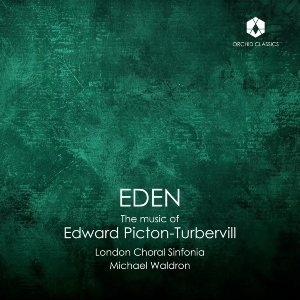
Edward Picton-Turbervill (b. 1993)
Eden
Spell of Creation
Spell of Sleep
Songs of Eden
Out of Eden (2016-2025)London Choral Sinfonia/Michael Waldron
rec. 2025, St. John the Evangelist, Islington, London
Texts provided for ‘Out of Eden’ only
Reviewed as a digital download
Orchid Music ORC100453 [64]
The English choral world seems to be among the most ‘chronologically egalitarian’ subgenres in classical music, at least in my experience. There seems to be, among its fans, a healthy demand and enthusiasm for new music – that is, music that perpetuates the choral tradition but is genuinely original in its conception. I have to admire that. I would nominate the excellent album London Calling by the group Vox Urbane on Resonus, as an example of just how wonderful and avant-garde contemporary choral music can get. Picton-Turbervill fits in a little differently. His music is extremely accessible and likeable, and yet fresh. There were moments here which seem to borrow from the best of art rock. I sincerely hope Eden presages the rise of his star.
Here I would like to tell you more about Edward Picton-Turbervill, but I cannot. His biography in the booklet opens this way: “Edward Picton-Turbervill is a composer, pianist and organist. Since his return to music in 2021, he has been…”
The historian in me wants to suggest that the manuscript is missing lines, because the author seems to expect us to know some context that I do not. What we learn is that Picton-Turberville was an organ scholar at St. John’s, Cambridge, where he studied music and environmental science (not an insignificant detail), and his 2025 piece for solo piano, Count it All Joy, on the EP All Shall Be Well garnered a million streams. I believe his first full-length release came earlier this year, titled Listen. It is Here, which was dedicated to his songs. Eden, then, is his second.
The London Choral Sinfonia made their debut recording in 2019 with Michael Waldron, their founder and conductor. Together, they have gone on to release a number of highly-regarded albums dedicated mainly to 20th- and 21st-century British composers. Ken Talbot has commended their “virtuosic playing by all”, and John Quinn was enthusiastic about Waldron’s conducting as well as the choir’s singing. They’ve covered Arnold (review), Beattie, Britten, Coleridge-Taylor (review), Grier, Hough (review), Oldham, Pantcheff, Vaughan-Williams, and Warlock. Funnily enough, it was their French Album (review) which has received their highest praise to date.
The album gets off to an excellent start with Spell of Creation, a setting of the 1952 Kathleen Raine poem (“Within the flower there lies a seed…”). This lovely poem, which looks back both to Romanticism and to the modernist spirituality of Yeats, uses a simple anaphoric structure and easily comprehensible symbols (wood, fire, sea, heart, etc.) making it somewhat Psalm-like in effect. I was not surprised to read that other composers have been drawn to it – among them, Bob Chilcott, Richard Rodney Bennet, and Alissa Firsova. Picton-Turberville translates all the mysticism and affective simplicity of the text into his setting. The structure of Spell of Creation can be understood as a sort of triad consisting of a) incantatory opening, building steadily → b) very powerful climax → c) soft ending with a slightly expanded tonal palette. I found this very effective; frankly, I loved it. Picton-Turbervill seems to favour a particular sound throughout this disc that reminds me of the Lydian mode – I am not a musician, but I hope you can picture what I mean.
We stick with Raine’s collection The Year One for our next piece, Spell of Sleep. The two works may look similar on the tracklisting, but Picton-Turbervill has conceived of this one as a five-minute rhapsody for mezzo-soprano Katie Bray, with choir, piano, and organ all providing a beautiful, textured backdrop. For a lullaby, it’s rather on the epic, sweeping side – which, to be clear, is a compliment. The London Choral Sinfonia gives a masterclass in sensitive accompaniment here, and Bray’s rich, gleaming voice is everything you could want. Unlike Spell of Creation, the structure here is much more free-flowing. Perhaps Picton-Turbervill is evoking a dream-like state.
It’s a bit of a shame that Raine’s poems could not be included in the CD booklet. I assume there were copyright issues, but it would have been nice to have them to read while listening to the performances.
Having established his choral bona fides, Picton-Turbervill gives us an unusual instrumental suite next, the Songs of Eden. According to the booklet notes, Waldron suggested that Picton-Turbervill write something that would be “readily digestible for a listener”. The composer turned an almost-certainly apocryphal oration made by the Suquamish chieftain Seattle (Si’ahl) in 1854. The speech is a protest against white settlement of their ancestral lands, as well as a plea that, if they must take it, they treat the animals and plants of the earth as their brothers. Seattle, at the very beginning of the Industrial Revolution, is prescient about the effect white settlers are going to have. “Whatever befalls the earth, befalls the sons of the earth.” Picton-Turbervill excerpts six lines from the speech and then reduces them to single words for the movement titles: I. Solitude, II. Reliquary, III. Kindred, IV. Incandescence, V. Migration, and VI. Hallowed. The text of the speech is not given, and the only version I could find appears to have been drawn from a different translation, so I know nothing more about the intentions here.
Solitude begins in a slow, atmospheric way, with plenty of open space – there is a prevailing mood of sorrow, but with two pockets of ‘warmth’. It is written for some kind of mallet percussion (is it a vibraphone?). Reliquary fires up the pipe organ for a very serious meditation with majestic diapasons and a little buzzing from the reeds deployed at the climax. Kindred takes us back to the soundscape of Solitude but with an effect more like the chiming of bells. Incandescence and Migration are both for organ and pitched percussion – a very unusual effect. I sort of wish more had been done with it. Hallowed closes the suite out quietly, almost invisibly, with a few ringing percussion notes.
I wanted to like Songs of Eden more than I actually did. The forces chosen were ambitious (how many other pieces do you know for organ and vibraphone?), but the movements are all atmosphere, no direction. I’m not per se against that in small doses, but eleven minutes is a little on the longer side, at least for me.
No matter. Out of Eden shows Picton-Turbervill back in top form. The piece originated in Heidelberg in 2016, where Picton-Turbervill decided to write a requiem for the natural world. There are a couple of works out there which, unsurprisingly, deal with this theme. Sarah Kirkland Snider’s written one, as has Reena Esmail and Tan Dun. Picton-Turbervill’s does not follow the Latin Mass for the dead, but it is more overtly religious than others of its type. The first movement is almost like a miniature cantata, setting the story of the fall of Adam and Eve from Genesis 3 with a tenor narrator, instrumental interludes, choral lines, and a lengthy monologue from God, here, a baritone. I think Picton-Turbervill somehow manages to pull this all off, in part because it’s such an earnest re-telling.
With the scene set by humankind’s expulsion from Eden, Silent Spring features ostinato piano plinking while a soprano soloist introduces a recording of the bird call of the Kauai O’O, which was declared extinct in 1987. Picton-Turbervill goes on to use the bird call as a leitmotif, representing the damage we’ve done to the environment. The overall effect is profoundly eerie, and everything is arranged in such a way that it gives the listener goosebumps. After a violin elegy, the choir re-enters, singing wordlessly at first, before declaring ‘Sion deserta facta est’ (Sion has become a wasteland) in imitation of Renaissance polyphony. Start to finish, this movement is a standout.
The third movement, Lamentations, is a grab bag of scriptural quotations from five different books. Picton-Turbervill begins with the choir unaccompanied, sticking fairly close to what sounds to me like ‘traditional’ choral singing up to its first climax, after which the mood is subdued and forlorn. Miserere features some of the most gorgeous harmonies on the album so far, with a moving solo for violin. Although the fifth movement is marked Trisagion, Picton-Turbervill does not borrow (or, at least, not in an obvious way to my ears) from Greek Orthodox chant. This is, however, the movement where we transition from despair to acceptance. The other texts are drawn from the Anglican Burial Sentences and the Orthodox Kontakion for the Departed; this is a sombre, monumental funeral service for the earth.
With The Valley of the Dry Bones, the longest movement on this album, Picton-Turbervill turns to the idea of ‘hope’. We are back in cantata-storytelling mode, with rippling piano arpeggios at first. There is a sort of ‘crash’ effect he gets from percussion that is very dramatic and well-executed, and I admit to loving the organ solo representing the breath of God, which consists of a lot of pipe blasting. We get our money’s worth out of the pedalboard, but then again, why shouldn’t we? – it sounds great. The final movement sets Philip Larkin’s poem The Trees (which also could not make it into the booklet). Picton-Turbervill knows how to wrap up the entire Out of Eden experience with something that feels suitably weighty and dramatic, but also soothing.
The audio engineers include the only choral producer I know by name, Adrian Peacock, so it goes without saying that the sound quality is excellent. Solo voices are so much a matter of taste that I hesitate to weigh in on them, except to say that Bray’s performance in Spell of Sleep was excellent. Kudos really must be given to all the instrumentalists as well, and the London Choral Sinfonia emerged yet again as a truly magnificent ensemble.
Picton-Turbervill’s choral music has the epic sweep of a gothic cathedral, but the freshness and energy of the 21st-century. I hope we will hear much more from him in the future.
Aidan Gray
Other performers
Katie Bray (mezzo-soprano)
Ed Lyon (tenor)
Hugo Herman-Wilson (baritone)
Michael Foyle (violin)
Hannah Watson Emmrich (piano)
Hugh Rowlands (organ)
George English (percussion)
Buying this recording via the link below generates revenue for MWI, which helps the site remain free













