
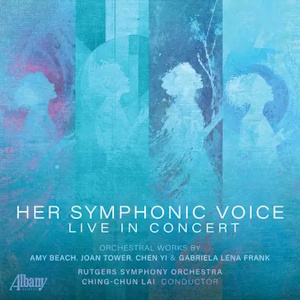
Her Symphonic Voice: Live in Concert
Rutgers Symphony Orchestra/Ching-Chun Lai
Reviewed as a digital download
rec. 2023 & 2025, Nicholas Music Center, New Brunswick, USA
Albany TROY2033 [60]
It is a wonderful thing to discover a classical musician who is a thoughtful programmer, someone who pays attention to the sequencing and the possibilities of different works ‘playing off each other’, even if they were written centuries apart. For example, there is Tiffany Poon’s album Nature (review) which starts with the baroque composer Louis-Claude Daquin and ends with Ravel, the uniting theme being her love for animals and natural bodies of water. Hearing an album like this is a fun way to place classics in fresh contexts. There is an art and a skill to putting a great programme together.
Her Symphonic Voice consists of exactly that sort of programme and includes some welcome performances of rare compositions. It might, I hope, also herald the rise of a relatively new conductor and ensemble; I was greatly impressed by both the corporate sound and the playing throughout.
This is conductor Ching-Chun Lai’s sophomore album – she and the Rutgers Symphony Orchestra recorded a brief disc of works by Lili Boulanger and Unsuk Chin on Albany last year. Lai made her conducting debut in Taiwan, but has spent most of her career at the Crane School of Music in Potsdam… that is, Potsdam, New York, naturally. Lai was the protégé of Gunther Schuller, who won the Pulitzer Prize for his 1994 composition Of Reminiscences and Reflections, and is also, by the way, the person who coined the term ‘Third Stream’ to refer to Jazz-Classical fusion. He is quoted on Lai’s website praising her ‘bright analytical mind’. About the Rutgers Symphony Orchestra (based in New Brunswick, New Jersey) I know nothing else, except that they have been recorded at least one additional time, in 2006, in works by Nicolas Flagello (review).
Nothing captures the listener’s attention like a fanfare – just ask any of the French baroque composers. Lai gives us not one but two, both by Joan Tower, at the top of the album. Tower is a composer I associate with dynamism: energy, forward-driving rhythms, and vivid colours. This is not to say that everything she writes is loud or aggressive. I particularly enjoyed her piece Red Maple for bassoon and strings (review), but even there she works her way up to something quite propulsive. She is best known for her Fanfare for the Uncommon Woman, which is a response to Copland’s famous Fanfare for the Common Man. Despite the name, it really consists of 6 fanfares dedicated to six different women in classical music. The first five were composed between 1987 and 1992, and include Marin Alsop among the dedicatees; she has recorded that set of five with the Colorado Symphony Orchestra. But Tower has written a sixth, dedicated to Cuban-American composer Tania León, and that is the one Lai chooses to open this album. It might be a world premiere recording – I couldn’t find any previous releases of it. Fanfare for the Uncommon Woman No. 6 is really a five-minute overture, not as brass-heavy as you might expect from the title. The rhythms are capricious in a way that reminded me a bit of Stravinsky, but the whole thing feels more ‘American’, for lack of a better description. Robert Battey in his review in the Washington Post invokes John Adams due to the ‘chugging, repeated notes’. I can imagine orchestras programming it to show off their tight control of rhythm.
The fourth fanfare, composed in 1992, was, at some point, renamed For the Uncommon Woman, which is what this album uses. It is dedicated to JoAnn Falletta. Like the sixth, it is scored for full orchestra and works as a sort of five-minute overture. It is spikier than the sixth: there is an ominous undercurrent that serves to build up tension, leading to a dissonant brass climax that sort of reminds me of cars honking on a busy street – and I promise I mean that in a positive way. Well, it worked for Gershwin, didn’t it? I must say that I found both of these fanfares delightfully fun and invigorating.
Chen Yi (also given as Yi Chen; Chen is the surname) is the composer up next. She is a Chinese-American musician who is, in my view, uncommonly good at blending western and eastern idioms. Her recent CD of violin, viola, and piano works on Naxos is a fantastic place to start – she has her own approach to tonality and rhythm that I find compelling. She has been mentioned here a few times, for instance, in a disc of compositions for woodwinds (review). Her piece here, Celebration, reminds me of music for wind band, in fact. It picks up on Tower’s two fanfares: it, too, is a five-minute overture full of excitement and momentum, but unafraid to introduce some dissonance to keep things interesting.
Chen’s second piece on this album is somewhat vaguely titled Tone Poem for Chamber Orchestra. Actually, there is a fairly specific reference here: two poems by the 11th-century Chinese writer Su Dong-po on the subject of landscape paintings. Chen cites the following lines in particular:
The brimming waves, the sunny day
The dimming hills, the rainy haze
The West Lake as the Beauty Xizi
Whether she is adorned richly or plainly.
From the second poem:
Like spilt ink dark clouds spread o’er the hills as a pall
Like bouncing pearls the raindrops in the boat run riot
A sudden rolling gale comes and dispels them all
Below Lake View Pavilion sky-mirrored water’s quiet.
There’s a lot of Ravel and Debussy about these musical landscapes. Chen is a wonderful tone painter – in the first five minutes, she describes something hazier and somewhat sparser, while the last three minutes feature bursts of colour and light; if I had to guess, I’d imagine that’s the approximate breakdown of the music into corresponding poems. It’s a delightful piece, I must say.
Amy Beach’s Gaelic Symphony is perhaps the most frequently performed symphony by a woman (Price No. 1 is also in the conversation) – on this album, I think it helps to make the case that there is a long history of women writing for orchestra. In the 1890s, as a superbly talented 27-year-old pianist-composer, Beach heard Dvořák’s ninth symphony and disagreed with him. For Beach, American music should not be based on Indigenous or African-American idioms, but western European. As such, her symphony is in very close dialogue with Dvořák 9: both are in E Minor, both make use of folk ideas, both are very exciting and tuneful. On Her Symphonic Voicewe get the middle two movements: the Siciliana and Lento. I believe the Siciliana is a popular favourite. It opens with an oboe (again, very Dvořák) playing Goirtin Ornadh (The Little Field of Barley). There is an exciting middle section before returning to calm at the end. The Lento features an unaccompanied violin cadenza and lots of dreamy, beautiful writing. It just so happens that Beach’s Gaelic symphony got a fantastic recording last year by the Müncher Symphoniker and Joseph Bastian which I highly recommend (review). How do Lai and Rutgers compare? They are a bit faster and lighter, with smaller forces and all that that entails – more clarity, maybe a bit less depth and richness. To my ears, this gives them an edge in the Lento but not so much in the Siciliana. I was able to hear more details in those slow, big chords, which I appreciated. But Bastian brings out much more excitement and energy in the jig from movement two. I also have some questions about how well these movements work as excerpts. I am not generally a fan of chopping up works that have been written as a single unit.
Gabriela Lena Frank is a California-based composer whose father was a Lithuanian Jew and whose mother was Peruvian-Chinese – as such, her musical style reflects an interest in multiculturalism. I was quite taken by her album Hilos, in part because I love all things Peruvian. Recently, Naxos has released her Conquest Requiem (review) which is a powerful, serious work. But here, to close out Her Symphonic Voice, we get her Three Latin American Dances. The first, titled Jungle Jaunt, is described by Frank as an ‘unabashed tribute to Bernstein’s Symphonic Dances from West Side Story’. It’s got a quick theme, plenty of layered percussion, and both rhythmic and tonal spice. What’s not to love? The second dance, Highland Harawi, is nearly 10 minutes long. A ‘harawi’ is a genre of indigenous Andean music (and poetry) which some listeners might recognise from Messiaen’s song cycle Harawi, chant d’amour et de mort. Frank evokes a grand, mountainous vista with plenty of silence and mystery. The third, which has the sly title Mestizo Waltz, is based on the ‘romancero’ tradition of the South American Pacific coast. It’s the most upbeat of the three, and almost feels like an encore for this disc.
The sound quality is fine – it’s definitely live, so things can be a little recessed in parts, but nothing upsetting. Audience applause is kept brief and unobtrusive, and there is no unwanted noise, even during the pianissimo sections.
Actually, it being a live recording is the source of one small issue I had with this album – or, rather, not with the album but with its self-description. On Albany’s website, we read “…these recordings bypass the sterile perfection of the studio to favor the raw, human vitality of a live performance.” I don’t love this. First, it’s really not all that uncommon to record orchestral music live; second, it’s not really fair to call studio performances ‘sterile perfection’. It almost reads as a pre-emptive apology for ‘imperfection’ in these performances, but that clearly wasn’t the case, because the playing is tight and beautiful. I hope this doesn’t sound overly nitpicky, but when I read that description, coupled with the lack of a booklet (these were not self-explanatory pieces of music!) I started to wonder if this album was really created for people who knew anything about classical music or not.
It turns out that yes, it is. This is a wonderful and varied disc sure to be enjoyed by connoisseurs of orchestral writing, playing, and programming.
Aidan Gray
Buying this recording via the link below generates revenue for MWI, which helps the site remain free
Contents:
Joan Tower (b. 1938)
Fanfare for the Uncommon Woman No. 6 (2014)
For the Uncommon Woman (Fanfare for the Uncommon Woman No. 4) (1992)
Yi Chen (b. 1953)
Celebration (2014)
Tone Poem for Orchestra (2012)
Amy Beach (1867-1944)
Symphony No. 2 in E Minor, “Gaelic”, Op. 32 (Excerpts) (1894)
Gabriela Lena Frank (b. 1972)
Three Latin American Dances (2004)













