
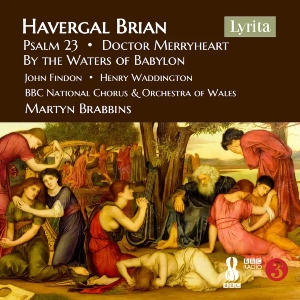
Havergal Brian (1876-1972)
Psalm 23 (c.1904)
By the Waters of Babylon (1905, orch. Rodney Newton)
Doctor Merryheart, comedy overture 1 (1912)
John Findon (tenor, Psalm), Henry Waddington (baritone, Babylon)
BBC National Orchestra & Chorus of Wales/Martyn Brabbins
rec. 2025, Hoddinott Hall, Cardiff, UK
Lyrita SRCD451 [57]
The days are long gone when Havergal Brian enthusiasts would wait with giddy anticipation for a recording – any recording of any work – by their favoured composer. Now not only have nearly all the main works received professional recordings, but we are reaching the point of having a choice of performances. This disc is a case in point: two of the three works on offer receive their third commercial recordings. The path in both cases is similar.
Psalm 23 was first performed and recorded in the early 1970s by the remarkable Leicestershire Schools Symphony Orchestra under Laszlo Heltay. It is a tribute to the musical and technical standard of that group of players and tutors back then that the performance is still well worth hearing. Jump forward to 2003 for the Classico recording, latterly re-released on Griffin, with Douglas Bostock and the Royal Liverpool Philharmonic Orchestra and Choir. That fine performance of Psalm 23 was part of an interesting mixed programme “Elgar & The English Choral Tradition”.
The comedy overture Doctor Merryheart appeared on a Dutton release of a 1959 radio broadcast with the London Symphony Orchestra and Harry Newstone. Its first commercial recording, in 1979, featured another youth orchestra. The City of Hull Youth Symphony Orchestra conducted by Geoffrey Heald-Smith made a good fist of this tricky music, but they were not at the same level of ability as their Leicestershire contemporaries. In 1993, Adrian Leaper with the National Symphony Orchestra of Ireland made the first professional studio recording on Marco Polo; it was not released until 2000.
At least two decades, then, have passed until this new Lyrita collection. The label is so synonymous with the best in British music, performances and engineering that for me something of a frisson of expectation still accompanies any of their releases. This Brian collection does not disappoint. In Martyn Brabbins, they have the living conductor who has arguably done most to promote the music of this complex and intriguing composer. This, therefore, is a self-recommending-review-not-required release. Conversely, for those yet to embrace Brian’s individuality and occasional eccentricities, would this be the disc to provide the gateway? Probably not.
The one “premiere” recording on this disc, By the Waters of Babylon, is of a reconstructed score. The liner notes say: “Many of Brian’s compositions from the earlier part of his career are lost, the combined consequence of publisher’s not returning manuscripts and multiple house moves [22 times between 1900 and 1927].” Here it is performed in an orchestration by Rodney Newton from the original vocal score. It must be said that the music sounds very authentically Brianesque.
The accompanying original score of Psalm 23 was also lost in 1920 but Brian completed his own reorchestration in 1944. It is this setting that opens the programme. John Pickard in his exemplary liner describes it as “the most famous of all the Psalms” starting as it does with “The Lord is my Shepherd”. The original setting was made in 1904 but there is no evidence that it was performed in the composer’s lifetime. In the first decade or so of the 20th century, Brian’s career seemed very much in the ascendant. All three scores exhibit confidence and individuality alongside other features that can be considered quirks or lapses, depending on the listener’s point of view.
The work begins with a nobly processional march-like melody. The BBC NOW and the BBC National Chorus of Wales are recorded with spacious warmth in the supportive acoustic of the Hoddinott Hall; the organ writing has a telling effect throughout. Brabbins allows slightly more spacious tempi than Bostock or Heltay, to good effect. It must be said, however, that Bostock’s fine performance with the RLPO also sounds opulently splendid. Indeed, all three performances underline the fact that this is an attractive and effective work which is, as Pickard writes, “eminently suitable for performance by ambitious amateur choral societies”. John Findon sings the brief tenor solo “Thou shalt prepare a table before me” with suitably heroic fervour.
These three early scores are notable for Brian’s willingness to embrace then-modern musical trends, and to experiment with form, harmony and orchestration in a way that most conservatory-trained British contemporaries shied away from. Brian, after all, was four years younger than Vaughan Williams and two years younger than fellow “Heir and Rebel” Holst. Even so, neither of these Royal College alumni were yet writing in 1904 the individual masterpieces that would define their legacies. Likewise, Brian’s most significant works lay in the future – but this relatively brief work impresses.
By the Waters of Babylon, closely contemporaneous with the psalm setting, fared better in concert halls. It received its first performance in April 1907 at a concert where Brian met the composer Granville Bantock for the first time; that started a close friendship which lasted right up to Bantock’s death in 1946. The text is drawn from Psalm 123 which – in part – is more familiar to modern-day listeners from its use in Walton’s Belshazzar’s Feast. Pickard points to various musical fingerprints that would become part of the mature Brian’s vocabulary: “dogged march rhythms, abrupt changes of mood and key, strong tonal shifts” amongst others.
Another feature is Brian’s willingness to set aggressive, even brutal texts. Apart from the musical considerations, this puts him quite at odds with the legacy of the Victorian Choral tradition – works of an explicitly ‘worthy’ or spiritually uplifting nature. Elgar’s troubles with the text of Gerontius are well-known; Brian seems to embrace such notoriety. But even he baulked at the concluding text here: “Blessed shall he be that taketh thy children, and throweth them against the stones”. He added a reprise of the opening “By the waters of Babylon, we sat down and wept”. Apparently, the Times reviewer of the first performance thought this “a fatal mistake from the dramatic point of view”. That critic may have considered this a flaw, but I feel that Brian’s willingness to experiment with just about every aspect of composition was surely a strength, and something he remarkably strove to do right into his 90s. For sure, along the way some experiments might fail and others prove to be creative dead-ends, but this sense of life-long questing was a creative strength.
In some ways, By the Waters of Babylon is a trickier piece to programme. At 23 minutes in this performance, it is long and complex enough (and in need of a baritone soloist) to demand considerable rehearsal without filling half a programme, let alone a full concert. Pickard considers it “a significant advance on Psalm 23 in imagination and scale of ambition. It is also a much darker work […] Even the tonality in which the work begins and ends – E flat minor – is dark, and extremely unusual for the choral and orchestral music of this period”. The cumulative effect of the work is powerful if rather sombre. As in the earlier psalm, the Lyrita recording is predictably excellent at handling a deep, rich and wide soundstage. The complexities of orchestral and choral writing are skilfully handled. Baritone Henry Waddington makes the most of his relatively brief solo where Brian is most clearly channelling his inner Wotan. In the context of this work, the reprise of the opening is somewhat anticlimactic; one cannot imagine it would bring an audience roaring to its feet, although on disc such concerns matter little.
Crowd-pleasing in many ways is what the comedy overture Doctor Merryheart seeks to be. Aside from composing, Brian was an active music critic, and he immersed himself in the most modern musical trends. This work is an explicit homage / pastiche / satirical commentary on Richard Strauss’s extended tone poems, especially Ein Heldenleben and Don Quixote. To be sure, Strauss was lampooned (affectionately and otherwise) by others. The prime examples are Emil von Reznicek’s symphonic poems Schlemihl – Ein Lebensbild (1912) and Der Sieger – Ein symphonisch-satyrisches Zeitbild (1913). I have no idea if Brian would have known, let alone heard, these works. Even if not, clearly Strauss was a target of opportunity.
Reznicek’s works are big, even sprawling. Brian’s overture, remarkably concise, rather contradicts those who think he either wrote gargantuan monster-works or gnomic late symphonies. In just under 17 minutes, he creates an introduction and eight very clearly, indeed brilliantly, characterised variations that go toe-to-toe with Strauss’s Don Quixote for orchestral invention and musical illustration. Usefully, Lyrita divide out the variations, as did Marco Polo for Adrian Leaper. With the exception of Variation 6 Merryheart leads a procession of Heroes, Leaper is generally lighter of touch and texture, and a few seconds fleeter than Brabbins.
The Marco Polo sound likewise is still very good but not as full or rich as Lyrita’s. Variation 3 ‘Dreams: Asleep in the arms of Venus’ perhaps demonstrates this as well as any; Lyrita and Brabbins combine to make for an especially languorous and sensual sequence. At a push, I would say the new recording just has the edge in all-round refinement, polish and engineering, but this is certainly not a case where a previous version is wholly trumped by the new. Both performances make the case for a remarkable British orchestral work. Few if any other British composers of that time showed a similar wit and flair for the modern orchestra. Arnold Bax’s Spring Fire is almost exactly contemporaneous but with very different musical goals.
This disc will have already been snapped up by every Brian admirer. I am sure they will be thrilled by the quality of both the music, recording and performances. In many ways, this is an ‘old-school’ Lyrita release, echoing Lyrita founder Richard Itter’s ideals and values. Perhaps I would not point the yet-uncoverted toward this disc. For card-carrying enthusiasts such as myself, this is another fine release that brings great pleasure.
Nick Barnard
Buying this recording via the link below generates revenue for MWI, which helps the site remain free













