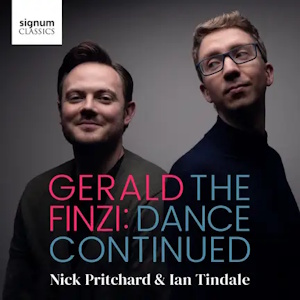
Gerald Finzi (1901-1956)
The Dance Continued
Till Earth Outwears, op.19a
Days too short
A Cradle Song
The Terrible Robber Men
Rondel
English Hills
A Young Man’s Exhortation, op.14
Oh Fair to See, op.13b
Nick Pritchard (tenor); Ian Tindale (piano)
rec. 2026, New College Chapel, Oxford, UK
Texts included
Signum Classics SIGCD1011 [71]
As far as I’m concerned, a new recording of songs by Gerald Finzi is always welcome and it’s especially pleasing that this new disc has arrived in the year that we mark the 125th anniversary of Finzi’s birth and also the 70th anniversary of his death.
Katy Hamilton opens her very useful booklet essay with a story which links this new album by Nick Pritchard and Ian Tindale with another Finzi disc which was issued by Linn Records in 2005. That earlier disc was recorded by James Gilchrist and Anna Tilbrook at Christ’s Hospital School in Horsham. Gilchrist and Tilbrook recorded all three of the cycles/collections which are on this new Signum release; it’s a very fine disc, which I’ve owned for years and I very much agree with the warm welcome it received on Musicweb (review). It seems that Nick Pritchard was a pupil at Christ’s Hospital School at the time and the school’s Head of Music gave him a copy. Pritchard says that the receipt of this gift was “a seminal moment”. Now, just over twenty years later, he has recorded the same programme and has made some valuable additions to it.
The valuable additions come in the form of five unpublished and hitherto unrecorded songs by Finzi. The manuscripts are held in Oxford’s Bodleian Library. Pritchard and Tindale were granted access to the collection and selected these five songs which, Katy Hamilton tells us, were composed when Finzi was in his teens and early twenties. As such, these are not examples of mature Finzi but I think they are significant formative examples of his craft. I think it may be significant that some of the poems which Finzi set in these songs are not prime examples of British poetry. I think that’s true of Days too short, which sets a poem by the Welsh poet, W H Davies (1871-1940). Finzi’s song is a merry little ditty; the piano part is light and energetic while the vocal line is supple. The setting of the last two lines (‘When such things are, this world too soon, / For me, doth wear the veil of light’) is much more interesting; here, Finzi slows the tempo and writes much more thoughtful music, giving us more than a hint of his mature style. A Cradle Song is one of two settings of poetry by Padraic Colum (1881-1972). I agree with Katy Hamilton’s judgement that the song, written when Finzi was eighteen, is “sweetly understated”. The Terrible Robber Men is another Colum setting; the style is somewhat akin to that of a folk ballad, even though the poem extends to just two stanzas. Rondel sets lines by Chaucer. Here, I think, we hear typical Finzian melancholy, even if the style is not yet fully formed. Last comes English Hills, a setting of lines by John Freeman (1880-1929). I wonder when Finzi composed this; perhaps we shall never know. The music is much closer to the mature Finzi; the words, I’d suggest, are also closer to the sort of poetry that we are accustomed to hearing set by this composer. Maybe the words inspired Finzi to a level that’s not quite present in the other four songs. For my money, this is by some distance the best of these previously unknown songs. I think admirers of Finzi’s music will find these five items to be fascinating additions to the composer’s discography, as I do. Nick Pritchard and Ian Tindale give them fine premiere recordings and we are indebted to them for bringing these compositions to the light of day.
A Young Man’s Exhortation was published in 1933, though the songs were composed in the late 1920s. All the songs set texts by Thomas Hardy and as I listened to this fine performance I reflected that Hardy’s poetry and Finzi’s music seem predestined for each other. Hardy’s poems are not always straightforward yet Finzi’s music seems to fit them like a glove. I enjoyed this performance very much. Pritchard is a very English tenor with a light, flexible voice. Throughout the programme, he sings with great clarity of tone and diction. His voice and the way he uses it seem ideally suited to Finzi. Similarly, Ian Tindale’s playing is ideal. It’s not just a question of supporting his colleague – though he certainly does that – but also he invests Finzi’s piano parts with poetry and appropriate colour. This is not their first disc together. I missed their earlier one, entitled Little Wanderer, but I see my colleague Simon Thompson, who has also seen them perform live, was most enthusiastic (review). Reading Simon’s comments after I’d done my listening to this new CD, it seemed to me that we’d identified a lot of common traits.
In A Young Man’s Exhortation, the chosen poems are very varied in nature and Finzi catches the mood of each one. I was interested to read in Katy Hamilton’s notes that these artists regard ‘Ditty’ as “a dense, knotty number that takes some untangling”. I know what they mean. It’s a poem expressing, it seems to me, a man’s adoration from afar of his beloved. The poem is not straightforward but all I can say is that in this performance Pritchard and Tindale succeed in putting the sense of it across to the listener. They give a swaggering account of ‘Budmouth dears’. In complete contrast, they communicate very well the strangeness of ‘The comet at Yell’ham’. In the second half of the cycle, I was very impressed with their tender, poignant approach to ‘The sigh’. In the final song, ‘The dance continues’, the poem expresses the voice of a dead man from beyond the grave; in Finzi’s setting, those thoughts are borne along on a seemingly endless flow of melody. It’s an acute response to Hardy’s poem which Pritchard and Tindale put across really well.
The other two sets of songs are not so much cycles as collections of individual songs drawn together, edited and published posthumously by Howard Ferguson and Joy Finzi. They did a great service in making all these songs available.
Till Earth Outwears is a collection of Hardy settings. Picking out a few highlights, in the second song, ‘In years defaced’ Tindale immediately establishes the melancholy mood in the way he delivers the short piano introduction. It’s a beautiful song which here receives a performance entirely worthy of it. I especially admired the poignant way that Pritchard delivers the last stanza. ‘At a lunar eclipse’ is a most unusual poem – and certainly an unusual choice for a song setting. There’s a real sense of celestial space in Finzi’s music and the present performance really conveys that. Here, I greatly appreciated Pritchard’s control of line. ‘Life laughs onward’ is, as Katy Hamilton observes, “a bittersweet musing on the passing of time and its rightness”. Nonetheless, the surface mood is lighter and thus the song is a good foil to ‘At a lunar eclipse’. As such, it’s a good way to round off the collection.
In contrast to the other two collections of songs, which are exclusively devoted to Hardy settings, Oh Fair to See sets words by a number of poets, though the first to be heard is Hardy. Here, I should mention that in the booklet Signum have mixed up the authorship of a couple of the poems; Katy Hamilton correctly attributes all of them in her notes. In the opening Hardy setting, ‘I say “I’ll seek her”’, the poet covers a range of emotions, all of which Finzi expresses well. The poem which gives the collection its title is by Christina Rossetti. This is a more straightforward poem than the Hardy and it draws from Finzi music that is similarly more straightforward but no less deeply felt. Both of these songs are very well interpreted by Pritchard and Tindale. Tucked away in the middle of the collection is ‘Only the wanderer’. This is Finzi’s only setting of a poem by Ivor Gurney. I wondered if he knew Severn Meadows, Gurney’s own setting of the words. That caused me to look out the booklet notes by Philip Lancaster which accompanied the aforementioned James Gilchrist disc; Lancaster states that Finzi did not know Severn Meadows at the time that he set the poem. Finzi’s setting may not quite match the poignant nostalgia of Gurney’s immortal musical response to his own words, but it’s a close call. Pritchard sings it beautifully and makes me want to hear him in some of Gurney’s songs. The set contains two songs to words by Edmund Blunden, with whom Finzi collaborated in his choral work For St Cecilia (1946/47). ‘To Joy’ is anything but joyful. Blunden wrote the poem in 1919 as a response to the death of his infant daughter, Joy. Finzi’s music matches the intense sorrow of the words. When this CD arrived, I immediately put it in the player and listened to just one track: the exquisite ‘Since we loved’, which is the final song in Oh Fair to See and, as such, the last song on the disc. It’s also the last song that Finzi composed. It has words by Robert Bridges and the setting lasts a mere 1:21 yet in that short timespan both Bridges and Finzi say a great deal.. It’s surely no coincidence that the second of the two stanzas begins ‘All my joys my hope excel’; Finzi must have been expressing in this tenderly rapturous song his love for his wife, Joy. Pritchard and Tindale perform it beautifully and, on first hearing their performance, I held high hopes for what I would hear on the rest of the disc. I was not disappointed.
This is an outstanding Finzi recital. It’s fit to stand beside the James Gilchrist/Anna Tilbrook disc which so inspired Nick Pritchard some twenty years ago.
The recording was made in New College Chapel, Oxford, where the acoustic seems perfect for such a project. Producer/engineer Raphaël Mouterde has recorded the performers most successfully, not least in achieving a very good balance between voice and piano. Apart from the slight error over the attribution of a couple of the poems, Signum’s documentation is excellent.
John Quinn
Buying this recording via the link below generates revenue for MWI, which helps the site remain free