
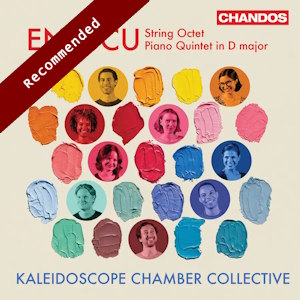
George Enescu (1881-1955)
Octet Op. 7 (1899-1900)
Piano Quintet (1896)
Kaleidoscope Chamber Collective
rec. 2025, Potton Hall, Dunwich, UK
Chandos CHAN20379 [63]
Enescu is the Romanian counterpart to Szymanowski the Pole and Bartók the Hungarian. Although professionally he earned his living as a virtuoso violinist, he was also an excellent pianist, and, as a composer somewhat of an infant prodigy. He began as an ardent admirer of Brahms and Fauré, but went on to develop his own style, which can be strangely elusive and enigmatic. However, both the works here are early, and straightforward in their manner. I shall discuss them in chronological order, although in this recording they are presented the other way round.
Enescu wrote this piano quintet in 1896, the year in which he became fifteen. (Do not confuse this early work with the mature piano quintet Op. 29, which dates from 1940. If you are interested in the later one, Chandos also has a recording of that, on CHAN10790.) It is so close to Brahms’s idiom as to be practically pastiche, but – and I do not say this lightly – it is of equivalent quality. The themes are memorable, the writing for the combination of strings and piano assured, and the whole work gives an impression of mastery. There are four movements. In the opening Allegro moderato, in sonata form, you can hear some resemblances to Brahms’s second piano quartet. The second movement is a scherzo, a form Brahms was a bit chary about, and I did hear a hint of the scherzo from Beethoven’s ninth symphony. The slow movement perhaps gives the greatest hint of the mature composer and the finale is a gypsy rondo, following the example of Brahms’s first piano quartet. This work was apparently given one performance in 1897 and then forgotten for a century. It is really quite a find.
The octet is much better known. Enescu was still a teenager, in fact only eighteen when he wrote it, but already he was in command of his own idiom, though it was not yet as subtle as it was to become. It is in an expanded sonata form. Enescu said: ‘I wanted to write this octet in four connected movements in such a way that although each movement would have its own independent existence, the whole piece would form a single movement in sonata form, on a huge scale.’ In doing this he was following the example of such pieces as Schubert’s Wanderer fantasy or Liszt’s sonata – Schoenberg’s first chamber symphony, which might seem a closer parallel, was still ten years in the future. The first movement expounds and develops several themes. It is followed by a scherzo marked très fougueux (very fiery), which has a rhythmic drive almost Bartókian in its urgency, although a good deal less dissonant. In the slow movement all the instruments, apart from the first violin, begin muted; it was described by the composer as a sort of nocturne. The finale, improbably, is a waltz, but one which takes up ideas from the previous movements. The work is very richly scored for its ensemble, so much so that Enescu also allowed performances by a string orchestra, provided some passages were retained for solo strings – he didn’t specify which. It really is a superb work.
The Kaleidoscope Chamber Collective particularly wanted to play and record the octet and they do it proud here. Their founders, Elena Urioste, the lead violinist, and Tom Foster, the pianist, write of their enthusiasm for both these works. They have already made a number of recordings for Chandos and this one certainly adds to their reputation. The recording is up to Chandos’s high standards and the booklet has good notes.
I am aware of only one other recording of this piano quintet. However, there are several others of the octet in its original form, and also at least two of the string orchestra version. I am sure some of them are very good but; it really is a find.
Stephen Barber
Buying this recording via the link below generates revenue for MWI, which helps the site remain free













