
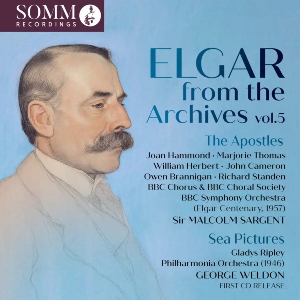
Sir Edward Elgar (1857-1934)
From the Archives Volume 5
The Apostles, Op 49 (1903)
Joan Hammond (soprano) – The Blessed Virgin / The Angel; Marjorie Thomas (contralto) – Mary Magdalene; William Herbert (tenor – St John; John Cameron (baritone) – St Peter; Owen Brannigan (bass) – Judas; Richard Standen (bass-baritone) – Jesus
BBC Chorus; BBC Choral Society;
BBC Symphony Orchestra/Sir Malcolm Sargent
Sea Pictures, Op 37 (1899)
Gladys Ripley (contralto)
Philharmonia Orchestra/George Weldon
rec. live, 12 June 1957, Royal Festival Hall, London (Apostles); 28 May, 1946, Studio No 1, Abbey Road Studios, London (Sea Pictures)
SOMM Ariadne 5050-2 [2 CDs: 138]
Just recently, I reviewed Volume 3 in SOMM’s valuable ‘Elgar from the Archives’ series, which was primarily devoted to The Kingdom in a fine and wise performance conducted by Sir Adrian Boult as part of the 1957 Elgar Centenary Festival. That Boult concert took place on 29 May. A couple of weeks later Sir Malcolm Sargent led a performance, also in the Royal Festival Hall, of the companion oratorio, The Apostles and it’s very pleasing that SOMM has now issued Sargent’s account of the work in their series. Most Elgar admirers will be familiar with Sargent’s interpretation of The Dream of Gerontius; he made two commercial recordings of that work and there is also a live 1961 performance in the catalogue. However, as Andrew Neill reminds us in his excellent booklet essay, Sargent never had the opportunity to record any other choral work by Elgar. What I hadn’t appreciated until I read Neill’s essay was that, I infer, Sargent would have accepted with alacrity an invitation from a record company to record either The Apostles or The Kingdom; Neill says that he much admired both works and, indeed, the present performance of The Apostles was the first of two that he conducted in London in 1957.
Perhaps it is unsurprising that Sargent was not asked to record either of these two oratorios. I doubt that record company executives thought that either work would sell well and it was not until 1968 that EMI, with some trepidation at executive level, I suspect, recorded The Kingdom with Boult on the rostrum. A few years later, presumably fortified by sales of that recording, they engaged Boult to take The Apostles into the studio. A performance of The Apostles is an undertaking which is likely to give a Finance Director or Treasurer some sleepless nights because it’s an expensive proposition, requiring a very substantial orchestra and no fewer than six soloists. However, the Elgar centenary was an appropriate occasion for Sir Malcolm to undertake the work in London. He was given a strong team of soloists – though, as we shall see, I think one of them was miscast – and BBC choral and orchestral forces as his time as Chief Conductor of the BBC Symphony Orchestra drew to a close at the end of the 1956/57 season. Incidentally, I think I’m right in saying that the BBC Chorus is the professional ensemble which we now know as the BBC Singers; I suspect that these singers – or at least the ladies – formed the semi-chorus in this performance.
In considering the soloists, I may as well get my one reservation out of the way at once. I didn’t enjoy Joan Hammond’s singing at all; I think her voice is ill-suited to the two roles which Elgar allotted to the soprano soloist. Possibly I’ve been spoiled by Sheila Armstrong, whose contribution to the Boult recording is near-ideal. Unfortunately, Hammond does not display the silver-toned purity of sound that Armstrong offers. More seriously, though, she is often too forthright in her approach, especially where high notes are involved, and I was genuinely surprised by how frequently she fails fully to observe quiet dynamics in passages where the marking indicates that this was exactly what Elgar intended. Hammond does some good things – her duet with William Herbert immediately following the death of Jesus is one such example – but overall, I was very disappointed, Marjorie Thomas is infinitely better. Unlike Hammond, she is faithful to Elgar’s dynamics. Even more importantly, she sings most expressively. She is particularly to the fore in the extended section ‘By the Sea of Galilee’ and here I thought she was very convincing, especially when, near the end of this section, she expresses Mary Magdalene’s sorrow and penitence and receives forgiveness.
The male soloists all do well. I was impressed by the Australian tenor, William Herbert, in Boult’s performance of The Kingdom. Here, he does a similarly good job for Sargent. I like the clarity of his voice and diction. The tenor doesn’t have the most prominent solo role in this oratorio but Herbert is completely reliable; I enjoyed his contribution. John Cameron does well as St Peter. That character comes into greater prominence in The Kingdom; here, on a slightly more limited canvass, Cameron gives a very good portrayal of Peter and I liked his singing. Richard Standen is dignified in his portrayal of Jesus. His style of enunciation and delivery is somewhat elevated but I much prefer his way with the role to the rather aloof manner of John Carol Case on the Boult recording. Standen is a success. It interests me very much that in this oratorio the two characters to whom Elgar gave the most prominence – and the most interesting solo music – are the two ‘flawed’ characters, Mary Magdalene and Judas. The latter comes into his own during and after the betrayal of Jesus. Owen Brannigan is well suited to the role, conveying Judas’s torment and repentance when he comes to realise what he has done in return for a mere thirty pieces of silver. He has a big, imposing voice which he uses to telling effect.
Sargent is well served by his choir and orchestra, though I did notice a few occasions when the playing was a bit scrappy or when the choir didn’t display complete unanimity of ensemble. However, those minor scrapes in what is a difficult score to bring off don’t detract from the overall quality of the performance. I don’t think the BBC singers quite match the quality of the Croydon Philharmonic Society in the Boult performance of The Kingdom but we must not forget that the latter came into that concert with the benefit that they’d sung it for Sir Adrian just a couple of weeks beforehand.
I have mixed feelings about Sargent’s conducting. It’s a tricky work to bring off. Much though I love the work, I’ve always felt that it does sprawl a bit; I wonder if Elgar tried to pack too many incidents into the libretto. In many ways Sargent conducts well and with conviction. However, as the performance unfolded I became increasingly unsettled by his tendency to slow down for expressive effect when no such slowing is marked in the vocal score. In addition, often he will anticipate by three or four bars an easing of the tempo which is marked. To be fair, there is dynamism elsewhere but Sargent rather left me with the impression that his performance was a bit too expansive. It was something of a surprise, then, when I checked his overall timing for the work against other recordings in my collection. Sargent’s performance lasts for 116 minutes whereas Boult’s studio recording takes 122 minutes and Hickox takes 126. Perhaps the most relevant comparison is the recording by Sir Mark Elder because, like Sargent’s, it’s a live performance; Elder’s reading plays for 114 minutes. So, judged by the stopwatch, admittedly a bit of a crude measure, Sargent is not out of line with other conductors. His may not be my ideal interpretation of the score in every respect but it’s very well worth hearing and I’m pleased to have experienced it and to be able to add it to my collection.
Yet again, Lani Spahr has done an excellent job of restoring and remastering a live recording from the past. The sound isn’t quite as good as was the case on the Boult recording of The Kingdom. However, I strongly suspect this may reflect the respective qualities of the source material because in the booklet for this present release Andrew Neill states that he has heard the Sargent performance previously but “in what might best be described as execrable sound”. Spahr’s transfer is a million miles away from that description. The soloists and choir are very clearly heard and the details of Elgar’s imaginative and inventive writing for the orchestra come over very well – the clink of the thirty pieces of silver is unmistakable! At the biggest climaxes – the Daybreak in Part I and the big, fervent ensemble as the score nears its conclusion – the recording can’t quite cope with the volume of sound but that’s not unexpected in a recording that is nearly seventy years old. Overall, this transfer is a fine achievement.
As a filler, SOMM offer us the first of two recordings of Sea Pictures which Gladys Ripley (1908-1955) made with George Weldon (1908-1963). The second was made in 1954, only a matter of months before the singer’s untimely death. SOMM have already issued that later performance, though I’ve not heard it (review ~ review). I know Ripley’s singing principally through her participation in Sargent’s famous 1945 recording of The Dream of Gerontius; I admired her sincere and well sung depiction of the Angel. Here, I found much to enjoy in Sea Pictures. The performance gets off to a promising start with ‘Sea Slumber Song’. Ripley’s approach is pleasingly expressive, though well controlled. I like the sound of her voice, which is fairly forwardly placed but not so much as to relegate the Phlharmonia to the background. I was pleased about that because we’re able to hear that Weldon shapes the accompaniment in an excellent and supportive fashion. The same virtues are on display in ‘In Haven’. In ‘Sabbath Morning at Sea’ Ripley commands attention effortlessly; nothing is overdone. Her voice has depth but it’s quite light in timbre. In the closing pages (from ‘These shall assist me’) she addresses the highest notes with no audible strain. It’s in the last two songs that Elgarians may sit up and take notice. ‘Where Corals Lie’ is taken at a surprisingly brisk speed; indeed, Weldon’s tempo almost suggests a scherzando. I don’t think I’ve ever heard the song taken so swiftly but I rather like the approach; both singer and conductor bring out a lightness of spirit in the music. ‘The Swimmer’ is also taken at quite a lick. From the outset there’s significant urgency in Weldon’s conducting. Ripley plays her part through clear and positive articulation. It’s true that you miss the grandeur that Baker and Barbirolli bring to this song, particularly towards the end, but Ripley and Weldon bring us what I might call urgent grandeur. Some may feel that the speeds in the last two songs are controversially swift but I thought the performance of those songs, and of the cycle as a whole, was refreshing. Just by way of comparison, in the first three songs, the timings are pretty close to those on the famous Baker/Barbirolli EMI disc. However, in the fourth song Ripley and Weldon take just 2:58 against 4:08 in the Baker version. In the last song the respective timings are: Weldon 5:30; Barbirolli 6:04.
I presume Lani Spahr has made the Sea Pictures transfers from 78s. The sound is remarkably good, especially when one considers that the recordings were made eighty years ago. The recordings are clear and free from any surface noise.
This is a very interesting and successful addition to the ‘Elgar from the Archives’ series. The performances are well worth hearing, especially in such good transfers. Andrew Neill’s booklet essay is up to his usual standard of excellence. SOMM haven’t printed the texts in the booklet but these can be accessed from their website by using a QR code.
John Quinn
Buying this recording via the link below generates revenue for MWI, which helps the site remain free













