
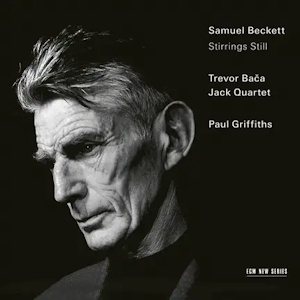
Trevor Bača (b. 1975)
Stirrings Still (2016-18, rev. 2023), text by Samuel Beckett (1906-1989)
Paul Griffiths (narrator)
JACK Quartet
rec. 2023-2024, Auditorio Stelio Molo RSI, Lugano, Switzerland
ECM New Series 2801 [65] Reviewed from a WAV download: 96 kHz/24-bit
What were you doing on the morning of Friday 3 March 1989? I was on a commuter train, a bit glum. I opened my copy of The Guardian and saw a teaser at the top of the front page, ‘Samuel Beckett stirs after a famous silence’. Turning to the books pages I saw three things. A note from Beckett’s publisher John Calder giving the background to a new short prose work, Stirrings Still. A review of it by Frank Kermode. And, in what felt like an act of munificence, the text itself. I was so absorbed that I looked up to find myself alone in the carriage at Waterloo. No longer glum.
Thirty-seven years on, the composer Trevor Bača has attempted something daring with that text: a new dramatic work, using music to respond to and illuminate Stirrings Still. Beckett finished it in 1987, and it reached most of its first readers in the newspaper I was holding. It depicts a man sitting at a table, head on hands. He sees himself rise and go. He reappears elsewhere. Throughout, his mind is an unstillable ‘hubbub’, and at the end of Beckett’s not quite two thousand words we are left with the image of a ‘self and second self’, alone, wishing for an ending that will not arrive. ‘…oh to end. No matter how no matter where. Time and grief and self so-called. Oh all to end.’
Stirrings Still is identifiably late Beckett, thematically and stylistically. In the brilliant short theatre piece, Ohio Impromptu (1980), for example, two identical figures sit at right angles at a table, Reader and Listener, so that the self-doubling is actualised, as it were. Anyone who has seen Ohio Impromptu will recognise in Stirrings Still similar speech rhythms and cadences. But the prose in Stirrings Still is perhaps more baroque and has even more of a brittle beauty: sentences almost without commas, circling back to revise themselves as they go. Nacht und Träume, the television play of 1983, opens with a dreamer alone in a dark room who rests his head on his hands while a male voice hums and then sings the last seven bars of Schubert’s song — after which a dreamt self appears, a mirror image in a kinder light. Set that beside the first sentence of Stirrings Still, ‘One night as he sat at his table head on hands he saw himself rise and go’. The man at the table, the second self, the unstillable mind are one continuous late preoccupation.
According to the ultra-elliptical sleeve note accompanying this new release, Manfred Eicher, the founder of ECM, asked the distinguished writer Paul Griffiths in 2006 to identify a composer who could write music that would unobtrusively and sympathetically coexist with a reading of Stirrings Still. Eicher showed typical acuity both in identifying the work as something which might fruitfully be experienced with music and in his choice of the person to guide the project. Ten years later Griffiths heard the JACK Quartet rehearse Bača’s Akasha and thought Bača might be the talent he and Eicher were looking for. It is not hard to hear why. The title refers to the Sanskrit word for the aether, and a feeling of space coupled with a powerful animating spirit pervades the work. Technically it is a tour de force, sounding something like a summation of the twenty-first-century string quartet so far, but without extraneous gesture, and there is the strongest sense of composer and performers sharing a vision.
Born in California in 1975, Bača is a widely performed composer who holds a PhD in music from Harvard and now teaches at Yale. He is also the creator of Abjad, a Python-based open-source software system for composing and engraving musical scores, a seriously impressive technical achievement. Because he publishes his work as source code, I was able to use Abjad to produce a freshly engraved score of Stirrings Still from the current files in his GitHub repository — definitely a first in my reviewing career. That generosity towards his audience extends further. A number of his works, including Akasha, are on his SoundCloud page and, making up for ECM’s minimalism, there is a superb essay on his website about his approach to the music of Stirrings Still. From it we learn that he spent a long time with the text before he wrote a note, copying it out by hand until its returns and revisions were second nature, then dividing it into fragments.
Words are first and last. The first thing you see in the score (in what feels to me like an appropriately hieratic red font) and the first thing you hear. And there really is a sense of words and music moving independently. Beckett’s sentences circle back, as I’ve said, revised, extended, shortened. Similarly Bača’s music uses a relatively small vocabulary of sounds, tempi and movements which keep returning in altered combinations. His distribution of the text evidences the exacting preparation I’ve described above and works superbly from a dramatic perspective. Early on for example, he makes a cut straight through the middle of a subordinate clause, at a word that then acts on the music. ‘because the window was not made to open ‖ or because he could or would not open it…’. The music that follows ‘open’ stretches a recurring chord until it resolves into the cello’s first entry, a sustained low D — as if, as Bača says, ‘the chord itself has somehow opened from within’. Words and music moving in their own streams, but finding the same action.
The quartet’s stream occupies draws on five kinds of material, each tied to a physical motion: chordal declamation, elliptical bowing, glissandos travelling across all four instruments, a tremolo flicker (sometimes the barest touch), and long held pitches that open into harmonic fields. Bača has said that they neither illustrate the words nor accompany them. And as with Beckett’s prose, music from elsewhere keeps intruding on the present — sometimes a fragment of the piece’s own past, sometimes a premonition of what is still to come. For the most part the register doesn’t open beyond the text’s resolute interiority, but there are striking moments when the agitation builds to something overwhelming, which quickly dissipates.
The distribution of words and music overall feels organic, authentic. Longer blocks of music shoot off and develop thoughts which go forward, back, and then resume. The narrator sometimes speaks a sentence or two, sometimes much longer passages of complex material from which meaning must be carefully sought. As the piece progresses the words thin, relatively, and there’s an extended stretch of music before they return. The calibration feels perfect and gives the work an unexpected momentum just at the stage where the stream of words seems to be almost fragmenting.
This is the fourth recording by the JACK Quartet I have heard this year (I’m including Akasha, and I’d also urge you to read my colleague Aidan Gray’s excellent review of their new Terry Riley album) and another remarkable achievement. All of the different characteristics of the music I’ve mentioned above come with extraordinarily high technical demands. In a score where physical bow movement is at least as important as pitch, for example, the extended networks of bow-contact trajectories, circular strokes, tasto–ponticello travel and extreme-fast-bow indications demanded by Bača have to be right to the smallest detail. But you simply don’t notice the difficulty, you bask in its effect: the changing colouring of the sound, the raw thrill of tested strings. The JACK have again completely subordinated themselves to the piece and we’re the beneficiaries.
None of it would work without Griffiths’s reading. Like Bača, he’s clearly internalised the text to a remarkable degree and it’s difficult to imagine it being delivered better than it is here. The first thing that strikes you about his approach is the warmth and clarity of his projection. He’s by no means theatrical but there’s a minute appreciation of the architecture, the variety, and, yes, the drama. Halfway through the work he has to read an extended passage where the man begins ‘to wonder if he was in his right mind’. It’s Beckett at his most elusive and tricky. Get it wrong and the listener is left wondering what on earth has just been spoken of. Get it right and we’re not only able to parse it but also appreciate the beauty of its cadences. When Griffiths speaks it, there’s the most wonderful feeling of joins being made, pieces falling into place and complexity made lucid. He’d eschew the analogy, I’m sure, but I had the same feeling of exhilaration as when a cadenza is pulled off. I’ll give just one more example of his excellence. Towards the end of the work the man hears something that he can’t make out ‘faint from deep within oh how’. Griffiths drops his voice to an anguished whisper on ‘oh how’. It stops you in your tracks. It would be trite to say that he’s located the emotional heart of the work, but he made me think again about this whole passage, one which has a concealed echo of Beckett’s beloved Dante that Griffiths will have been well aware of.
In a year which has already seen the release of Kurtág’s Fin de Partie, Stirrings Still is the second answer to the problem of Beckett and music, and it answers it the other way round. Kurtág set Beckett’s words; Bača leaves them alone. I’ve listened to it almost obsessively in the last couple of weeks. Luckily I’ve escaped the morning commute, otherwise I would definitely have had a guard tapping me on the shoulder telling me to take my headphones off and leave the train like everyone else.
Dominic Hartley
Buying this recording via the link below generates revenue for MWI, which helps the site remain free













