
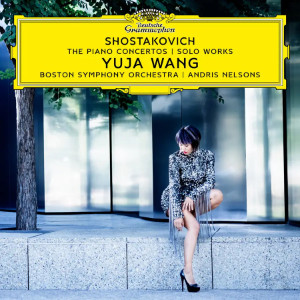
Dmitri Shostakovich (1906-1975)
The Piano Concertos & Solo Works
Yuja Wang (piano)
Thomas Rolfs (trumpet – Op 35)
Boston Symphony Orchestra/Andris Nelsons
rec. 2022 (concertos) & 2024 (solo items), Symphony Hall, Boston
Deutsche Grammophon 4866956 [50]
This programme offers a compact portrait of Shostakovich at the piano. The two concertos place his wit, lyricism and taste for parody in a public setting, while the six short solo pieces turn towards a more private world. Yuja Wang has all the velocity these scores demand, but the distinction of her playing lies in the speed with which she changes character. A phrase can move from dry mockery to tenderness without losing its shape.
The Piano Concerto No. 1 begins with an alert, slightly guarded manner. Wang gives the first movement’s rhythmic dislocations a firm outline, yet she avoids making every accent equally hard. That flexibility matters because the work depends on abrupt changes of tone. Thomas Rolfs is a genuine second protagonist rather than an orchestral accessory. His trumpet can sound jaunty, insolent or unexpectedly lonely, and Wang answers each change with finely judged colour. The Boston strings play with polish and a full-bodied sonority. At a few points that warmth softens the music’s sharper edges, but it also gives the reflective episodes unusual weight.
Wang is especially persuasive in the Lento. She sustains the long piano line without sentimental lingering, and her soft playing remains clear at the bottom of the dynamic range. Rolfs’s muted interjections seem to come from a greater distance, subtly changing the emotional perspective. The brief Moderato then tightens the tension before the finale releases it. Wang’s repeated notes, scales and chordal attacks are immaculate, but the comedy comes from timing and dialogue rather than velocity alone. Alexander Melnikov and Teodor Currentzis, on Harmonia Mundi HMC902104, offer a leaner and more abrasive account, completing the concerto about a minute faster. Wang, Rolfs and Nelsons instead make its succession of masks feel more theatrical.
The Piano Concerto No. 2, written for the composer’s son Maxim, is more direct in manner, though its apparent innocence is never entirely secure. Nelsons gives the opening march a buoyant pulse, and Wang’s entry has spring without sounding brittle. Her articulation keeps the rapid writing transparent, so the listener can follow the exchanges with the woodwind rather than hearing only a display of pianistic brilliance.
The central Andante is the heart of the performance. Wang introduces the melody with simplicity and shapes it as one sustained span. Nelsons provides a broad, warm string background, but the piano is never engulfed. At 6:06, the movement is considerably quicker than Melnikov and Currentzis at 7:42, yet it does not feel hurried; Wang preserves space between phrases through touch and voicing rather than through a slow basic tempo. In the final Allegro, Shostakovich’s parody of keyboard exercises is dispatched with crispness and evident relish. The humour stays light because the tempo remains buoyant and the inner voices are not blurred.
The solo sequence is brief but intelligently ordered. The Prelude in F-sharp minor, Op. 87 No. 8a, has the outline of a small dance with a shadow at its edge. Wang keeps its two-part texture spare. The A minor Prelude and Fugue move from toccata-like motion to more angular counterpoint, and she distinguishes the voices without making the fugue sound academic. The half-minute Prelude in D major, Op. 34 No. 5, flashes past like a mischievous aside. By contrast, the D-flat major Prelude and Fugue, Op. 87 No. 15, bring greater weight and a controlled sense of disorder. Wang’s attack is brilliantly clean, but she also allows the harmony to sound abrasive when the music demands it.
Only eight minutes of solo music are included, and the isolated F-sharp minor Prelude makes one wish that its Fugue had been retained. Even so, these miniatures are more than encores. They expose the same tension between discipline and disruption that animates the concertos. The recording gives the piano a substantial presence while retaining string detail and the trumpet’s cutting profile. The result is a vivid and thoughtfully shaped introduction to Shostakovich’s contrasting pianistic voices, with Wang’s virtuosity consistently placed at the service of character.
Cristina Alejandra Estrella
Previous review: John Quinn
Buying this recording via the link below generates revenue for MWI, which helps the site remain free
Contents
Piano Concerto No 1 in C minor, Op 35 (1933)
Piano Concerto No 2 in F major, Op 102 (1957)
Prelude in F-sharp Minor, Op 87/8a (1950/1)
Prelude in A Minor, Op 87/2a (1950/1)
Fugue in A Minor, Op 87/2b (1950/1)
Prelude in D Major, Op 34/5 (1933)
Prelude in D-flat Major, Op 87/5a (1950/1)
Fugue in D-flat Major, Op 87/5b (1950/1)













