
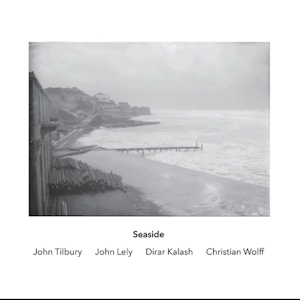
Seaside
John Tilbury (clavichord)
John Lely (electronics)
Dirar Kalash (oud)
rec. 2016, John Tilbury’s home, Deal, UK
Another Timbre AT100 [63]
This is a welcome reissue by Another Timbre of an album which sold out on its release in 2016. The reissue has been timed to coincide with a box set of new recordings by John Tilbury, At Home, most of which were recorded, as the title suggests, at Tilbury’s home in Deal. My review of that set will follow soon, but suffice to say capturing Tilbury in a domestic environment allows new perspectives on his playing to emerge. I don’t think Seaside was conceived of as a pilot of domestic recording, but it immediately affirms that the environment is not just viable as a venue but positively conducive to exciting music making. Sitting in Tilbury’s conservatory on two days in 2016 were the keyboardist himself with a newly acquired clavichord, an instrument he had never previously been recorded playing; the young Palestinian musician Dirar Kalash playing oud; and the composer and improvising musician John Lely using a variety of electronics. The material is a mixture of composed and improvised.
The disc starts and ends with Lely’s Line, a piece written for the disc with the clavichord in mind. In its first incarnation, for clavichord alone, it’s a beguiling series of struck notes and occasionally chords, some held long enough for the decay of the sound to become a key part of the aural experience. The second take at the end of the album sees Lely accompany Tilbury’s line with a variety of electronic sounds and effects. There’s a fascinating timbral difference, of course, but the formal effect on the piece is also striking; here it develops into something almost twice the length of the solo version.
Tilbury also includes two of the piano pieces written for him by Christian Wolff in 1969 and 1970 but now arranged for clavichord. Tilbury 2 sounds like a soliloquy — there’s a real sense of deliberation — which ends in a sort of philosophical acquiescence. Tilbury 4 is a conversation of sorts. Wolff stipulated that the parts should be performed by ‘at least two players’, so Tilbury recorded two solo lines and overdubbed them. I say conversation, but it’s one marked by a sense of fragmentation, a perception perhaps heightened by the brittleness of the clavichord’s sound.
I don’t think you would need to know that the titles of the improvised pieces are the names of former Palestinian villages, depopulated or destroyed when the state of Israel was created in 1948, to sense the poignancy and dislocation that pervades each to varying degrees. Biyar ‘Adas feels oud-led, Kalash setting out simple patterns which Tilbury and Lely respond to. By contrast, Lely’s electronics give Saqiya a feeling of profound unease, menace even, at the start, which never entirely dissipates even when the oud and clavichord are in dialogue with each other. Jarisha, the longest piece on the album, develops into something increasingly fractured and claustrophobic, whereas the final improvisation, al-Safirriya, begins with a relatively assertive sense of something more constructive before gradually dissolving into a haze of uncertainty. In all of the improvisations the playing and the interplay are exquisite. Tilbury’s clavichord is not amplified, so Kalash and Lely match its volume. The overall effect is magical and bewildering: the pieces seem to be somehow simultaneously disturbing and seraphic.
I’ve divided the album into segments to describe it, but the running order mixes the improvisations and composed pieces and by so doing the boundaries are interestingly blurred. I listened to the album cold at first and couldn’t have definitively told you which work was composed, which improvised. That nebulosity is also a characteristic of the album’s exploration of concepts of place. So, seaside. We’re in Deal, a coastal town. From Tilbury’s conservatory we can occasionally hear seagulls insinuate themselves into the sonic mix. And there on the cover is an old picture of Deal itself, with a pier-like structure in the foreground. Except it turns out that the picture is actually of the coastline at Jaffa in Palestine, around 1910; the four villages which give the titles to the improvisations are in the subdistrict of Jaffa. Some gentle points are being made through music here about politics and place, all the more effective given the delicate and prepossessing realisations of each of the pieces.
If you didn’t buy a copy of the CD in 2016, don’t miss your chance to acquire a true classic of the remarkable Another Timbre catalogue while you can. There’s another imperative too. Proceeds from the sale of the CD will go to Medical Aid for Palestinians, a humanitarian charity which John Tilbury has supported for many years, and which is working in Gaza and the West Bank to alleviate the suffering of the Palestinian people.
Dominic Hartley
Availability: Another TimbreContents
John Lely (b. 1976)
Line (2016)
Line with Accompaniment (2016)
Christian Wolff (b. 1934)
Tilbury 2 (1969)
Tilbury 4 (1970)
Improvisations
Biyar ‘Adas
Saqiya
Jarisha
al-Safirriya













