
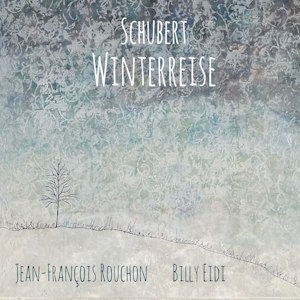
Franz Schubert (1797-1828)
Winterreise
Jean-Francois Rouchon (baritone)
Billy Eldi (piano)
rec. 2025, Coeur de Villes, Vincennes, France
Le Palais des Dégustateurs PDD062 [65]
How many recordings of Winterreise are there? Few would care to count them, but the one thing for certain is that the work has an honourable history with a variety of vocal types in a piece where the intelligence of the singing and playing is quite as important as whatever comes out of mouth or keyboard. Whoever is brave enough to take on this most challenging of all song cycles has to be very sure of themselves and completely secure in their game, for they will be stepping into some fairly heavy shoes. There is many an honourable failure in the catalogue, as well as many that quite simply aren’t up to the mark – in some cases nowhere near it. Sadly, it is clear right from the start that this release from Le Palais des Dégustateurs with baritone Jean-Francois Rouchon and pianist Billy Eide is one of those.
It’s difficult to know where to start, because at these times you feel as if you have to test your sanity or just your musical knowledge by playing a game of ‘can this really be as bad as it seems to be? In any lieder performance, let alone a cycle as famous as Winterreise, you expect singer and pianist to be able to conjure an ever-changing atmosphere accompanied by the appropriate vocal dynamics. He or she also needs to have clear diction, especially if it is not his, or her native language. The singer also needs to put real feeling in the words to convey the empathy that the character needs to evoke from their audience. In general, the voice needs to be attractive and ingratiating enough to make the listener wish to continue.
It pains me to report that Jean-Francois Rouchon fails in all departments. At no time do I feel at all engaged with what is being sung. My German is pretty good, but I find if you stick your nose too much in the lyrics, you will soon lose track of the music and especially the dialogue between the soloists. That having been said, there was nothing here to make me care. The diction, contrary to the rather fawning record company interview, is dreadful, either ironed out at the end of a phrase, or lacking the necessary bite altogether. A lot of the words I could hardly make out, which is unforgiveable, but what is worse is that sometimes one line seems to run into another.
Then there is the question of intonation. Cursed with near perfect pitch as I am, I end up wincing when a wrong note is hit, or even worse, missed. Thankfully, Jean-Francois Rouchon does not fare as badly at this, but there are many times he threatens to, and he often gives the impression of not quite being able to make higher notes, or at least not stay on them. Then there is his lack of empathy. This is not Die schöne Müllerin, where it can sometimes be all too easy to get exasperated at the whining little tyke who can’t see past his own obsessions to the true danger within – whereas I find Winterreise difficult to enjoy for the most part. If you’re willing to take the time and the risk of ending up more depressed than you started, then with the right duo it can bring highly satisfying rewards. I’m no great fan of Dietrich Fischer-Dieskau as a Lieder singer, but there’s no doubting the care and intelligence he puts into his versions, especially the recording with Daniel Barenboim, where his word pointing and emphasis are kept just right, allowing the drama to emerge as organically as possible. This is vital, because ultimately Wilhelm Müller’s sequence of poems tells a story, one of winter despair, rather than the initial burgeoning hope. Neither was composer or poet to live for much longer. Just listen to the difference between the way Fischer-Dieskau and Barenboim begin the cycle with Gute Nacht. This is one of the longest poems and serves as a mini-drama to what is to come – a foreshadowing if you will. Both artists have this understanding in their bones and never let go of it. This song is about the contemplation of death, a will I, won’t I. To say it all goes downhill from here is a bit of an understatement. Unlike the hero in Die schöne Müllerin, who is egged on by ill fortune, and the inviting stream, to his eventual suicide, the older character in Winterreise, who, following this latest rejection by his lady love and her family, is well on his way. Fremd bin ich eingezogen, Fremd zieh’ ich wieder aus. (As a stranger, I arrived. As a stranger, again I leave.) He has not done the thing he came to do, and he is running out of options and into darker thoughts? At every point Fischer-Dieskau and Barenboim make not just the vocal, but the psychological points that need to be made. Sadly, I cannot remember ever believing this when listening to Jean-Francois Rouchon. I must make a point here that to my ears the fault doesn’t really lie with the pianist Billy Eide, who gives a decent account, only lacking the support from his seemingly uninterested partner.
Another famous recording of Winterreise is the renowned 1990 one by the German mezzo Brigitte Fassbaender, accompanied by the German composer Aribert Reimann. This was a celebrated recording at the time and in the first song you immediately recognise why. Again, there is the same word pointing and intelligence as Fischer-Dieskau, but more than that, there is a warmth and engagement which make you want to continue. As I’ve said, for many this cycle is a hard listen – perhaps less when you are not engaged with the lyrics. A wonderful example of this is the fifth song, Der Lindenbaum, which is even more a heralding of death, for this is the very tree where the wanderer will rest. “And the branches rustled, as though calling to me. Come here to me, my friend. Here you will find the rest”. Whereas Fassbaender’s almost schizophrenic reading of the two competing voices is evocative and chilling in equal measure, Jean-Francois Rouchon seems to have no idea how to convey this.
For a final example we need to turn to a tenor, and one who, like Fischer-Dieskau has made a name for himself singing the cycle. Ian Bostridge has at least three recordings to his name, and it’s the one with Leif Ove Andsnes from which I will draw a couple of examples. In the final song Der Leiermann, Andsnes’s notes fall like cold pebbles, while Bostridge turns the word still into the echo of the wanderer’s coming doom, as in “Dreht, und seiner Leier. Steht ihm nimmer still” (He plays, and his organ is never still). Again, the French baritone misses so much of this word-pointing opportunity, as he does throughout.
One final example from Ian Bostridge before winding up, comes in the jolliest of the songs in Winterreise, Der Post. The leaps of hope need to be almost manic, like the horse which might bring the hoped-for letter, and the fall into despair, just as sudden. Bostridge and countless others, understand and do this. Jean-Francois Rouchon – as happens so often – simply fails.
In conclusion, there is no doubt for me that this endeavour is a dismal misfire and Rouchon’s uningratiating voice does not help. Poor Billy Eide seems to be flogging a dead horse most of the time. I am trying to find more positive things to say but I can’t. To tolerate something as unengaging does a disservice to all those who have followed before.
Stephen John Wray Gladwin













