
Cipriani Potter (1792-1871)
Piano Works (in the Romantic Piano edition)
Luke Jones (piano)
rec. 2024, RNCM Concert Hall, Royal Northern College of Music, Manchester, UK
Naxos 8.574694 [69]
In the 2020s, Cipriani Potter’s music reads as dependable, unfussy and historically useful rather than revelatory. The music demonstrates an understanding of Beethoven’s language but does not push it anywhere new; it is the good workmanship that still draws the ear. He is no lost master, but neither is he just the footnote he was once made out to be. In today’s climate of rediscovery, Potter comes across as a capable, clear‑voiced early‑Romantic composer. His music, piano pieces included, helps sketch the landscape of British music before Sterndale Bennett and Hubert Parry.
Philip Cipriani Hambly Potter, born in London on 3 October 1792, was trained early by his father before studying counterpoint with Thomas Attwood and theory with John Wall Callcott and William Crotch. A five‑year period with Joseph Woelfl sharpened his pianistic and inventive handling of musical ideas, and by 1816 he was already appearing at the Philharmonic Society with an overture and a Sextet for Piano, Flute and Strings of his own. His travels on the Continent were important – he visited Vienna, other German towns, then Italy. Briefly, but memorably, he met Beethoven, who described him as a “good man” with talent for composition. Returning to London in 1819, Potter became a regular Philharmonic performer and, in 1822, professor of pianoforte at the newly founded Royal Academy of Music. He succeeded Dr Crotch as Principal in 1832, holding the post until 1859, when he handed it to Sterndale Bennett.
Potter’s wide-ranging output had the piano at its centre. There were many character pieces, studies and chamber music, alongside nine surviving symphonies and four piano concertos, some of which once had Philharmonic currency but have since slipped from view. His contemporary reputation rested as much on his playing as his composing – he introduced several Beethoven concertos to English audiences – and he was admired as a sympathetic conductor. In late life, he assisted at the premiere British performance of Brahms’s German Requiem.
Potter’s Piano Sonata in E minor shows him working confidently within a Mozart/Beethoven framework. The opening movement, as may be expected, sets drama against lyricism, with significant contrast of material. There are plenty of wayward modulations. The brief Andante offers a gentler, Mozartian interlude with a few interesting turns. The Leggiero Menuetto is charming, its graceful theme offset by a darker, more energetic Trio section. The finale brings a touch of Beethovenian humour: three sharply contrasted ideas jostle for position before the music finally settles, almost by accident, on a bright E major close. This varied, absorbing sonata shows Potter’s instinct for momentum and his more expressive side at its best. I would rather hear this work than some by better‑kent composers; it is too good to remain outside the pianists’ repertoire.
Cipriani Potter infuses the Introduction and Rondo giocoso with a Beethovenian sonata finale’s sense of vigour. A restrained opening gives way to a sparkling rondo whose “bubbling” main idea keeps the music alive. The contrasting sections – one more melodic, one delicately shaded – offer welcome repose before the rondo theme reasserts its cheerful drive. The whole movement feels open‑hearted and deftly paced. It closes with a burst of humour that suits Potter perfectly.
The Three Toccatas sit squarely in the early‑Romantic tradition of the virtuoso toccata: fast, extrovert, and driven by almost continuous semiquaver motion. Daring modulations and occasional chromatic surges give all three pieces a restless vitality. The first Toccata is the most overtly Bachian or Buxtehude‑like. Its perpetual‑motion figuration, brief central relaxation, and rhetorical sweep could easily suggest a Baroque toccata if heard without context. The writing is less about thematic argument than about impetus.
The second Toccata feels less Baroque in mood even if it follows a similar pattern: uninterrupted texture framing a quieter middle paragraph. The third Toccata, though equally reliant on semiquaver patterning, shifts the emphasis. Its texture leans toward melody with accompaniment rather than contrapuntal interplay, and its harmonic colouring is decorative rather than structural. It is the most lyrical of the set.
Although unlikely ever to become as ubiquitous as a certain other composer’s Enigma Variations, Cipriani Potter’s take is fun: Variations and Fantasia on a Favourite Irish Air in the Style of Five Eminent Artists. Unlike Sir Edward Elgar, Potter explained the reasoning behind his “mystery”. To paraphrase: the Introduction was aimed at Ignaz Moscheles, with its oddly chromatic harmonies; then, after the Theme (not identified in the liner notes), the five variations allude to five contemporary composers: Ferdinand Ries, Friedrich Kalkbrenner, Johann Baptist Cramer, Gioachino Rossini, and once again Moscheles in the final variation. The concluding Fantasia revisits these gentlemen in a different order. Only a specialist in all five men will be able to discern how accurate Potter’s allusions are. Yet overall it is an attractive piece, with plenty of notes splashed around. It is a wee bit too long for an encore, and would nowadays need a fair amount ofcommentary to engage the audience’s interest.
On the strength of these post‑Beethoven pieces, one can only be struck by Welsh pianist Luke Jones’s technical command and his evident enthusiasm for the repertoire.
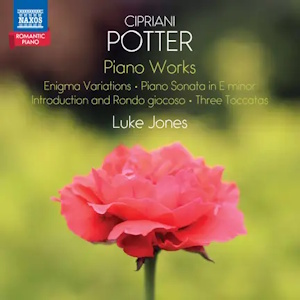
Rodney Smith’s liner notes are helpful, though some of the commentary on the music tends to be too technical. He gives a decent overview of Cipriani Potter’s life and achievement. Sadly, the insipid record cover offers no clue as to the interesting programme.
This attractive new release is a clear reminder of how much music from the catalogues of early‑Romantic Britain has still to yield. Hopefully, Naxos and Luke Jones will issue further instalments of Cipriani Potter’s piano music.
John France
Buying this recording via the link below generates revenue for MWI, which helps the site remain free

Contents
Piano Sonata in E Minor, op.4 (publ.1818)
Introduction and Rondo giocoso, op.20 (c.1826)
Toccata in G Major, op. 9 No.1 (publ. c.1816)
Toccata in B flat Major, op. 9 No.2 (publ.1818)
Toccata in E Major, op. 9 No.3 (before 1825)
Variations and Fantasia on a Favourite Irish Air in the Style of Five Eminent Artists, op.5 “Enigma Variations” (c.1825)













