
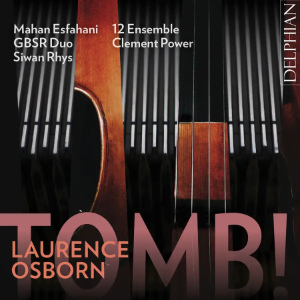
Laurence Osborn (b. 1989)
TOMB! (2022)
Lakes, Mists, Bats, Daggers and Fountains (2023)
Me and 4 Ponys (2018)
Coin Op Automata (2021)
Siwan Rhys (piano)
Mahan Esfahani (harpsichord)
GBSR Duo (Rhys and George Barton, percussion)
12 Ensemble/Clement Power
rec. 2024, Trinity College, Cambridge, UK
Delphian DCD34350 [66]
As a general rule, the more academic a piece of music’s concept is, the less likely I am to feel like I ‘get’ it. A piece of music that the composer says is about, I don’t know: falling in love, nature, sorrow – I am confident that I’ll be able to follow, regardless of whether the piece itself is a success. When, however, I read something like:
“ …a piece that recognises and questions the morbid obsessions of heritage culture (…) homage becoming necromancy (…) Occasionally, things appear in their pure, calcified form: frozen, like fossils, at the moment of expiry.”
I tend to doubt that I’ll be able to hear music in that way. It’s not that I don’t want to – as a fan of contemporary music, I wish I could reliably hear things like that in a piece of music. Usually I do not. But, and this is the exciting thing: Osborn manages to pull it off. That quote is drawn from his description of the first work on this album, TOMB!, and after giving it a couple of careful listens, I think he conveys every inch of his concept.
His success in that arena is due to a few things. First, he writes with precision and expertise. As the listener, you are pulled into the Laurence Osborn sound-world, not to be confused with anybody else’s. Second, Osborn is a master of tone. He can slide between slyly funny and earnest in a matter of bars. The music is so much fun. Third, he is supported here by some incredible musicians who clearly believe in the music and give it all their heart.
So, what do we know about Laurence Osborn? His website biography tab attests to a glittering CV: a PhD in composition supervised by George Benjamin (of Written on Skin fame), a ‘Laurence Osborn Day’ put on by Wigmore Hall in 2023, and an artist-in-residency program at Trinity College, Cambridge, where this album was recorded.
In terms of recordings, though, I think we are still slightly waiting for the Golden Age of Osborn. He has received just one prior reference on MusicWeb, for a 12-minute piece for cello and bass he contributed to a chamber music collection in 2019 (review). His two previous full-length albums were released on smaller, specialist contemporary labels: His Essential Relaxing Classical Hits on Ensemble Klang (for amplified solo soprano and six players; the title is ironic) and CTRL / ABSORBER on a Darmstadt-based label with the delightfully Germanic name MBM Mielke Bergfeld Musikproduktion oHG. By contrast, Tomb! is on Delphian. So I think I am right in saying that this could be the breakout album that really establishes Osborn’s career on disc.
Of the other performers on this disc, two of the four were completely new to me. Pianist Siwan Rhys was one I did not know, but she seems to have done a stellar job in the Morton Feldman Trios last year (review). She dispatches what must be fairly challenging parts here on both TOMB! And Me and 4 Ponys with vigor and sharpness, an ideal advocate for the music. Together with the percussionist George Barton, the two of them are credited as GBSR Duo as well. Barton deserves some credit too: TOMB! gets quite a lot of its color from various pitched and unpitched instruments, and I assumed there was probably a second musician manning the percussion. But actually, I think it might just be Barton. Then there is 12 Ensemble, the strings, conducted by Clement Power. You may know them from Decca’s 2023 Ola Gjeilo Christmas album Winter Songs, which seems to be quite a hit – a cool 8 million plays on Spotify for The First Nowell. They are joined by Mahan Esfahani, one of the most famous currently-active harpsichordists, and a personal favourite musician. Not that I’m unusual in holding that opinion. In his review of Esfahani’s Well-Tempered Clavier, Book 1 Dominy Clements described him as “…a true joy…you are captured by his eloquence and subtlety of touch,” (review), and concerning his 20th-century Czech harpsichord concerto album Woolf praises “…his ability to weave together the narrative” (review). It’s lovely to have him on Coin Op Automata, where that ‘subtlety of touch’ and narrative-thinking help provide a sense of life to a jerky, stuttering piece.
Let’s return to the eponymous work, TOMB! a single 19-minute movement for strings, percussion, and piano. As Osborn describes it, the inspiration for the piece was the ‘tombeau’ genre in baroque music, whereby “a living artist honours a dead one by impersonating their voice.” For Osborn, this is almost a symbol of cultural heritage itself. I think Ravel was struck a similar idea when he wrote Le Tombeau de Couperin, which is, as far as memorials to deceased friends and relatives go, deeply enigmatic. Osborn’s approach is somewhat different from Ravel’s: he brings different baroque forms in and out of view throughout this single movement, sometimes making me wonder if there was a quotation to a specific piece I was missing. But it never feels like collage, because the rest of the work is so contemporary, spiky, and unsettling. Andrew Clements, writing for The Guardian, described it in the following way: “musical forms like fugue, jig, and passacaglia flit in and out…like apparitions” (quoted on the back of the CD cover). If Osborn wants to make you think of a fugue, he’s only going to write so much of a fugue: the rest of it is this scherzando totentanz. His use of the low strings to create a ‘groove’ lends irresistible drive and momentum. I think it’s really tremendous fun, the kind of Halloween-ish blend of creepy and witty which does end up making an interesting point after all about the similarities between ‘homage and necromancy’.
Lakes, Mists, Bats, Daggers and Fountains is the second work, a 21-minute string quartet in four movements. The title comes from a mocking definition of Romanticism, which appeared in the French Newspaper Le Corsaire. The Romantic has “greasy hair growing over the coat-collar…sighing at least three times a minute…dreaming of lakes, mists, bats, daggers and fountains.” I couldn’t help but think of Jane Austen’s Northanger Abbey, which parodies Romanticism in a similar vein. Osborn, on the other hand, wants to show that these images “rebel against their own glibness and communicate something in spite of their intentions” but it is, to my ears, the least successful work on this disc. All four movements feel a bit same-y to me: they are marked Subdued, emerging, like lost, old music (1), Nocturnal (2), Soft and light (3), Always light and airy (4). The string players from 12 Ensemble comply, and we get what feels like a single, rather long slow movement written in short bursts and fragments, played with a slightly keening edge. It’s interesting, don’t get me wrong, but it doesn’t live up to the other three works here.
For instance, there is Me and 4 Ponys, a 14-minute piano quintet in three movements, and, yes, that spelling is intentional. I did wonder if ‘ponys’ might be a Welsh word, because it sort of looks the part, but actually the inspiration is the unrestrained and accidentally avant-garde crayon drawings made by children. The “ponys” in particular refer to the jig-like pulse that underpins the three movements. You can already understand, I think, why Osborn is interested in things that are “endearing and grotesque in equal measure,” as he puts it. He is careful to add that he did not compose Me and 4 Ponys in a childlike way, but that it took quite a lot of careful revision: c.f. Pablo Picasso, “It took me four years to paint like Raphael, but a lifetime to paint like a child.” I loved this piece. It is neither garish nor artificially simple. It does feel spontaneous and fearless, wholehearted in its embrace of controlled chaos.
Our final work is Coin Op Automata, a 12-minute work for string quartet and harpsichord (should we use the term harpsichord quintet?) in two movements, running for 12 minutes. The inspiration is apparently a museum Osborn’s wife used to visit as a child, which had a number of, you guessed it, coin-operated machines. The first movement makes use of the harpsichord’s ‘mechanical’ sound production in a choppy, complex rhythmic dance. The second movement, marked ‘sweet and sad’ is arioso, with, to quote Osborn, “arabesques borrowed from both baroque and auto-tuned RnB singing.” I really enjoyed this piece, not least because it makes interesting and original use of the harpsichord.
The sound quality is excellent: everything is extremely clear and well-balanced. I said it earlier, but it bears repeating – the performers are top-of-the-line in this repertoire.
I’m excited to hear much more from Osborn in the future. I see from his website that he has studied opera and already composed five of them: I can easily imagine something visceral, darkly funny, and evocative by way of Adès’s Exterminating Angel, perhaps?
If I have written rather a lot of words in this review, it’s because Osborn’s works are not self-explanatory. But they are well worth the effort. These are delightful, engaging, and rewarding contemporary works.
Aidan Gray
Buying this recording via the link below generates revenue for MWI, which helps the site remain free













