
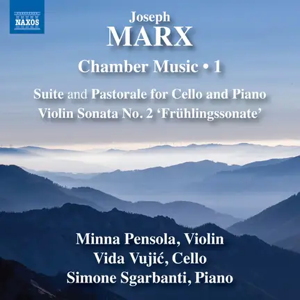
Joseph Marx (1882-1964)
Chamber Music • 1
Suite in F Major for Cello and Piano (1914)
Pastorale for Cello and Piano (1913)
Violin Sonata No.2 in D Major Frühlingssonate (1944)
Vida Vujić (cello), Minna Pensola (violin), Simone Sgarbanti (piano)
rec. 2025, DV Studios, Sala Musicale Giardino, Crema, Italy
Naxos 8.579181 [67]
For someone whose exposure to the highly charged music of Joseph Marx has been focused on works involving the orchestra, Volume 1 of his chamber music is an enticing prospect. Interestingly, Marx only turned to the orchestra in his late thirties. His substantial legacy of over 150 songs belongs to the period 1901-1916. The main website dedicated to the composer lists his chamber music as including two violin sonatas (the second is on this disc), a Fantasy Piano Trio and three works for piano quartet, and three mature string quartets along with a first version of one of them. This would suggest at least two more discs in this series, depending on the scale of these works. They have all been recorded across a variety of labels. The impressive ASV recordings of the three quartets are long gone from the catalogue; they never made the transition to Naxos which the ASV orchestral collections did.
In volume 1, we get the Suite in F major for cello and piano, the Pastorale for cello and pianooriginally intended to be part of the suite, and the Violin Sonata No.2 ‘Spring Sonata’. The cello works belong to the lieder phase of Marx’s composing life, the sonata to the orchestral phase. That difference proves to be significant, because these works occupy notably different aesthetic and musical worlds. The Suiteis a substantial work with the four movements running thirty-five minutes. But the feel is lyrical, almost salon-like in the clarity of the writing and the undeniably song-like melodies in the cello part. For someone coming to this music from the tortured grandiosity of Marx’s orchestral scores, this is rather unexpected. Textures are clean and quite light, the harmonies are attractive and piquant but nothing as complex as the later scores. Generally, there is a benevolent mood that I would not necessarily associate with Marx.
Serbian cellist Vida Vujić is an accomplished guide, and she is ably supported by pianist Simone Sgarbanti. The acoustic of the DV Studios in Crema is not the most generous or supportive you will ever hear. This is more the neutral modern studio acoustic than the church-type space that many recording companies favour. This affects more the violin sound in the violin sonata rather than the cello. Sgarbanti’s Steinway Grand is nicely caught, with a good balance between the instruments.
The Suite’s four movements are similar in length, ranging from the second-movement Largo at 8:27 to for the third-movement Menuett at 9:01. Even though this is a fine performance, I am not quite sure that the calibre of the actual music sustains the scale of individual movements, let alone the entire suite. The style is consciously classical. Although the liner notes suggest “impressionistic elements”, they are few and far between. The notes make no comment on why Marx wrote this work, whether as a commission or for publication.
Let me return to the fact that this music sounds so different from Marx’s later works that I wonder if it was targeted at more of a domestic or amateur audience and clientele. In the hands of skilled players such as Vida Vujić and Simone Sgarbanti, this is lifted far beyond the realm of home entertainment. It sounds grateful to play, and the writing is pragmatic and effective without making extreme technical demands on either player. I enjoyed hearing this work and the accompanying Pastoralebut I would struggle to say that the actual musical content has lingered long in my memory. The list of chamber works makes it notable that all of those mentioned above also date form the “song” phase of Marx’s career. The exception are the three quartets from 1936-1941 – not that long before Marx simply stopped composing for the last 20 years or so of his life.
Violin Sonata No.2 which completes the disc actually comes from the very end of Marx’s composing career. Simone Sgarbanti is joined by Finnish violinist Minna Pensola. According to the main Marx website, this late sonata revisits the “colourful style” of the earlier chamber works. Yet in technical and indeed harmonic terms there is a significant difference between the violin and cello works. Yes, in the sonata Marx still follows a very traditional three-movement form, and the title “Spring Sonata” is something of a surprise because of its associations with Beethoven’s famous work. To quote the liner notes, Marx wrote the piece “amidst the ravages of the Second World War”. The opening Allegro espressivo seems wholly ignorant of any such ravages. Apparently he reuses the main theme from his earlier Violin Sonata No.1 in A majoras a conscious reminder of happier (simpler?) times.
I cannot say I am completely enamoured of Minna Pensola’s playing. Technically, it is perfectly good but I find some of her phrasing and musical choices (and occasional portamenti) not quite convincing. I wonder if there is a haze of digital reverb added to the violin which gives it a tonal edge that otherwise would not be there. As a work, this makes far greater demands upon both players than the relative directness of the cello suite. Emotionally, this inhabits much of the same Alt-Wien nostalgia of Korngold’s post-war scores. This is especially true of the central Allegretto (im Serenadenton). Might this be where Pensola could employ a lighter, even gentler tone? This lovely movement has more than a hint of Mediterranean melancholy about it.
When one listens to music like this, written when it was, it is very easy to understand why a composer of this expressive disposition would choose to stop composing in the face of the rise of the post-war Darmstadt School ideologues. Quite why Marx chose “Spring” as the title is again unclear – although the closing Moderato has a kind of pastoral open-air dancing feel. In this movement, Marx lifts a theme from his epic 1921 Eine Herbstsymphonie and references material from earlier in the sonata, so perhaps there is a sense of renewal and rebirth. After the relative reflection and lightness of the work, the very end is a big bravura virtuosic conclusion, perhaps a last defiant Romantic gesture shaking its fist at imminent Modernism.
Even though this is all repertoire recorded before, there will be value in a coherent set released on one disc. If Simone Sgarbanti is ‘resident’ pianist for the project, this bodes well: he is a fine and sensitive player. The jury is still out on the enduring stature of Marx’s resolutely Romantic music but the more performances one can hear, the more considered those judgements can become.
Nick Barnard
Buying this recording via the link below generates revenue for MWI, which helps the site remain free













