
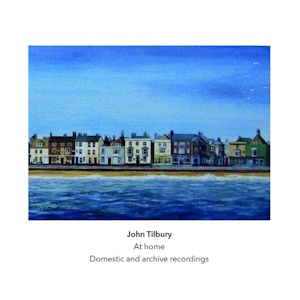
John Tilbury (piano, clavichord, organ)
At home – domestic and archive recordings
rec. 2018-2026, Deal, Kent; archive recordings c.1970-2016, various venues
Full track listing below
Reviewed from a WAV download: 44.1 kHz/24-bit
Another Timbre at257x4 [4 CDs: 311]
In his touching Foreword to this new box set, Simon Reynell describes John Tilbury as a ‘giant’ in the history of contemporary music. Critics hear words like that in circulation a lot, from gushing press releases to excitable programme notes, but in the case of Tilbury it seems to me that no other word will do. Has there ever been a performer who has so been part of the creative fabric of the music he plays, so single-minded in his approach to the now? Clive Bell’s superb programme notes hint at possible alternative histories. What if the prodigious 14-year-old whose Chopin was broadcast had decided to pursue a more conventional career? There’s enough evidence from those who heard him play in his early years — Mozart and Beethoven particularly — to suggest that other doors, and other musical riches, might have opened to him and us. And yet. I don’t think I could trade anything in this magical release for a mythical Mozart K576. Magical, because I don’t think I ever experienced a valediction like this, its serendipitous selections and perfectly judged playing inviting us to take intriguing paths through the repertoire.
In 2018, aged 82, Tilbury decided that he would stop performing concerts. Having already recorded the recently reissued album Seaside at Tilbury’s home in Deal, Reynell suggested that he could travel to Kent on a regular basis and record Tilbury playing whatever he wanted on piano or clavichord. The sessions came to an end earlier this year, around the time of Tilbury’s 90th birthday, and represent his final recordings. There are four discs, each mixing home recordings with performances from the archive, and however you choose to listen to them, they make for wholly engrossing listening.
Listen to Disc 1 as a recital for example. It starts with an archive recording of Kurtág’s brilliant two-piano arrangements of Machaut which give way exquisitely to five recent pieces by Howard Skempton, glittering and beautifully simple. There’s a simplicity of a different sort in Michael Parsons’s Oblique Piece 25 for clavichord, where the instrument’s limitations become a sort of quirky virtue. Works from Cornelius Cardew and Linda Catlin Smith follow: the former’s Three Short Piano Pieces has a sort of epigrammatic kick that hits you after it’s moved on, the latter’s Poire is a fragile, meticulously constructed enigma. Christian Wolff’s For Pianist comes in an archive recording of his landmark piece, where Tilbury’s choices feel appropriately fluid and in the moment, and move us with a sense of consequence to John Lely’s bewitching Sycamore. There the temporal considerations of the Wolff seem to have given way to something outside time altogether.
You can go on like this, through the other three discs, and appreciate, say, the juxtaposition of Christopher Hobbs’s restless and surprisingly turbid Five Pieces for Clavichord with Dave Smith’s bluesy Endgame and Mark R. Taylor’s Five Nocturnes which sound as though they’re circling techniques and sonorities in the most tantalising way, never settling, like a refusal of genre. Those are all on Disc 2. Disc 3 brilliantly sandwiches Dave Smith’s substantial and rewarding Al Contrario from the archives between Catherine Kontz’s specially written (for clavichord) and surprising December 22 and Tilbury’s own wonderfully sustained improvisations. These interpret five performative drawings by the Venice-based artist Morgan O’Hara, which follow the movements of dancers in real time during live performances.
Beckett is the unifying force of Disc 4. Tilbury’s own What is the Word is rendered on, of all things, the organ of King’s College Chapel, Cambridge. There’s an intense opening chord held for nearly 30 seconds, then Tilbury brings the volume down and begins himself to speak the words of Beckett’s final poem. You have to hear it. There’s also a two-piano improvisation from the archive on music written by Tilbury for Beckett’s radio play Cascando where Sebastian Lexer plays with Tilbury. Not for a second in the 29 minutes of the improvisation do the players lose the listener as they figuratively examine music, language and sound. Mark R. Taylor’s Pour rien also takes keyboard (a clavichord) and voice to deliver Beckett, but this is very different from What is the Word. The clavichord part sounds like a necessary ceremonial encumbrance, a sort of desultory recitative over Tilbury’s reading of the text. Highly theatrical, highly effective.
There are other paths you can take through the set of course. How about considering those archive performances one after another? As well as the ones I’ve already written about, there’s Cardew’s insistently cascading Volo Solo from around 1970, and his Bun No. 2 for Orchestra, recorded in concert in 2002, in a Dave Smith version for two pianos (Tania Chen plays with Tilbury here), which seems to bring out the thespian in Tilbury (in a lovely aside in Bell’s notes Tilbury is recorded as saying, ‘I was good at acting…but I think I would have been a very dissolute actor, a very drunken actor. I think music kept me on the straight and narrow somehow. Because you can’t play a Beethoven sonata and be drunk at the same time’). Perhaps most surprisingly of all though is an improvisation from 2004 played on the organ of Holy Trinity Church, Leeds, with Keith Rowe providing electronics. What that mixture of sounds actually does is to propel the listener into a liminal space for the duration, a disorientating and thrilling experience.
Feldman is here too, of course. Bell prefaces his notes with a recollection of Feldman coming to the UK in 1966 and meeting Tilbury, Cardew and David Bedford. ‘If anything,’ Feldman said, ‘they have more swagger, they’re more out of a movie than we were.’ Swagger or no, Tilbury’s long association with Feldman has two notable commemorations here. There’s a striking 2016 recording of Piece for Four Pianos (Philip Thomas, Mark Knoop and Catherine Laws join Tilbury) whose precision is somehow underpinned with what feels like a spirit of flexibility, and Madame Press Died Last Week at Ninety, Feldman’s tribute to his piano teacher when he was aged 12, arranged here for a single piano and played by Tilbury with knowing glee.
There’s more. I’ve already touched on improvisation, but Klaus Filip and Tilbury composed and played a substantial one for electronics and piano in 2019. Filip recorded dust sounds to sit alongside Tilbury’s piano. Dust recorded in Switzerland, then mixed with an improvised inside-piano recording. Yes, the dust is audible and yes, the whole is very definitely compelling. What else? There are two substantial bonus tracks, which come with the Bandcamp download and can be downloaded separately by purchasers of the CDs: Skempton’s 24 Preludes and Fugues and Wolff’s No Security Rope, both played here on clavichord. I don’t know if it’s the clavichord as well as the composers here, but there’s a sense of joyous subversiveness in both.
Finally two 90th birthday presents. Erika Fox’s J.T. Bagatelle commemorates a long friendship. Tilbury met Fox on their first day as piano students at the Royal College of Music in 1952, so this is a touching gift which doesn’t take itself too seriously: it’s very much a bagatelle. Michael Parsons’s Salient, which closes the set, is four and a half minutes of lyrically calibrated isorhythmic beauty. You do have a sense of finality, yes, but also of destination reached, an artist at peace with himself and what he has achieved.
Dominic Hartley
Availability: BandcampTrack listing
CD 1
Guillaume de Machaut – Four pieces arranged by György Kurtág (1985)
John Tilbury, Tania Chen (pianos)
Archive recording from a concert in London, 2002, recorded by Bryn Harris
Howard Skempton – Bishopsgate (2019); Piece in Old Style (2017); Potters Bar (2004); Ageless in Langham (2022); Deal (2018)
John Tilbury (piano)
Michael Parsons – Oblique Piece 25 (2023, revised version for clavichord)
John Tilbury (clavichord)
Cornelius Cardew – Three Short Piano Pieces (1955)
John Tilbury (piano)
Linda Catlin Smith – Poire (1994)
John Tilbury (piano)
Christian Wolff – For Pianist (1959)
John Tilbury (piano)
Archive recording from about 1970, recordist unknown
John Lely – Sycamore (2023)
John Tilbury (piano)
CD 2
Morton Feldman – Piece for Four Pianos (1957)
John Tilbury, Philip Thomas, Mark Knoop, Catherine Laws (pianos)
Unused version recorded during the session for the Morton Feldman: Two Pianos double CD, Huddersfield, 2016
Cornelius Cardew – Volo Solo (1965)
John Tilbury (piano)
Archive recording from circa 1970, recordist unknown
Erika Fox – J.T. Bagatelle (2026)
John Tilbury (piano)
Christopher Hobbs – Five Pieces for Clavichord (2023)
John Tilbury (clavichord)
Dave Smith – Endgame (2023)
John Tilbury (piano)
Mark R. Taylor – Five Nocturnes (2014-2016)
John Tilbury (piano)
CD 3
Catherine Kontz – December 22 (2022)
John Tilbury (clavichord)
Dave Smith – Al Contrario (1991-1992)
John Tilbury (piano)
Archive recording made in Bristol in 1995
John Tilbury – O’Hara Improvisations (2026)
John Tilbury (piano)
Improvisations interpreting five performative drawings by Morgan O’Hara
Cornelius Cardew – Bun No. 2 for Orchestra (1964), arranged for two pianos by Dave Smith
John Tilbury, Tania Chen (pianos)
Archive recording from a concert in London, May 2002, recorded by Bryn Harris
Klaus Filip & John Tilbury – Dust and piano (2019)
Klaus Filip (electronics), John Tilbury (piano)
Morton Feldman – Madame Press Died Last Week at Ninety (1971), arranged for piano by Frank Märkel
John Tilbury (piano)
CD 4
John Tilbury – What is the Word (2015), text by Samuel Beckett, 1988
John Tilbury (organ, voice)
Archive concert recording from King’s College Chapel, Cambridge, recordist unknown
Keith Rowe & John Tilbury – Untitled improvisation (2004)
John Tilbury (organ), Keith Rowe (electronics)
Archive concert recording, Holy Trinity Church, Leeds, April 2004, recordist unknown
John Tilbury & Sebastian Lexer – For Samuel Beckett (2005)
John Tilbury (piano), Sebastian Lexer (piano+)
Archive concert recording by Sebastian Lexer from the London Musicians Co-op Festival, 2005. Improvisation based on the music John Tilbury had written for a radio realisation of Beckett’s Cascando. In memoriam Josef Patkowski
Mark R. Taylor – Pour rien (2023), text by Samuel Beckett, from Texts for Nothing
John Tilbury (clavichord, voice)
Michael Parsons – Salient (2026)
John Tilbury (piano)
Two further pieces, not included on the discs, are available as free downloads from the label: Howard Skempton – 24 Preludes and Fugues (2019) and Christian Wolff – No Security Rope (2020).













