
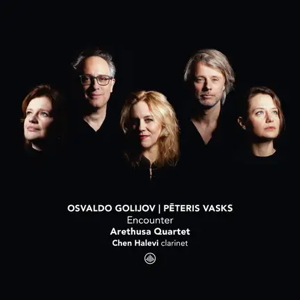
Encounter
Osvaldo Golijov (b. 1960)
The Dreams and Prayers of Isaac the Blind (1994)
Pēteris Vasks (b. 1946)
String Quartet No.6 (2019)
Chen Halevi (clarinet), Arethusa Quartet
rec. 2025, Studio 150 Bethlehemkerk, Amsterdam, The Netherlands
Challenge Classics CC720050 [60]
This disc brings together two works which have little in common, other than they each employ a string quartet and that in each case the players worked with the composer.
Osvaldo Golijov was born in Argentina of Jewish parents and was familiar with klezmer, tango and Jewish liturgical music as well as classical music as he grew up. He studied for a time in Israel and then in the United States, where he finally settled. He is currently composer in residence at the College of the Holy Cross, in Worcester, Massachusetts. His breakthrough came in 1994 with the first work here, a work for clarinet and string quartet with the title The Dreams and Prayers of Issac the Blind. This was a phenomernal success: there are at least a dozen recordings and here is another. It led to a number of important commissions and recordings, but later there were problems, though more recently Golijov has been composing again.
Isaac the blind was a twelfth century French Jewish rabbi, an authority on the Jewish mystical philosophy known as the Kabbalah. This work has three main movements, which Chen Halevi, the clarinettist here, associates respectively with Dreams, Prayers and Blindness and which the composer associated with three languages, Old Aramaic, Yiddish and Hebrew. There is also a Prelude and a Postlude, making five movements in all.
The clarinettist is required to play on instruments of different sizes, including a bass clarinet. The idiom of the clarinet wiritng derives a good deal from klezmer. Klezmer is the folk music of the Ashkenazi Jewish people of Central and Eastern Europe. There are characteristic ornaments, grace notes, slides and so on, and the music often uses the Phrygian mode. However, Golijov has not written a klezmer work, but drawn on the idiom in a similar way to how Brahms drew on gypsy music or Ravel and Stravinsky at one periood on jazz. The work is attractive, varied and compelling and it is not surprising it has had such a success.
Paired with this we have the first recording of the sixth string quartet by the Latvian Pteris Vasks. Vasks was one of the post-Soviet composers who was brought up under Soviet Communism but was later able to break free and develop his own idiom. Vasks owes something to Shostakovich but also to the minimalist school of Pärt, Kancheli and Silvestrov. He is particularly fond of string instruments and his best-known work is a violin concerto, Distant light, which has been recorded several times. I had not previously come across his string quartets, but they have all been recorded, and the sixth, which we have here, is the most recent and possibly the last, as Vasks is now eighty.
It is is four movements, each with a title. The whole is a review of a human life. It opens with Farewell, which begins with big gestures before turning to something more lyrical. The second and longest movement, Looking Back, is full of passion and intensity with constantly changing moods. The third movement, Leaving, is about dying, with a tender melody but ending with three blows representing death. Finally, Choral Encounters is a moment of transfiguration, represented by repeated quotations of the Heiliger Dankgesang from Beethoven’s string quartet in A minor, Op. 132.
The Arethusa Quartet is led by Daniel Rowland, who writes in the booklet of his friendships with Golijov and Vasks. They have also been playing Dreams and Prayers with Chan Halevi for many years. Their mastery of both scores is not in doubt, and the recording is excellent.
I should point out that there are many other recordings of Dreams and Prayers, if that is your interest, but that this appears to be the first of the Vasks sixth quartet, although it is not advertised as such. So, if you are collecting Vasks’ quartets, you will need this, but if your primary interest is Golijov, you have a wider choice.
Stephen Barber
Buying this recording via the link below generates revenue for MWI, which helps the site remain free













