
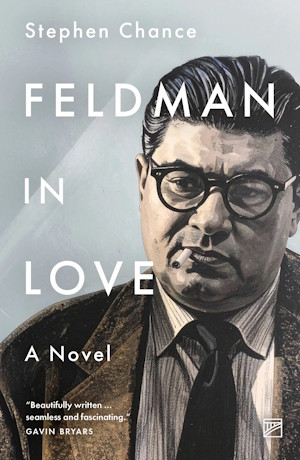
Feldman in Love
by Stephen Chance
Published 2026
262 pages, paperback
ISBN: 978-1-915606-71-6
Lendal Press
Possibly the most surprising thing to be issued in this Feldman centenary year is a novel. Stephen Chance’s Feldman in Love occupies the same territory of mixing fact and ‘emotional truth’ as Julian Barnes’s The Noise of Time (about Shostakovich) and Jean Echenoz’s Ravel. Of those two I think Echenoz was more successful — in French certainly — because of the voice. I don’t know that Echenoz’s Ravel in fact sounds like the composer did, but he made me believe so. Stephen Chance does the same. His deft, indirect third-person view of Feldman gives us someone plausibly larger than life, brusque and internally as well as externally gregarious. And the exchanges Chance gives to Feldman even in relatively inconsequential moments also have a wit that feels absolutely appropriate: ‘Good morning Mr Feldman. How are we feeling today?’ … ‘Still foolish, but “we”? Pass me my glasses and I will decide whether to be part of the collective noun’.
The book is centred around the relationship between Feldman and the artist Philip Guston and their twenty-year friendship between 1950 and 1970. Throughout this time both men become major figures in their chosen fields and Chance, highly imaginatively stepping back and forth between fact and surmise, gives an intellectually and emotionally satisfying portrayal of their relationship and their interaction with other figures in their milieu: John Cage, Lukas Foss, Robert Rauschenberg, Robert Hughes, amongst others. The friendship famously came to an end in 1970 when Feldman was confronted with Guston’s return to figurative art. The episode is an excellent example of Chance’s clever method. Feldman’s own telling of it is elliptical to a fault as I’ve written about in these pages before. Asked by Guston what he thought of a painting in the new style at a major exhibition in 1970, Feldman muttered, ‘Well, just let me look at it for another minute,’ and ‘with that’, he wrote, ‘our friendship was over’. In the novel, Chance builds an increasingly claustrophobic and gripping sequence. First, Feldman visits the warehouse where the new pictures are being stored with Hughes and can barely look at them. Chance has Hughes off pat: ‘Morty? You okay? You look pale… You weren’t expecting this, were you? From your old mate? This cartoonery. This Ku Klux Kommix’. Feldman excuses himself before Guston can see him. At the gallery opening Feldman fortifies himself with drink but has to face Guston who asks his opinion as the chapter’s closing cliffhanger. We then have another chapter of raw anguish ending with ‘just give me a minute’. The tension and Feldman’s distraught state are powerfully and palpably evoked.
The second part of the book is set in 1987. Feldman is in hospital, dying. With the benefit of a new interlocutor — a young doctor — Feldman is able to look back on the things we’ve experienced in the first half of the book. The elegiac tone introduces a new dynamic of reflectiveness whilst not losing Feldman’s essential chutzpah. It’s a wholly believable, always interesting sequence of conversations which anchors the novel. I should add that Chance has legitimately exploited the freedoms available to a novelist rather than a biographer and there are key gaps which would need to be filled if one were seeking a balanced portrayal. Above all Feldman’s relationships with women exist only in the margins here and there’s deliberately nothing about the Bunita Marcus allegations. I’ll also admit to being slightly baffled by the title. There’s no suggestion that the Guston/Feldman relationship is homoerotic or a ‘bromance’, and there’s no other human figure towards whom Feldman shows comparable affection in the book. Chance is too canny a writer to suggest that Feldman’s true emotions were reserved for his art. Misdirection, perhaps, or an ironic hint at discretion even? Chance’s epigraph from Feldman after all is ‘You have to be discreet. You cannot tell the whole story’.
Anyway, I enjoyed this book a lot. Its brevity and accessibility are deceptive in terms of the charge it carries. It’s sent me back to some of the music, and off to find out more about Guston. But above all, that thread of people, personalities and art is so skilfully woven to keep you thinking about relationships, creativity and the human cost for a long time afterwards.
Dominic Hartley
Availability: Lendall Press













