
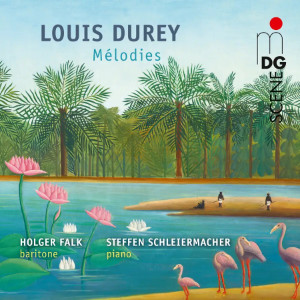
Louis Durey (1888-1979)
Mélodies
Holger Falk (baritone)
Steffen Schleiermacher (piano)
rec. 2024, Konzerthaus Abtei Marienmünster, Germany
Texts and translations provided
MDG 613 2357-2 [75]
Louis Durey is the least well-known member of the Groupe des Six and his music is still largely overlooked for various reasons. The first is that, although he befriended the other members of the Group, he quickly became estranged from them. His output, although fairly extensive, is mainly vocal includes little orchestral music – although there are a few orchestral works such as the Sinfonietta Op.105 for strings and the quite beautiful Octophonie for strings. He was an artist favouring short forms such as songs, piano and chamber music, including three string quartets. Secondly, and most importantly I think, was his left-wing inclination that eventually had him joining the French Communist party, whereas during the Second World War he had been active in the French Resistance. On the purely stylistic aspect, his music is of variable quality, to say the least, some going as far as describing it as uninspired or boring. I personally do not share such a dismissive approach. This all-too-severe appreciation of the music also most probably results from rare performances and from very few recordings of it, and is often easily brushed away when it is performed and recorded by musicians who believe in it as do those here.
I must admit that Durey was just a name to me, as a member of the Groupe des Six and as the one that always stood in some secluded corner of the picture. During the LP era, French Columbia released a two-disc set L’Album des Six conducted by Georges Tzipine with a spoken introduction by Jean Cocteau with one piece by Durey, his Le Printemps au fond de la mer Op.24 (1920) for soprano and wind instruments on a text by Cocteau. This set was reissued onto CD by EMI as Les Rarissimes de Georges Tzipine, hopefully still available and well worth looking for. I think that this must have been my very first contact with Durey’s music, as I had overlooked a Calliope release of some of his piano works beautifully played by Françoise Petit. Fortunately, this was reissued in CD format by Calliope (CAL 4815) and it too may still be available. Thus, this release under review is to be heartily welcomed – although mention must be made of another disc with almost identical content released by Hyperion (CDA 67527) with the French baritone François Le Roux and Graham Johnson, but I still have to hear it.
Le Bestiaire ou Cortège d’Orphée Op.17a is by far the longest work here, consisting of twenty-six very short poems which Durey sets as a series of colourful miniatures in turn funny, whimsical and slightly more serious. I will not go into too many details about the cycle, as the music speaks for itself. When Durey composed it, he was still much under Satie’s influence and aiming at simple expression, and both Poulenc and Durey composed song cycles on these poems apparently quite coincidentally. Poulenc, who dedicated his short song cycle to Louis Durey, eventually chose only six of Apolllinaire’s texts which he set for voice and small orchestra although the version for voice and piano is the most frequently heard nowadays. It is also worth noting that Louis Durey set Apollinaire’s “Zoo” almost complete in that he omitted the three somewhat longer poems to Orpheus; these are spoken by François Le Roux in the HYPERION disc mentioned earlier which is thus the most complete version available. Mention must also be made of a later version that Durey made for voice and orchestra in 1958 as Le Bestiaire Op.17b. This was once available on SNE-565-CD sung by mezzo-soprano Christine Lemelin accompanied by the Orchestre des Jeunes du Québec conducted by Michel Tabachnik. (This may now be a collector’s item but still well worth chasing for its most interesting programme.)
The various songs composed at about that time are all mostly influenced by the music of Satie but also by that of Ravel. This may be heard in the Six Madrigaux de Mallarmé Op.22a (1919) and is still more in evidence in the quite attractive and varied Epigrammes de Théocrite Op.13 and the Trois poèmes de Pétrone Op.15, though it is hard to imagine that by the time he composed these two short cycles he was under the spell of Satie’s Socrate in which there is hardly any music. Durey was also the first French composer to study the music of Arnold Schönberg, particularly Das Buch des Hängenden Gärten of 1909, but that was not to be reflected in his own music until a few years later; some of his piano works would bear the imprint of Schönberg’s music, but never systematically so. This may be heard, at least to a degree, in the Deux Lieder Romantiques Op.20 on poems by Heinrich Heine. The first song Mon Pâle visage exudes a claustrophobic feeling that one would not have associated with Durey up to that time. However, the Chansons Basques Op.23 on texts by Cocteau partly reflects Durey’s earlier manner. From the same period, too, are Inscriptions sur un Oranger Op.16 (1918) on two poems by Evariste Parny (1751-1814) who lived on the Island of La Réunion, then a French colony. Parny is considered as the first ever French poet of colour. (Later, Ravel also set words by Parny in his own Chansons Madécasses.) These two songs and their texts are intimately knitted together in that in the first song; the poet proudly tells of a love inscription that he carved into the bark of an orange tree and, in the second song, he wishes that he could undo it. This is mirrored in the music, too.
In the early 1930s, Durey set some rather enigmatic poems written in Frenc by Rilke: Vergers – Sept poèmes de Rilke Op.42 in which there is no trace of Satie’s music nor of Cocteau’s aesthetics. Durey’s music is as ambiguous as Rilke’s enigmatic poems. The whole makes for a rather puzzling, though quite appealing, song cycle.
Satie’s music exerted an important influence on Durey’s early output and the curious Hommage à Erik Satie on a rather surreal text by Blaise Cendrars is an example of the sort of circus aesthetics once favoured by Les Six. It is some sort of grotesque scena evoking the circus and elephants – and even Charlie Chaplin takes a bow. Nothing very serious, indeed, but some time later the song was turned almost unchanged into a piano piece now called Hommage à Poulenc because Durey had in the meantime fallen out with Satie.
Earlier in this review, I mentioned Durey’s left-wing leanings as one of the possible reasons for his music’s relative neglect and indeed he must have been one of the first Western composers ever to set Mao and Ho-chi-Minh to music. In these settings he obviously tried to write accessible, comprehensible music (as if his music was ever “difficult”) and his Deux Poèmes d’Ho-chi-Minh Op.69 (1951) are telling examples of him wasting his talent.
This generous survey of Louis Durey’s song output is most welcome, as his music is still too easily overlooked. The present performers are no strangers to this repertoire, as this is the fifth disc that they have devoted to the music of members of the Groupe des Six. Both actually do a very fine job with this music and, as a native French speaker, I may say that Holger Falk’s French pronunciation is very fine indeed. The whole is superbly produced with excellent recorded sound and with well-informed notes by Steffen Schleiermacher. Those who may possess their previous albums with songs by Auric, Honegger, Milhaud and Tailleferre will need no further commendation to prompt them to investigate and enjoy this one.
Hubert Culot
Buying this recording via the link below generates revenue for MWI, which helps the site remain free
Contents
Le Bestiaire ou Cortège d’Orphée Op.17a (1919)
Six Madrigaux de Mallarmé Op.22a (1919)
Vergers – Sept Poèmes de Rilke Op.42 (1931/2)
Epigrammes de Théocrite Op.13 (1918)
Trois Poèmes de Pétrone Op.15 (1918)
Hommage à Erik Satie (1918)
Chansons Basques Op.23 (1919)
Inscriptions sur un Oranger Op.16 (1918)
Deux Lieder Romantiques (Heinrich Heine) Op.20 (1919)
Deux Poèmes d’Ho-chi-Minh Op.69 (1951)













