
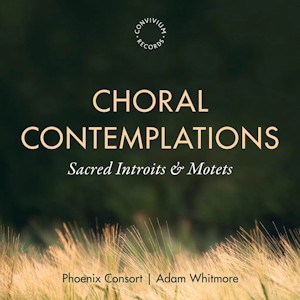
Choral Contemplations. Sacred Introits & Motets
Phoenix Consort/Adam Whitmore
rec. 2026, St John’s, Upper Northwood, London
Texts included
Convivium Records CR130 [50]
If, like me, you have not previously encountered the music of the nine composers whose works are featured on this album, there’s a reason for that: as Adrian Green explains in his useful notes, these composers, of whom he is one, “would never have considered themselves professional or ‘trained’ composers”. I think I’d be inclined to stress “professional” in the sense that, I presume, none of them has made their living through composition. I would caution, though, that it should not be thought that we are dealing with “amateur” composers here. All the pieces on this disc are the work of accomplished, sensitive musicians and people, moreover, who write very well for the human voice. As the title of the album suggests, the primary focus of the programme is sacred music with a contemplative nature, though there are one of two more lively compositions. Within that constraint, though – if constraint it be (I would argue it isn’t) – there’s a good deal of musical variety.
The programme gets off to a good start with Ask, seek, knock by Derek Saunders. The composer tells us that the music of this short introit “endeavours to reflect the sentiment that if the search is genuine then the result will be just and even-handed”. That’s a laudable aim and, listening, I felt the aim had been achieved. It’s a sincere and attractive piece, which would make an ideal Evensong introit. Later, we hear Saunders’ Be still, and know that I am God. The title of the piece functions as the only text and, if I’m honest, I think the setting is a little long; we hear those words a few times too often. That said, the music successfully conveys a sense of stillness.
The first offering from Adrian Green is O most merciful, an anthem originally conceived for men’s voices but here performed by SATB. I like the soothing homophonic writing but I think some of Green’s other pieces make an even stronger impression. One such is Every good gift which he wrote as a tribute after the death of his former headmaster. The structure is interesting. Green has taken some verses from the First Epistle of St James. These are first sung in Latin by a bass soloist; the music has the character of a free-flowing, wide-ranging chant and, though sung by a singer listed as a bass, it goes quite high – up into baritone territory – in places.. Then the choir sings the words, this time in English; their music is warm and homophonic and is elaborately decorated by the soloist. It’s a fine and most interesting piece. The solo part is challenging and Will Pate, a member of the Phoenix Consort, delivers it very well indeed. Just as impressive is Green’s The Absorbeat. This setting is founded on expressive melodic lines, very well clothed in equally expressive harmonies. For reasons he explains in the booklet, Green describes his piece as “a meditative musical patchwork”; I think he’s knitted together the strands of that patchwork very convincingly.
I liked David Fletcher’s approach to the text of Set me as a seal. Often, in my experience, settings of these words are meditative in nature but Fletcher introduces greater variety in response to words such as ‘vehement’; that provides useful contrast and gives extra interest to the music. His In Rama a voice is heard is for female voices (S&A) and, as befits the words, much of the composition is poignant in nature. At the end, however, the words take on a more optimistic vein and Fletcher catches that in his music. In contrast, his Sing we merrily is for male voices (T&B) and is lively and joyful.
Noel Skinner’s For the Fallen is interesting on several counts Originally conceived for children’s voices in two parts with organ accompaniment, it now appears in an a cappella SATB version by Matthew Coleridge. Fletcher selected two of the verses of Laurence Binyon’s famous 1914 poem. The concluding verse (‘They shall grow not old’) has been set by many composers but it’s more unusual to encounter a setting of the previous stanza (‘They went with songs to the battle’), though Elgar set this verse – and the poem in its entirety – in his deeply eloquent The Spirit of England. Skinner’s setting is touching, though I’m fairly sure that Coleridge’s harmonisation – and reborning for unaccompanied voices – enhances the piece. Skinner’s The earth is the Lord’s isa two-part (S&A) piece, which was only discovered after his death. The fresh-voiced singers of the Phoenix Consort present it very well.
I liked Rosemary Broadbent’s And he arose. It’s a succinct piece but very well crafted. Also notable is John-Paul Bowman’s Dum medium silentium. The hushed opening and closing music is impressive and contrasts well with the more forthright music that is, rightly, stimulated by the words ‘Thy almighty word’.
Though I haven’t mentioned every work specifically, that doesn’t mean those on which I haven’t commented are inferior. All the music on this programme is very well crafted, sincere in expression and well suited to the chosen texts. It’s very good that these pieces by less well-known composers have achieved a recording; I hope that will bring their work to wider attention.
I’m sure the composers would agree with my view that the music receives splendid advocacy from Adam Whitmore and the Phoenix Consort. Whitmore founded the ensemble while he was studying at Durham University but I infer from the booklet that subsequently the membership of the group has widened; they may not all be Durham alumni. That doesn’t matter; what does matter is that they make an excellent sound. Eighteen singers are involved (5/4/4/5) and I really like their singing. The tone is consistently fresh and clear, blend is excellent, as is their diction. It’s a very attractive, well-balanced sound; tuning and discipline are very good indeed. I’ve already referenced one soloist from within the group; five others have slightly less significant solos, all of which are done well. On the evidence of what I’ve heard here, Adam Whitmore has trained them very well.
The recordings were made by engineer Tom Mungall. He has captured the sound of the choir very faithfully in sound that is clear and which gives a nice sense of the acoustic of St John’s, Upper Northwood. Convivium’s documentation is very good and is set out with commendable clarity.
John Quinn
Availability: Convivium Records
Contents
Derek Saunders (b. 1966)
Ask, seek, knock (2015)
Adrian Green (b. 1985)
O most merciful (2012)
David Fletcher (1931-2024)
Set me as a seal (1993)
Noel Skinner (1947-2019) arr. Matthew Coleridge (b. 1980)
For the Fallen (1980s)
David Goymour (b. 1946)
O Oriens
John-Paul Bowman (b. 1985)
A new commandment (2019)
David Fletcher
In Rama a voice is heard (2008)
Rosemary Broadbent (b. 1950)
And he arose (2002)
David Fletcher
My beloved spake (1997)
Peter Blumsom (1942-2026)
What is man? (1971)Bruce Ramell (b. 1939)
To Cecilia (2022)
Adrian Green
The Absorbeat (Prayer of St Francis) (2020)
Derek Saunders
Be still, and know that I am God (2020)
Noel Skinner
The earth is the Lord’s
Adrian Green
Every good gift (2025)
Bruce Ramell
O Adonai
John-Paul Bowman
Dum medium silentium (2011)
David Fletcher
Sing we merrily (2021)
David Goymour
Lighten our darkness (2000)













