
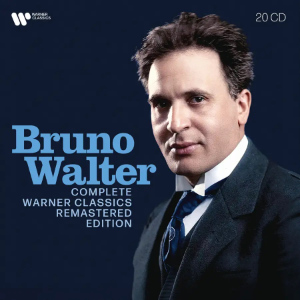
Bruno Walter (conductor)
Complete Warner Classics Remastered Edition
rec. 1924-49
Warner Classics 2173240890 [20 CDs]
Bruno Walter (1876–1962), while hardly unknown, receives less attention from record collectors than his younger contemporaries Otto Klemperer and Wilhelm Furtwängler. One reason might be that large portions of his discography have been scattered across releases by budget labels that do not always have access to the best sources. The present boxed set from Warner Classics makes this great conductor’s work of the 1920s and 1930s accessible in remastering that reveals more detail than I have ever heard in recordings of this vintage. These transfers have astonishing clarity and realism: surface noise, in most cases, has been minimised to such a degree that it is unobtrusive without compromising the musical signal. The mostly clean, lively mono sound reveals a culture of music-making from nearly a century ago that remains fresh and relevant, especially given that Walter shaped the early performance history of many of the compositions contained herein.
The sheer vitality of Walter’s performances contradicts stereotypes about Austro-German conductors and orchestras being ponderous and sluggish. Furtwängler and Hans Knappertsbusch were not representative of all conductors in the German-speaking countries. Recordings by Felix Weingartner, Richard Strauss, and Erich Kleiber, among others, reveal a diversity of interpretive styles. There is considerable propulsion and forward momentum throughout Walter’s repertoire. Walter’s tempi in the works of his friend and mentor Gustav Mahler are much swifter than subsequent generations of conductors adopted. Walter had a keen sense of pacing and drama; he evoked tenderness, lyric beauty, tension, and even terror when the music called for it. Even when I prefer other interpretations of certain works, each Walter performance is compelling and enjoyable.
The set opens with a rousing interpretation of Ludwig van Beethoven’s Violin Concerto in D Major, Op. 61, featuring Joseph Szigeti as the soloist and Joseph Joachim’s cadenza in the first movement. Pulsating drive makes the sprawling opening movement (Allegro ma non troppo) taut and purposeful. The Larghetto is touching without descending to sentimentality, and the finale (Rondo. Allegro) incorporates virtuosity into the musical tapestry. This performance equals other legendary interpretations, such as Wolfgang Schneiderhan’s 1962 stereo recording with Eugen Jochum conducting the Berlin Philharmonic, The Beethoven overtures comprising the remainder of the first disc receive similarly spirited readings.
The second CD contains a performance of Beethoven’s Piano Concerto No. 5 in E-Flat Major, Op. 73, with Walter Gieseking at the keyboard. From a stylistic perspective, Gieseking did not change much between the present version, recorded in 1934 with the Vienna Philharmonic, and his 1951 outing with the Philharmonia Orchestra, conducted by Herbert von Karajan, which I also reviewed for MWI. The most notable difference between these two recordings is that Walter emphasised the concerto’s lyricism, while Karajan brought out its structure and forward momentum with electrifying effect. A mellow performance of Beethoven’s Symphony No. 6 in F Major, Op. 68 ‘Pastoral’ prefigures the manner of his own 1958 stereo recording with the Columbia Symphony Orchestra and Karl Böhm’s with the Vienna Philharmonic (1971).
Some surprises appear on the third CD, such as concerti grossi by Arcangelo Corelli and George Frideric Handel, both of which are sufficiently transparent for the counterpoint to be heard distinctly. Hector Berlioz’s Symphonie fantastique benefits from detailed sound and passionate, committed playing by L’Orchestre de la Société des concerts du Conservatoire.
Johannes Brahms’s Symphonies Nos. 1, 3, and 4 and the Academic Festival Overture were contemporary music from Walter’s childhood. Along with the recordings conducted by Felix Weingartner and Arturo Toscanini, Walter’s accounts derive from direct contact with performing conventions during the composer’s lifetime. (Weingartner, whose interpretations resembled Walter’s in their steady, forward momentum, received Brahms’s approval after a concert in 1895 featuring the Symphony No. 2.) All three conductors chose vigorous tempi, clean orchestral textures, and minimal vibrato. My hypothesis is that some conductors from the following generation slowed down the music and added sonic weight. Recent historically-informed recordings are, in some respects, influenced by Weingartner, Toscanini, and Walter.
Four Haydn symphonies (Nos. 86, 92, 96, and 100) illuminate Walter’s approach to late 18th-century music. He employed lithe tempi, pellucid textures, and, it seems, reduced orchestral forces. These recordings anticipated what became standard mid-20th-century Haydn performance practice, exemplified by Antal Doráti.
Walter’s performances of Mahler’s Das Lied von der Erde and Ninth Symphony, two works that he premiered in 1911 and 1912, respectively, are as ‘authentic’ as possible. (N.B.: I am aware that a conductor’s interpretation can change over time. The performances preserved here are not necessarily identical to those he directed over twenty years earlier.) The impressive amount of detail captured in these sound documents from Vienna’s Musikverein in 1936 and 1938 enables comparison with Otto Klemperer’s 1960s recordings. Of all the conductors who went on to make recordings, Walter, Klemperer, Willem Mengelberg, Carl Schuricht, and Oskar Fried had the closest relationships with Mahler. Walter opted for swift tempi and warm lyricism; Klemperer made every detail distinct through laser-like precision and gaunt textures. Artistic rivalry yielded two distinct interpretations that both originated from extended contact with Mahler himself.
Walter’s Das Lied von der Erde derives from a live performance at the Vienna Musikverein in 1936. The music-making has honesty, integrity, and spirituality, properties that stem from Walter’s conducting as well as from the fact that this is an unedited broadcast transcription of a real concert. The recording is much more than a souvenir by a conductor who knew the composer, although this circumstance is vital to understand the music in its original cultural context. This is a great performance that rivals Walter’s two subsequent studio versions and that by Klemperer. Contralto Kerstin Thorborg sang with affinity for the text, particularly in ‘Der Abschied’, where she seemed to embody the words she was narrating. Tenor Charles Kullman projected his three songs ardently and with conviction, rivalling Fritz Wunderlich in Klemperer’s recording. The Vienna Philharmonic infused the score with intimacy and a sense that individual and small groups of instruments took turns playing prominent roles, except in a few tuttis in which the entire ensemble displayed its power.
Walter’s 1938 live recording of Mahler’s Symphony No. 9 with the Vienna Philharmonic is poignant and searingly intense, with a rustic quality in the Ländler. The brisk final Adagio, which lasts just over 18 minutes, is a virtue: it eschews sentimentality and creates a strong sense of coherence. Although Walter’s 1961 reading of this movement with the Columbia Symphony is just over 21 minutes, his tempo remained swifter than those preferred by later generations. Klemperer took about 24 minutes in 1967; Karajan stretched this movement to nearly 27 minutes in 1982; and Leonard Bernstein pushed the timing to nearly 30 minutes in 1985. This brief survey illustrates the general tendency to reduce the tempo more than Walter did. The first movement (Andante comodo) has an aching, nostalgic string tone; the second movement (Ländler) is coarse and bucolic; the Rondo-Burleske is ferocious and bitter; and the Adagio flows toward a peaceful farewell.
Despite its sonic limitations, this is my favourite performance of Mahler’s Ninth Symphony because it situates the work in early twentieth-century Vienna, the musical environment in which it was conceived. Walter’s light touch also reveals how the spirit of Johann Strauss II pervades the first and third movements of this symphony. The unsentimental reading is redolent of how Richard Strauss conducted his own music and a precursor to Karl Böhm’s 1953 recording of Strauss’s Vier letzte Lieder, with Lisa della Casa as the soprano soloist.As with Böhm’s Strauss, Walter’s Mahler suggests that treacly, maudlin versions by later conductors do not reflect how these two composers understood their own music.
The contralto Kathleen Ferrier delivered what may be the definitive renditions of Mahler’s Kindertotenlieder with the Vienna Philharmonic in 1949. Walter conducted with emotional intensity but never indulged in sentimentality, an approach consistent with the content of Friedrich Rückert’s poems. Rückert lived during a time in which infant mortality was a sad but common reality. I must invoke Johann Sebastian Bach because I detect a connection between his cantatas dealing with death and Mahler’s settings of Rückert’s poems. Bach and Mahler confronted loss with a sense that death was the inevitable end of life and, perhaps, the beginning of something better. Resignation permeates Ferrier’s voice throughout this five-song cycle. It is tempting to speculate that she had a premonition of her own early demise here and in her 1952 recording of Das Lied von der Erde for Decca with the same orchestra and conductor. Ferrier’s clear, idiomatic German diction attests to her high artistic standards. It is easy to understand why Walter held her in high esteem.
Although it is odd to find it on the same disc with Mahler, a 1937 live performance of Giovanni Pierluigi da Palestrina’s Stabat Mater demonstrates the breadth of Walter’s repertoire and his interpretive versatility. Purists may cringe at hearing the Chor der Wiener Staatsoper perform Renaissance ecclesiastical music, but I find it moving and, given the concert setting, fitting for an opera choir to sing after its powerful account of Anton Bruckner’s Te Deum.
In a range of Mozart opera overtures, two performances of the serenade Eine kleine Nachtmusik, the D minor Piano Concerto, the Requiem, and Symphonies K. 504, K. 543, K. 550, and K. 551, Walter took crisp, nuanced tempi and conjured mellifluous sounds from the orchestras. Of particular interest is the Piano Concerto, which Walter directed from the keyboard with profound melancholy. Walter deemed his recording of the Requiem, probably the earliest of the work, unfit for publication. There are too many instances of rough ensemble playing and uneven contributions from the soloists for this live recording to merit serious recommendation. Regrettably shorn of all their repeats, the performances of the symphonies and Eine kleine Nachtmusik are elegant, with immense emotional depth in the G minor, K. 550, and buoyancy in the C Major, K. 551.
Walter’s mastery of the ‘Wiener Klassik’ is further in evidence through his performances of Franz Schubert’s Symphony No. 8 in B minor D. 759, Symphony No 9 in C Major D. 944, and two selections from the ballet music for Rosamunde Op. 26 D. 797. Spaciousness and gravity take precedence over drama in the symphonies. The ‘Unfinished’ B minor Symphony opens with dark, atmospheric mystery that builds towards powerful climaxes, while the second movement is reflective and has a relaxed singing line. Similarly broad and stately is the C Major Symphony, which features rich string playing and autumnal serenity.
As much as I enjoy Robert Schumann’s D minor symphony, Op. 120, having two similar recordings of the work on the same CD, with only Bedřich Smetana’s Bartered Bride overture separating them, is not ideal sequencing. Given Walter’s vast repertoire, it is a pity that he did not record something else (e.g., another Haydn symphony) in lieu of the duplication.
The selection of Johann Strauss II overtures and waltzes is an unalloyed joy because Walter imbued these works with grace, fluidity, and rich, rounded sonorities. A welcome contrast to Clemens Krauss and Karl Böhm, Walter brought humanism, flowing lines and transparent textures to tone poems by Richard Strauss. Krauss and Böhm, who had long-standing working relationships with Strauss, tended to prioritise raw, visceral theatricality and, occasionally, abrasiveness. Like Mahler, Strauss can be interpreted in multiple ways, so Walter’s readings provide an alternative perspective, which dates to the composer’s lifetime.
Apart from a second performance of Weber’s overture to Der Freischütz, the remainder of the set is devoted to Richard Wagner. The legendary, thrilling first act, supplemented by two scenes from the second act, of Die Walküre from Vienna in June 1935 is a bracing reminder of the challenges surrounding the recording process in that era. The virile tenor Lauritz Melchior (Siegmund) and the soprano Lotte Lehmann (Sieglinde) portrayed passionate siblings and incestuous lovers. The bass Emanuel List delivered a frightening Hunding, whose presence heightens the tension and motivates Siegmund and Sieglinde to continue bonding. Walter’s fluid conducting paces the action masterfully and reveals a wealth of orchestral colour and detail (e.g., themes, expressive solos and motives). Walter was supreme in moulding phrases, balancing the orchestra, tempo relationships, and enabling the singers to be heard clearly without straining. It is regrettable that Decca did not commission him to direct the whole Der Ring des Nibelungen while he was in Vienna in the early 1950s.
Recordings of instrumental opera paraphrases and overtures offer glimpses of how Wagner’s music sounded before becoming popular concert hall fare. Refreshingly free of bombast, Walter provided thoughtful readings in which melodies and ideas merge into an organic whole. If there is any fault with this set, it is the presence of four recordings of the Siegfried-Idyll and three of Siegfrieds Rheinfahrt that are not easy to distinguish from each other, apart from variations in the recording quality. Otherwise, this collection of Wagner excerpts is among the most attractive ever made; its main competition is Klemperer’s from the 1960s.
To sum up, this boxed set epitomises what a historical issue should be: the remastering brings even the acoustic recordings to life, making Walter’s achievements accessible. With hindsight, it is unfortunate that he did not record more Mahler because he was a primary living link to this composer. Nonetheless, audio productions of large-scale works were impractical before the advent of magnetic tape and long-playing records. Walter and his orchestras’ achievements are particularly noteworthy because shellac recordings could not be edited. This Warner Classics release enables us to enjoy these historic recordings with a level of fidelity and convenience that was elusive to the original intended audiences, who had to purchase massive stacks of delicate 78 RPM records and listen with disruptive side changes every four to five minutes.
Daniel Floyd
Buying this recording via the link below generates revenue for MWI, which helps the site remain free

Contents
Disc 1: Ludwig van Beethoven
Violin Concerto in D Major, Op. 61
Die Geschöpfe des Prometheus, Op. 43: Overture
Fidelio, Op. 72: Overture
Leonore Overture No. 3, Op. 72b
Coriolan Overture, Op. 62
Disc 2: Ludwig van Beethoven
Piano Concerto No. 5 in E-Flat Major, Op. 73 “Emperor”
Symphony No. 6 in F Major, Op. 68 “Pastoral”
Disc 3
Felix Mendelssohn: A Midsummer Night’s Dream, Op 61, No 7: Nocturne
Hector Berlioz: La Damnation De Faust: “Menuet des follets”
Hector Berlioz Symphonie fantastique Op 14
Arcangelo Corelli: Concerto grosso In G minor, Op 6, No 8: “Fatto per la notte di Natale”
George Frideric Handel: Concerto grosso In B Minor, Op. 6, No. 12
Disc 4: Johannes Brahms
Symphony No. 1 in C Minor, Op. 68
Symphony No. 3 in F Major, Op. 90
Academic Festival Overture, Op 80
Disc 5
Johannes Brahms: Symphony No. 4 in E Minor, Op. 98
Carl Maria von Weber: Der Freischütz: Overture
Franz Joseph Haydn: Symphony No. 92 in G Major, Hob. I:92: “Oxford”
Disc 6: Franz Joseph Haydn
Symphony No. 86 in D Major, Hob. I:86
Symphony No. 96 in D Major, Hob. I:96: “The Miracle”
Symphony No. 100 in G Major, Hob. I:100: “Military”
Disc 7: Gustav Mahler
Das Lied von der Erde
Rückert-Lieder: No. 3, “Ich bin der Welt abhanden gekommen”
Disc 8: Gustav Mahler
Symphony No. 5 in C-Sharp minor: IV. Adagietto. Sehr langsam
Symphony No. 9 in D Major
Disc 9
Gustav Mahler: Kindertotenlieder
Anton Bruckner: Te Deum
Giovanni Pierluigi da Palestrina: Stabat Mater
Disc 10: Wolfgang Amadeus Mozart
Die Zauberflöte, K. 620: Overture
Le nozze di Figaro, K. 492: Overture
Symphony No. 40 in G Minor, K. 550
Serenade No. 13 in G Major, K. 525: Eine kleine Nachtmusik
Le nozze di Figaro, K. 492: Overture
Symphony No. 39 in E-Flat Major, K. 543
Disc 11: Wolfgang Amadeus Mozart
Serenade No. 13 in G Major, K. 525: Eine kleine Nachtmusik
Symphony No. 38 in D Major, K. 504 “Prague”
Mozart: 3 German Dances, K. 605
Piano Concerto No. 20 in D Minor, K. 466
La finta giardiniera, K. 196: Overture
La clemenza di Tito, KV 621: Overture
Disc 12: Wolfgang Amadeus Mozart
Requiem in D Minor K 626
Symphony No 41 in C Major K 551
Disc 13: Franz Schubert
Symphony No. 8 in B minor D. 759
Rosamunde Op. 26 D. 797 Ballet music 1 and 2
Symphony No 9 in C Major D. 944
Disc 14
Robert Schumann: Symphony No 4 in D Minor Op 120
Bedřich Smetana: The Bartered Bride: Overture
Robert Schumann: Symphony No 4 in D Minor Op 120
Disc 15: Johann Strauss II
Die Fledermaus: Overture
Wiener Blut
Der Zigeunerbaron: Overture
G’schichten aus dem Wienerwald
Rosen aus dem Suden
Kaiser-Walzer
Die Fledermaus: Overture
Der Zigeunerbaron: Overture
Disc 16: Richard Strauss
Tod und Verklärung
Don Juan
Salome: “Der Tanz der sieben Schleier”
Potpourri aus den Walzen des Rosenkavaliers
Der Rosenkavalier: Act 2 “Da Lieg’ Ich”
Disc 17
Carl Maria von Weber: Der Freischütz: Overture
Richard Wagner: Siegfried-Idyll
Richard Wagner: Götterdämmerung: Siegfrieds Rheinfahrt
Richard Wagner: Die Meistersinger von Nürnberg, Act 3: Vorspiel
Richard Wagner: Tristan und Isolde, Act 3: Isoldes Liebestod
Richard Wagner: Parsifal Act 1 Vorspiel
Richard Wagner: Parsifal Act 1 Verwandlungsmusik
Richard Wagner: Parsifal Act 2 Klingsors Zaubergarten
Disc 18: Richard Wagner
Tannhauser Act 1 Venusberg
Rienzi: Ouverture
Der Fliegende Hollander: Ouverture
Siegfried-Idyll
Lohengrin Act 3 Vorspiel
Parsifal Act 3 Vorspiel
Parsifal Act 1 Verwandlungsmusik
Götterdämmerung: Siegfrieds Rheinfahrt
Disc 19: Richard Wagner
Siegfried-Idyll
Götterdämmerung Act 3 Scene 2 Siegfrieds Trauermarsch
Die Meistersinger Von Nürnberg Act 1 Vorspiel
Die Meistersinger Von Nürnberg Act 3 Vorspiel
Die Meistersinger Von Nürnberg Act 3 Tanz der Lehrbuben
Götterdämmerung: Siegfrieds Rheinfahrt
Siegfried-Idyll
Disc 20: Richard Wagner
Die Walküre Act 1
Die Walküre Act 2 (Scenes 3 and 5)













