
Ernest Bloch (1880-1959)
Violin Sonata No.2 ‘Poème mystique’ (1924)
Baal Shem – Three Pictures of Chassidic Life (1923)
Suite for Solo Violin No.1 (1958)
Violin Sonata No.1 (1920)
Boris Brovtsyn (violin)
Diana Ketler (piano)
rec. 2025, Jesus-Christus-Kirche, Berlin
Naxos 8.574728 [74]
Spectrum Concerts Berlin is a flexible chamber music collective under the artistic directorship of Frank S. Dodge. A quick look at their website reveals for their upcoming 2027 season a core group of some dozen players covering strings and piano. The repertoire for these five concerts in the Kammermusiksaal der Philharmonie reflects this flexibility and results in some genuinely fascinating programming. But “fascinating programming” could equally apply to Spectrum Concerts’ discography as well. Indeed, such is the quality of the playing and the interest in the repertoire of their releases – mainly on Naxos – that these discs have become an automatic listen for me regardless of content. The Korngold and Schulhoff collections are particular favourites.
This disc of Ernest Bloch’s violin and piano music is every bit as compelling in terms of repertoire and performance. The generous programme is a good overview of his works for violin. “Complete” surveys run to two discs with roughly two hours of music. The only larger works missing from this recital are the Suite No.2 for Solo Violin and the Suite Hébraïque. Bloch’s music is a fascinating amalgam of styles and influences. Born in Switzerland, he grew up in an observant Jewish family. He had enough promise on the violin to study with Eugène Ysaÿe in Brussels. He showed his peripatetic nature by travels around Europe. To quote Wikipedia: “moving to Germany (where he studied composition from 1900 to 1901 with Iwan Knorr at the Hoch Conservatory in Frankfurt), on to Paris in 1903 and back to Geneva before settling in the United States in 1916, taking US citizenship in 1924”.
The actual music also evolves and changes with Bloch’s travels and with passing years. It moves from high Romanticism to angular modernism, deep engagement with Hebrew melodies and traditions and even some New World musical vernacular. Then, at the very end of his life, the two Suites for Solo Violin– his last compositions – turn for direct inspiration right back to every violinist’s bible, Bach’s Sonatas and Partitas for unaccompanied violin.
This programme touches on most of those diverse styles. Violinist Boris Brovtsyn contributes a personal note to the booklet: “I remain amazed at how different they are from one another – the aggression and blunt force of the First Sonata, the religious ecstasy and eroticism of the Poème mystique, the neo-Classical rigidity of the Suite, the raw pain of the Baal Shem – and yet how there seems to be a common thread, that of a restless soul always bursting with creativity and unbridled passion.” Pianist Diana Ketler follows this up: “The music of the sonatas is filled with abundant joy, uncanny, destructive forcefulness, and a longing that can never be requited. All of life sweeps past in their magnificent climaxes. And then the Baal Shem suite: universal sadness, and – as a conclusion – Simchas Torah. All the sorrow of this world is forgotten, only hope and faith remain.” If these comments tell us how the performers are deeply engaged and moved by the music they play, well, that is exactly how it sounds.
I was slightly surprised to realise that, except for the famous Baal Shem, I have not heard the other works here. They have come as something of a revelation, especially in performances as technically fine and musically committed as here. Both players have the virtuosic resources these demanding scores require but at the same time there is expressive range and intensity. Brovstyn is a superb player who seems completely at ease with the wide stylistic range this music requires. Bloch’s writing for violin requires a true virtuoso but, no surprise for a composer who himself was a fine player, there is a clear understanding of what the violin can achieve.
Sometimes, as in the Violin Sonata No.1(placed last in this recital), this results in brutal, almost barbaric writing, the opposite extreme of the poised precipitous visionary writing of Baal Shem. By the time Bloch came to write this sonata, he had settled in America and had just been appointed the first director of the newly founded Cleveland Institute of Music. Interestingly this big thirty-minute work does not contain explicit references to his Hebrew culture. His best-known work, Schelomo,had received two of its earliest performances the year before in San Francisco. But the liner notes quote the composer “processing in it the experiences from the recently ended ‘terrible war’ and the subsequent, in some ways no less ‘terrible peace’” as motivation for the sonata. The notes also observe a certain musical kinship to Bártok in Bloch’s use of scales that do not conform to the usual combination of whole and half steps, and in the pounding, almost primal use of rhythm. The central Molto quieto is all pensive twilight and haunted nightscapes. Again the parallel with Bártokian night-pictures is notable.
Here and throughout the disc, the excellence of the engineering of this disc (recorded in Berlin’s famous Jesus-Christus-Kirche) allows every nuance of Brovtsyn’s and Ketler’s playing to register. The balance between the two instruments – where the writing for both is dense and demanding – is managed very well indeed. The closing, heavily stamping Moderato displays more of the musical and technical excellence. Perhaps unexpectedly, after a near half hour of passion and power, the sonata evaporates into the simplest of consonant chords.
Fast forward just four years for the couldn’t-be-more-different one-movement Violin Sonata No.2 ‘Poeme Mystique’ (placed first on this disc). The solo violin opening is just ravishing and sweetly played by Brovstyn. Bloch described the work as “the world we dream of, full of idealism, faith, passion, hope, where Jewish themes stand side by side with the Gregorian chants of the Credo and Gloria”. He had the Latin texts of the latter printed above the music where they occur. Here, then, there can be no doubt as to the composer’s intent. I must admit this work has rather bowled me over. Again, for all its technical demands on the players, there is a strong sense of “rightness” for the violin, and Bloch mines all the range and potential of the instrument. His enduring fame does seem to rest almost exclusively on his explicitly Jewish-heritage works. This work touches on that through its use motifs and modal scales but this should surely be far better known than it appears to be.
Baal Shem – Three Pictures of Chassidic Life clearly belong to that body of familiar works. Again it is interesting to realise that Bloch wrote this set of three strongly characterised pieces just a year before the utterly different sonata just discussed. The central panel Nigun (melody)is probably Bloch’s single most famous violin work, which most aspiring violinists will bash through at some point. Such was its popularity that the entire suite was orchestrated some sixteen years after it appeared in the original violin and piano form. Brovstyn and Ketler give as impressive a performance of the entire work as I have heard. They find the perfect balance between heart-on-sleeve passionate intensity and total technical control. In isolation, this is a superb version, but it is all the more interesting for the stylistic contrast within the entire programme.
Nowhere is this clearer than in the Suite No.1 for solo violin (placed after Baal Shem). I mentioned earlier the Bach solo violin works which have inspired and daunted composers ever since they were written. Bloch’s violin teacher Ysaÿe found his own unique and wonderful response in the form of his six solo sonatas, which make a passing nod at Bach. Bloch’s Suite, however, is a remarkably successful 20th-century take on the style and aesthetic of the original works. The four movements run to a compact interconnected 9:15 in this performance.
Yehudi Menhuin commissioned Bloch to write the pair of solo suites. It is interesting to note that at the end of his life Bloch wrote three solo cello suites and an incomplete solo viola suite. Once more, and I hang my head in shame, I have never heard those remarkable works before. The spirit of Bach is clear and present but refracted through a 20th-century lens with a clear debt of gratitude towards Ysaÿe. Brovstyn’s performance is every bit as assured and authoritative as one has come to expect by now. I can only sit and admire the total control of line and phrase that is so vital in this work and by extension in the seminal Bach they sprung from.
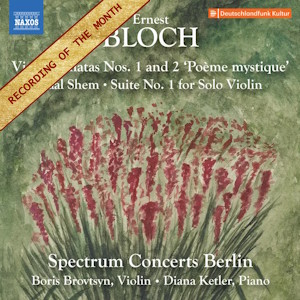
I was expecting to enjoy, or at least be interested in, this disc because of the calibre of previous Spectrum Concerts Berlin releases, but this has gone way beyond such measured considerations. This exceptionally fine collection celebrates revelatory performances of excitingly fine repertoire beautifully recorded. In essence, here is the textbook definition of a Recording of the Year in waiting. Even the disc cover provides an extra delight: a charming watercolour painted by the composer. This is very, very good – a must-hear for devotees of the violin or this composer.
Nick Barnard
Buying this recording via the link below generates revenue for MWI, which helps the site remain free













