
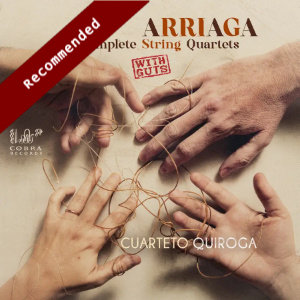
Juan Crisóstomo de Arriaga (1806-1826)
Complete String Quartets (1822)
Cuarteto Quiroga
rec. 2025, WestVest90 Church, Schiedam, The Netherlands
Cobra Records COBRA 0101 [77]
The Spaniard Juan Crisóstomo Arriaga, like the Belgian Guillaume Lekeu, the Austrian Hans Rott, the Englishman George Butterworth and the Frenchwoman Lili Boulanger, is one of the great might-have-beens of music, They all had considerable achievement and great promise but died before their promise could be fulfilled, and in each case we are left with a mere handful of works.
Arriaga was a child prodigy. His father, recognising his talent, sent him to Paris, where he studied under Cherubini among others and made an excellent impression. However, he died at the age of nineteen. He left a number of compositions, some of which have been lost. Of those which survive, the most important are his Symphony in D major and minor, and these three string quartets. He wrote them at the age of sixteen, which puts him in the company of the youthful Mozart and Mendelssohn for precocity.
The influences on these quartets are, as you would expect, Haydn, Mozart and early Beethoven. However, he also has a vein of lilting lyrical second subjects, which sound to me as if he had been listening to Schubert. The slow movement of the first quartet also sounds Schubertian to me. The three quartets are all relatively similar in structure. The first movements are in sonata form, with strong Haydnesque first subjects. In the case of the third quartet, the second subject is a variant of the first, rather as in some of Haydn’s monothematic movements. The first quartet has an argumentative development in Beethoven’s manner, and the third also has a strong and adventurous development section.
The second movements are in each case slow ones, with that in the second quartet being a theme and variations. That in the third quartet is marked Pastorale and has a storm in the middle section – Beethoven’s Pastoral Symphony being the obvius precursor.
The third movements, though marked Menuetto in the first two quartets, are really scherzos, with that in the third quartet being quite like a Beethoven scherzo with its rhythmic displacements.
The finales of the first two quartets are rondos, while that of the third is in sonata form, again with a Schubertian second subject.
The thematic material is throughout interesting, attractive and varied. These quartets are not impressive given that the composer was sixteen, but impressive by any standards. They are a remarkable achievement, and Arriaga’s early death a great loss.
The Cuarteto Quiroga have been playing together since 2003 and have been playing these quartets for over twenty years. They know the works through and through. They play with fire and precision, and convey their enthusiasm for these works. The recording is excellent.
There have been other recordings of these quartets, though most are now only available as downloads. I cherish a version by the eponymous Arriaga Quartet on the late lamented ASV label, but for those wanting to add these quartets to their collection, this new version will do very nicely. I urge you to do so, if you care for quartets at all: they are really remarkable.
Stephen Barber
Buying this recording via the link below generates revenue for MWI, which helps the site remain free














