
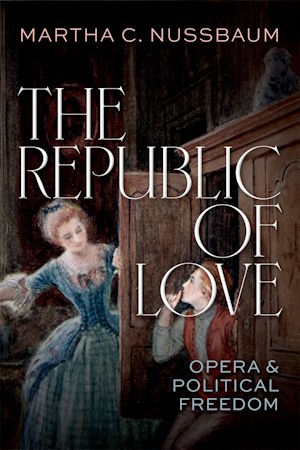
The Republic of Love. Opera and Political Freedom
by Martha Nussbaum
Published 2026
392 pages, hardback
ISBN: 9780197812556
Oxford University Press
As a Professor of Law and Ethics at the University of Chicago, Martha C. Nussbaum has long understood that students of jurisprudence need a grasp of political philosophy to add depth and context to their understanding. It turns out that she thinks opera studies could do with a smattering of it too. Accordingly, she’s produced a compelling account of the riches to be found in the intersection of opera and political thought. Her book is called The Republic of Love, and it’s predicated upon the Enlightenment and the greatest composer of that age, Mozart.
How Mozart interacted with the thinking of his time is not new ground, of course. Nicholas Till in his book, Mozart and the Enlightenment, has written informatively about how eighteenth-century thinking shaped Mozart and in particular how it enabled him to write the operas on the themes he did. Till is a cultural historian and his book is a model of the genre. Nussbaum is a philosopher and her thesis is bolder. Mozart, she argues, was a philosopher in his own right. He saw that however laudable many Enlightenment notions were, they were bound by the principles of rationality and remained essentially cold. In Nussbaum’s words they lacked ‘a politics of the heart’: it wasn’t just politics and legal theory that needed reform, sentiment did too. Music, which can touch the emotions in a unique manner, could provide the vehicle. Imbued with Mozart’s compositional genius and shaped by his Freemasonic beliefs, opera in his hands became a powerful and influential heuristic medium for exploring human emotions and their relationship with political thought and freedom.
Nussbaum sets out her stall with reference to a number of Mozart’s operas: the Da Ponte trilogy plus Idomeneo, The Magic Flute, and La clemenza di Tito. I found especially refreshing her focus on what Mozart’s music is doing in each. This isn’t a conventional account of how the great composer brought life to the ideas of his librettists. Whilst she’s very good at showing how brilliantly Mozart used and shaped what she rightly describes as the ‘clunky’ libretti of the latter three operas named above (the triumph of love and reconciliation in Idomeneo; a very personal and principled take on Freemasonry in The Magic Flute; and the political and emotional force of mercy in La clemenza), she’s revelatory on the Da Ponte collaborations.
For a start, she casts Mozart as more radical than Beaumarchais in The Marriage of Figaro. Quite a claim, I thought, but she makes her case. Da Ponte’s libretto very much tones down Beaumarchais’s more radical outbursts, but arguably on paper, whilst witty and dramatically compelling, it lacks what Nussbaum calls an ‘emotional trajectory’. She shows very convincingly how Mozart’s music unerringly provides that. His vision of female-male relationships being built on reciprocity and informed much more than hitherto by a feminine perspective was radical for its time and underlined by the choices he made when setting Da Ponte’s words. Mozart’s music isn’t out of step with the libretto here, Nussbaum says, but gives it much-needed depth. She argues, though, that in both Don Giovanni and Così, Mozart’s music is at odds with Da Ponte’s dramaturgy. Talking about Don Giovanni, she pertinently goes from her chapter’s wittily chosen epigraph — part of Molly Bloom’s soliloquy in Ulysses reflecting on the emotional inadequacy of her lover, a character identified with Giovanni — to a quick dissection of the Don, ‘a really horrible person’, and from there to a demonstration of how Mozart’s music depicts the Don’s utter vacuity much more pointedly than Da Ponte’s libretto does. And her writing about the emotional journey of the three female characters showing how Mozart repudiates the revenge drama that Da Ponte wrote is equally insightful. She shows that in Mozart’s realisation these characters are far more than the ‘pawns’ clamouring for retribution strategically placed in the narrative by Da Ponte, but living, breathing, compassionate beings.
Nussbaum’s reading of Così shows an ever-widening crack in the famed composer/librettist collaboration as the opera proceeds. Da Ponte’s clever libretto is shot through with cynicism. Mozart increasingly refuses to accept it. Things come to a head in Act 2. Mozart’s profoundly emotional music simply refutes the scenario being conveyed on stage, which affirms that convention and social order will prevail. I’d long viewed this as an insuperable problem in the theatre, because the mismatch is so blatant, action and music so divergent. Nussbaum has made me realise that perhaps a bit like Shakespeare in Measure for Measure, Mozart wanted to make the ending profoundly upsetting by undermining the ‘correctness’ of the depicted outcome and the hypocrisy of a convention not rooted in emotional truth.
If The Republic of Love had ended there, it would have more than justified its place in the crowded literature on Mozart (and at nearly 150 pages would be of more than respectable monograph length) but the book has a second half. Nussbaum has chosen a selection of composers and operas whose preoccupations reflect and extend Mozart’s political philosophy. That doesn’t, of course, imply a particular musical convention or similarity. Rather she’s sought composers adopting the ‘republican tradition’ pioneered by Mozart so (a community sustained not by reason alone but by love, reciprocity, compassion and respect for individual freedom) to confront a world increasingly bleaker than the late eighteenth century. Her choices are fascinating. Beethoven’s Fidelio is illuminatingly paired with Jake Heggie’s Dead Man Walking in an extended discussion of revenge. Whilst revenge in both Mozart’s operas and Fidelio is essentially personally wrought, Nussbaum is acute on the philosophical differences of their composers: Mozart cherishes what she calls the ‘erotic core’ of daily life, Beethoven is much more aspirational and earnest. The result? Well, as she points out it’s hard to imagine a performance of The Marriage of Figaro as a response to the Russian invasion of Ukraine, whereas Fidelio has been legitimately presented as such at the Met and elsewhere. Heggie’s work is about state execution, political vengeance in other words. Nussbaum delivers a bravura scene-by-scene analysis revealing the ‘Mozartean territory’ the work initially inhabits and goes on to show how Heggie’s music necessarily extends its range. Where adopting the unconditional love shown by Mozart’s women might have been sufficient for one aspect of the ‘republic’, in the modern world it’s not enough, beautiful though it is. Hence the deeply emotional and spiritual journey Sister Helen and Joseph must make.
The misuse of institutional authority takes Nussbaum to Verdi’s Don Carlos as another example of the tradition. She’s very good on the Inquisitor scene, drawing a perceptive comparison with Stephen’s experience of the sermons at the retreat in A Portrait of the Artist as a Young Man (she knows her Joyce) and Philip’s in Don Carlos, where Verdi’s music allows us to experience what Philip is feeling and share his terror, outrage and shame.
Nixon in China is another perspicacious selection. Nussbaum’s theme in examining Adams’s opera is the search for peace and the opera’s demonstration that the successful outcome of such a quest depends on flawed individuals such as the ‘labile and unsteady’ Nixon. Interestingly, and rightly in my view, this chapter focuses on the collaborative elements which made the work a classic. A flawed classic perhaps. Nussbaum is engagingly forthright about some of the problems. The Act 2 ballet — something that Peter Sellars held out for — is a ‘disaster’ she feels: dramatically inappropriate and whose historical points are likely to be lost on modern audiences. She’s also surely right to criticise the puzzlingly thin characterisation of Henry Kissinger in the drama. But she’s equally acute on what works — take for example her analysis of Alice Goodman’s brilliant poetic writing in Pat Nixon’s Act 2 aria evoking what Nussbaum calls ‘a politics of compassion’.
Internal exile — estrangement within one’s own society — is a condition Nussbaum thinks Mozart never treated realistically, and it brings Peter Grimes and Jenůfa together, with Britten and Janáček shown as kindred spirits in this regard. As you would expect from someone who has already published a book on Britten, she’s very good on the composer’s skill at emotional animation — in Grimes centred on anxiety and aggressive anger — and on the psychological realism that depicts a society which stigmatises and persecutes irrationally. She also provides an excellent postscript on Albert Herring and discusses how its treatment of crowds and exclusion offers a more hopeful path after the bleakness of Grimes. Jenůfa and Laca too find hope after bleakness in their love for each other, effectively transcending societal convention. Anyone who has seen Jenůfa would surely agree with Nussbaum that Janáček’s music adds immeasurably to Preissová’s drama, providing ‘daring musical expression for ideas of surging love, unconditionality, and the transcendence of mere social forms’.
Nussbaum diverts from her tracing of an essentially positive tradition to consider the case of Wagner, and Die Meistersinger in particular. She’s devastating on the composer’s antisemitism and the nationalism pervading the opera which culminates in Hans Sachs’s famous warning at the end for Germans to be on their guard for foreign influences. And as you might expect from a professional philosopher, she handles Schopenhauer’s influence on Wagner with deftness and clarity. She calls Wagner the ‘arch-enemy’ of the Mozartean republic and nobody reading her chapter would argue. Intellectually, I found it slightly disappointing though. Die Meistersinger is the lowest of low-hanging fruit as a metonymic presentation of failings in Wagner’s art and thought, as Barrie Kosky brilliantly demonstrated at Bayreuth in 2017. At the risk of sounding ungrateful, Nussbaum taking on Tristan at length (she dismisses it in a throwaway sentence here) might have provided something more aligned with the thrilling originality of thought that pervades the rest of her book.
Where could a book infused with the spirit and tradition of a ‘republic’ founded on the exuberance, compassion and colourfulness of Mozart end but with Falstaff? Maybe it’s unfair of me to make it sound inevitable so I’ll just say I’m glad it does. Her chapter heading uses Boito’s description of what he and Verdi were creating, ‘pandemonium as bright as the sun and dizzying as a madhouse’: a wonderful summary of the characteristics of the ‘Mozartean republic’ whose tradition this closest of collaborations triumphantly maintains.
A secondary motif connecting human freedom with breath and singing is set out in the introduction and took root with me as I read. Any singer will attest that singing with others is an emotional experience. In these operas, where the atmosphere becomes repressive — the prisoners in Fidelio, for example, sing of how one can’t breathe properly in prison — emotions become stifled and the wider fabric of society damaged. It’s a notion that’s stayed with me since I finished the book, and it’s made me listen afresh: the ‘problem play’ aspect of Così; Albert Herring as the optimistic face of the coin whose reverse is Grimes. I’d urge any opera lover to explore Nussbaum’s lucid and stimulating book; it will make you hear again works you thought you knew. Most startling for me was returning yesterday to that most claustrophobic of dramas, Billy Budd, where Billy’s breath is literally taken from him.
Dominic Hartley
Buying this recording via the link below generates revenue for MWI, which helps the site remain free














