
Robert Schumann (1810-1856)
Violin Concerto in D minor, WoO. 23
Five Pieces in Folk Style for violin & piano, Op. 102
Three Romances for violin & piano, Op. 94
Clara Schumann (1819-1896)
Three Romances for violin & piano, Op. 22
Midori (violin)
Özgür Aydin (piano)
Festival Strings Lucerne/Daniel Dodds
rec. 2025, KKL Lucerne, Switzerland (concerto); Teldex Studios, Berlin (others)
Pentatone PTC5187496 [70]
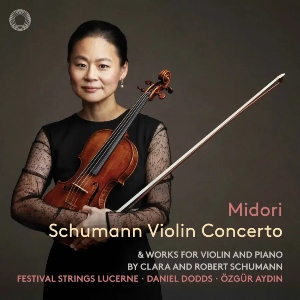
For her debut release on the Pentatone label, Japanese-born American violinist Midori has recorded Robert Schumann’s violin concerto. In addition, there are two sets of miniatures for violin and piano by Robert Schumann and one set by his wife, Clara Schumann, née Wieck.
An underrated work, Robert Schumann’s violin concerto in D minor, WoO. 23 (1853) still lingers in the shadows. After Schumann’s death in 1856, the violin virtuoso Joseph Joachim, for whom the concerto had been written, thought it a product of his deteriorating mental health and questioned its worth. Joachin together with Clara Schumann and Johannes Brahms, suppressed the score, thereby contributing to its long neglect. Few knew of its existence, and it remained unpublished for more than eighty years. Joachim had deposited the manuscript in the Prussian State Library, Berlin where it was eventually rediscovered. Several violinists sought to give the premiere, but the honour was awarded by the German authorities to Bremen-born Georg Kulenkampff, who introduced the concerto in 1937 with the Berlin Philharmonic under Karl Böhm. Despite numerous recordings, it has yet to gain an established place in the standard repertoire.
In the assured hands of Midori, the tone of the opening movement, with its two main themes, has a cautious vulnerability and is high on introspection. The long, flowing lines of the slow movement weep with a melancholy beauty. In the closing polonaise movement, Midori produces an energetic, dance-like quality and it is hard to fault the Festival Strings Lucerne under Daiel Dodds; they are most sympathetic to Midori’s playing and clearly relish every note of the music.
The year 1849 was most productive for Robert Schumann; he wrote both his Five Pieces in Folk Style for cello and piano, Op. 102 and the Three Romances for oboe and piano, Op. 94. Midori plays both sets using alternate parts for the violin.
The Five Pieces is an attractive set of contrasting miniatures. In the first piece, marked Mit Humor (With humour), Midori and Aydin underline the explicitly folk-like, bucolic character. Number two Langsam (Slow) is calm like a lullaby on the surface with tender introspection underneath. The third, marked Nicht schnell, mit viel Ton zu spielen (To be played not fast, with a full tone), sounds serious with a brooding quality. In the fourth piece, Nicht zu rasch (Not too fast), Özgür Aydin’s percussive accompaniment combines well with Midori’s robust and expressive playing. The concluding piece, Stark und markiert (Strong and well-defined), is striking, played by the duo with determination and vitality.
The first of the Three Romances, Op. 94 marked Nicht schnell (not fast), opens rather seriously and develops into an increasingly peaceful mood. Mainly calm and agreeable in character, the middle piece Einfach, innig (simple, heartfelt) contains a squally central section. Closing the set, the mostly vibrant and optimistic third movement, Nicht schnell,sees Midori and Aydin savouring the shifts of mood.
Midori closes the album with the set of Three Romances, Op. 22 for violin and piano by Clara Schumann, née Wieck. A child prodigy, Clara became a distinguished concert pianist, and her compositions are becoming increasingly performed. Clara dedicated the Three Romances, written in 1853, to violin virtuoso Joseph Joachim.
The opening Romance marked Andante molto is both lyrical and melancholy in character.
Marked Allegretto the central movement, itis unusual for its irregular rhythms, splendidly played by the partnership. Concluding the set, is the piece marked Leidenschaftlich schnell (passionately fast). It’s a denser, pulsating and more melodic piece that holds no fear for Midori and Aydin. Throughout the works, they are a stalwart partnership, highly committed, with no shortage of sincere expression.
The Pentatone recording teams achieve first-rate sound in both locations used here. This is a rewarding album; nothing seems forced and Midori’s playing is impeccably stylish, enriched by a varied tonal palette.
Michael Cookson
Buying this recording via the link below generates revenue for MWI, which helps the site remain free













