
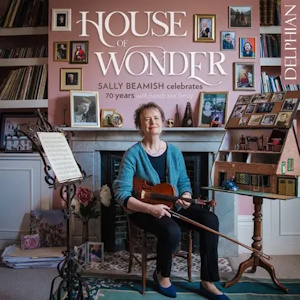
House of Wonder: Sally Beamish celebrates 70 years with friends and family
Sally Beamish and Rosalind Ventris (violas)
Ryan Corbett (accordion), Joseph Havlat (piano), Stephanie Irvine (lever harp and voice), Peter Thomson (speaker), Imogen Whitehead (trumpet)
rec. 2024, The Menuhin Hall, Cobham, UK
Delphian DCD34333 [70]
An enticing disc on the Delphian label marks the 70th birthday of Sally Beamish with a selection of her recent music for small forces, interspersed with pieces she commissioned from friends and family especially for the recording. The featured works include reflections on the composer’s childhood and tributes to her mentors and supporters, as well as important contributions from her present-day, close musical collaborators.
Among many items of interest, three substantial scores by Sally Beamish stand out. Crescent, for trumpet, viola and piano is inspired by her memories of growing up in a house in Mountfort Crescent in Barnsbury, North London. Andrew Stewart’s helpful booklet notes outline specific incidents depicted in each movement, but the listener need not be aware of such details to appreciate the characterful material, idiomatic writing and compelling narratives offered by these five, sharply-etched vignettes. From the opening movement’s viola glissando harmonics and muted trumpet motifs artfully evoking a rusty garden swing to the relaxed, Bachian reverie of ‘Midnight Blue’, the syncopated rhythmic fun and games in ‘Étude’, the stoical, sluggish progress to school of ‘Canonbury’ and the alternately playful and contemplative, concluding ‘Hide and Seek’, these autobiographical snapshots are enjoyable and thought-provoking in equal measure. Some ideas relate to events experienced much later by the composer and a recent work by her is also alluded to, these interconnections between past and present adding further layers of meaning to a haunting, tender piece that resonates beyond its compact, sixteen-minute span.
Night Songs, for speaker, viola and piano is a set of three, dream-related poetry settings that derive much of their impact from the composer’s responsive, sympathetic approach to the texts. The relaxed, flowing treatment of the love ballad, ‘Wide Night’ to words by Carol Ann Duffy contrasts satisfyingly with the improvisatory, folk-like freedom of the central setting of W. B. Yeats’s ‘Aedh Wishes for the Cloth of Heaven’ and the growing urgency of the rhythmic handling of W. H. Auden’s ‘Refugee Blues’. The recorded performance benefits greatly from Peter Thomson’s flexible, nuanced and evocative poetry readings, around which Sally Beamish has fashioned intimate, spontaneous-sounding musical responses. The three songs are separated by several other items on the programme, but this dispersal in no way diminishes the songs’ collective strength and serves to underline the distinction of each individual number.
Prelude and Canon, for two violas, embraces affinities between Scottish fiddle music and Baroque repertoire. This concise duet’s echoing, interwoven textures are nourished by the two rich traditions in which they are rooted. The ardent account of the piece by violists Rosalind Ventris and Sally Beamish captured on this recording is vigorous and marvellously assured.
Among the other featured pieces by Sally Beamish, the ornate and elegiac April, for viola and accordion makes a warmly expressive opening item. Gerropaedie, for viola and harp is at once wistful and consoling and the solo viola piece, Glanz, written in memory of Sir Peter Maxwell Davies, retains a coolly melancholic air throughout.
Of the works written by Sally Beamish’s sons and daughter, Laurie Irvine’s Lurk, for viola and accordion is a prowling, rough-hewn tango, Tom Irvine’s striking Where You Are, for solo viola is reflective and volatile and riven with anguished undercurrents and Stephanie Irvine’s eloquent setting for voice, harp and piano of House of Wonder is a refreshingly direct paean to her mother’s summerhouse. Contributions from the composer’s friends consist of Joseph Havlat’s Aquamarine Depths, for viola and piano, an impassioned, sensitive and wide-ranging musical response to a poem by Gwen Harwood; Karin Rehnqvist’s Cradle Song, for speaker and viola, which brings affectionate humour to an increasingly frustrated lullaby; and Chris Stout and Catriona McKay’s Sally’s Tune, for viola and harp, a spirited affirmation of friendship.
The disc ends with Sally Beamish’s FirstPeace (2024), for solo trumpet. This heartfelt bugle-call, which closes with a figure marked ‘Cease Fire’, is a thought-provoking conclusion to a fondly compiled and superbly performed album.
Paul Conway
Other review: Gary Higginson
Buying this recording via the link below generates revenue for MWI, which helps the site remain free
Previous review Gary Higginson
Contents
Sally Beamish (b. 1956)
April for viola and accordion (2020)
Crescent, for trumpet, viola and piano (2023)
Gerropaedie, for viola and harp (2008)
Night Songs, for speaker, viola and piano: I, ‘Wide Night’ (2020)
Laurie Irvine (b. 1989)
Lurk, for viola and accordion (2024)
Sally Beamish
Glanz, for solo viola (2016)
Karin Rehnqvist (b. 1957)
Cradle Song, for speaker and viola (2024)
Stephanie Irvine (b. 1995)
House of Wonder, for voice, harp and viola (2024)
Sally Beamish
Night Songs: II, ‘Tread Softly’
Joseph Havlat (b. 1994)
Aquamarine Depths, for viola and piano (2024)
Tom Irvine (b. 1990)
Where You Are, for solo viola (2024)
Chris Stout (b.1976) and Catriona McKay (b. 1976)
Sally’s Tune, for viola and harp (2024)
Sally Beamish
Prelude and Canon, for two violas (2006, arr. 2020)
Night Songs: III, ‘Blues’
First Peace, for solo trumpet (2024)













