
Wolfgang Amadeus Mozart (1756-1791)
Così fan tutte, K. 588 (1790), Opera in Two Acts
Libretto by Lorenzo Da Ponte
Fiordiligi – Federica Lombardi (soprano)
Dorabella – Emily D’Angelo (mezzo-soprano)
Ferrando – Filipe Manu (tenor)
Guglielmo – Peter Kellner (bass-baritone)
Despina – Kate Lindsey (mezzo-soprano)
Don Alfonso – Christopher Maltman (baritone)
Vienna State Opera Chorus and Orchestra/Philippe Jordan
Director: Barrie Kosky
rec. live, June 2024, Wiener Staatsoper, Vienna
C Major 770908 DVD [183]
I should confess at the outset that my appreciation of opera has always started in the theatre. I came to the form through plays, and I’ve never shaken the habit of judging an opera first as drama. On that reckoning I have always struggled with Così fan tutte and blamed Da Ponte for my struggles, pointing to Love’s Labour’s Lost as what to me was the superior model. Shakespeare punctures his own artifice at the end of the play I thought, but Da Ponte merely notarises his, wrapping the wreckage of four lives in a moralising ensemble and calling the result ‘reason’! Martha Nussbaum’s new book on opera, The Republic of Love, has however made me think again. She shows very clearly, much more so than I have ever discerned, what Da Ponte was seeking to do. Moreover, she’s made me read the libretto properly again so that I’ve come to believe she’s right when she says that what Da Ponte wrote was ‘funny, sophisticated, beautifully constructed’. But there are still two problems I think. One is in that construction. A director needs the tightest possible conception to bring it off successfully in the opera house. The other is that even if the first problem is solved Mozart’s music seems to undermine — gloriously — the determinedly cynical tone of his librettist. (Nussbaum sees this as Mozart’s music reflecting his enlightenment philosophy, something that must be felt without as well as within). In short, the opera hands every director a problem before a note has been sung.
The consequence is that every dramaturg and director feels they have to devise an explanatory premise. These mostly run on two lines. One is the laboratory. Patrice Chéreau’s late staging, first seen at Aix-en-Provence in 2005 and Michael Haneke’s production for Madrid’s Teatro Real in 2013, both treated the opera as a controlled experiment in feeling, Haneke imbuing it with the almost forensic psychological precision which pervades his films. The other is the theatre itself. Kosky puts us in a rehearsal room but unlike say the revelatory effect of the similarly set 1964 Gielgud/Burton Hamlet, his interpretation inserts a metalayer between us and the piece. It’s as if his trust of Da Ponte has failed him at the last.
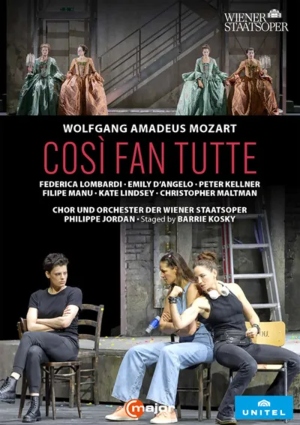
Let me describe it fairly though. We are in a provincial theatre, where Don Alfonso, a director conspicuously past his prime, is putting two young couples through a brutal exercise in method acting. The staging invites us to infer Alfonso’s exile, for some unspoken misdemeanours perhaps, where he takes his resentment out on the young actors under cover of professional process. Kate Lindsey’s Despina is the house dogsbody, a put-upon stage manager wielding vacuum cleaner and cordless drill and chewing gum through the seductions. The wager becomes a Mayakovskian experiment, where misogyny becomes the thesis Alfonso is determined to prove.
Kosky has said he waited thirty-five years before daring to stage the piece. But others weren’t quite so circumspect. Bruno Klimek also staged Così as an opera rehearsal at the Volksoper in 2015, also with the director singing Alfonso and the stage assistant singing Despina. Valentin Schwarz ran a similar concept at the Kammeroper in 2018. One Viennese critic wearily greeted the premiere as the city’s third rehearsal-room Così in nine years, permitting himself the devastating aside: ‘But Barrie Kosky doubtless considers his concept original’.
Original or not, the concept is flawed. A production premised on our inability to distinguish real emotion from synthetic raises a question over every piece of apparently awkward acting. Are these singers acting badly, or just pretending to? For me there’s more awkwardness on this stage than the governing idea can explain. Especially noticeable is an over-rehearsed, semaphored quality to the physical comedy that can’t be perceived as wit.
What survives? Well, there is Christopher Maltman. His Alfonso is the evening’s one fully realised idea and plainly the figure Kosky cares most about. He sings with saturnine relish and acts on a suitably grandiose scale. He brought to mind for me the jaded director in Bergman’s After the Rehearsal as well as the Count in Anouilh’s La Répétition, ou l’amour puni, who discovers when rehearsing Marivaux (of course!) that the rehearsal itself is the unadulterated machinery of seduction. Derivative or not, Kosky’s disgraced director belongs to this company, and Maltman’s portrayal is genuinely intelligent. Peter Kellner’s Guglielmo deserves his mention here too: the complete singer-actor on whom this kind of production utterly depends, alert in the body as well as the voice.
Musically the evening is decent rather than distinguished. The rather effortful overture is unfortunately a taste of things to come, and the pacing of the first act particularly bears this out. Philippe Jordan presides again from the fortepiano, as he did in Don Giovanni, but he is markedly less persuasive here. The score needs more flexibility than he is prepared to permit. The recitatives could often be lighter, and his handling of the orchestral score feels mechanical. Pace Nussbaum, I’ve enjoyed disappointing Cosi stagings because the orchestral playing often redeems things, providing the emotional truth the action lacks. That’s only intermittently true here. The singing itself though does, and it deserves praise across the board. Lombardi’s Fiordiligi rises magnificently to ‘Come scoglio’; D’Angelo is a vivid, gamine Dorabella, Lindsey as stage-wise as ever, and Manu a sweet-toned, ardent Ferrando. Jordan’s contribution, by contrast is adequate, but no more.
This is the second of Kosky’s Da Ponte cycle I’ve seen. When I reviewed Don Giovanni, I commented on what felt like a genuinely original conceptual apparatus—Pasolini, Dionysus, the volcanic ash of Teorema—which failed to cross the footlights. This Così offers second-hand machinery that crosses them all too easily and insulates itself on arrival. Two opposite failures of ‘high concept’ theatre, bookending a single cycle. Between them sits the Le nozze di Figaro of March 2023, released by C Major in November 2025 and by common consent the best received of the three. I have yet to see it, and I hope the consensus is right, because the cycle deserves a peak. The booklet for Così, I should record, as with Don Giovanni, doesn’t include any context about the interpretation, which needs to be found online at the opera house’s website. Last time I minded greatly, since without that scaffolding the production was illegible. This time—a backhanded compliment—nothing is lost: the idea explains itself at a glance.
I’d hoped for more from Kosky. But in a Così whose central conceit only intermittently holds and where Mozart’s music isn’t always allowed to flourish isn’t enough to make a satisfying evening.
Dominic Hartley
Production team
Sets and costumes – Gianluca Falaschi
Lighting – Franck Evin
Chorus master – Martin Schebesta
Technical details
Picture format: NTSC 16:9
Sound format: PCM Stereo / DTS 5.1
Region code: 0 (worldwide) 2 DVDs (DVD 9)
Sung in Italian, with subtitles in Italian, English, German, Korean and Japanese
Buying this recording via the link below generates revenue for MWI, which helps the site remain free














