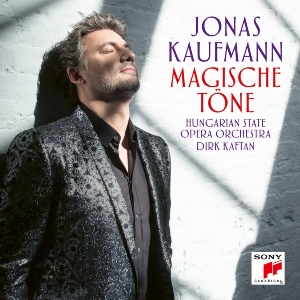
Jonas Kaufmann (tenor)
Magische Töne
Nikola Hillebrand (soprano)
Hungarian State Opera Orchestra/Dirk Kaftan
rec. 2025, Hungarian State Opera House, Ferenc Fricsay Studio & Béla Bartók National Concert Hall, Budapest, Hungary
Texts and translations included
Sony 19958413542 [81]
Even if you could not have told it from the way he sings, you can definitely hear that superstar tenor Jonas Kaufmann has a soft spot in his heart for Central-European operetta. His previous albums have been devoted to exploring its heritage in Berlin and Vienna. Now he turns further east to Hungary, exploring its Habsburg (and later) heritage in Budapest and beyond.
In the booklet note, the Senior Artistic Adviser of Müpa Budapest writes about how persuading Kaufmann to focus on this repertoire was a “dream come true”, something one can well understand. The disc does feel very much like a labour of love, put together by artists who have known and loved this repertoire for years, and have been desperate for others to get to know it too. They are good enough to organise the programme by composer, which gives some sort of reference point to listeners in English-speaking countries who are unlikely to have come across this repertoire before. The overall tone is a celebration of Hungary’s great contribution to the operetta tradition, even if that was a time when most composers thought it prudent to have their work premiered in German in Vienna rather than in Hungarian in Budapest.
Either way, the music is broadly marvellous. Written for a popular operetta audience, it is packed full of straightforwardly wonderful tunes that you can give yourself full permission to enjoy. There is a tremendous sense of showbiz to the whole thing, and that is meant as a compliment. There are so many intoxicating swoops and shimmering tambourine rattles that you might start to reach saturation point if you are listening to the whole disc in one sitting. But most of us, those happy to kick back and enjoy ourselves rather than analyse coldly, will have a marvellous time regardless.
Jonas Kaufmann did not get to become our generation’s great tenor without knowing how to colour his voice to his repertoire. Here he moderates his tone to make the point very persuasively – though, again, you might decide that it is a bit too much of a good thing. The opening number from Gräfin Mariza, for example, seems at times to be sung with the romantic ardour of Siegmund, at others with the delicate lightness of Belmonte. The song from Der Teufelsreiter is sung as though by Tannhäuser passing through on vacation. The uncharitable among us might find that leads to motion-sickness before too long.
It is hard to argue with the fact that Kaufmann’s vocal seduction technique in Ein Paradies am Meerestrand is worryingly heavy-handed. Nor will everyone love his unashamed crooning of the title track from Goldmark’s The Queen of Sheba, or its slightly bizarre falsetto notes. Many, however, will enjoy the full-fat caramel in his voice, and will like hearing it drizzled lavishly over some enormously attractive music that is not very well known. Connoisseurs might complain that this is not Kaufman’s natural milieu, and that he cannot avoid sounding a bit like a tourist in this repertoire. That may well be true, but anyone who picks up this disc knows what they are going to get. We should take our hats off to Kaufmann for gamely singing several of the numbers in Hungarian, however accented his language might be.
Nor is he completely alone. There is a glorious sense of abandon to the duets with Nikola Hillebrand. They all swing with the most persuasive sense of energy you will hear this side of the Danube, and the duets from Das Land des Lächelns are uncomplicatedly gorgeous.
The songs by Kálmán and Lehár, which take up nearly half the disc, are probably the greatest musically, even if they can sound a little formulaic when heard as a set. The song from Kaiserin Josephine, for example, comes across like a Schubert song on steroids. The other composers show similarly luscious musical indulgence. The songs by Paul Abraham show the influence of American jazz – hardly surprisingly for an operetta called Die Blume von Hawaii – and there is a gorgeous Jazz Age swing to the orchestral part in the number from Julia (which even contains a reference to Fred Astaire). The other composers do not appear to feature for any other reason that their tunes are all crackers, but who is going to complain about that?
Above all, Dirk Kaftan and the orchestra sound like they are having the time of their lives. The Csárdás that erupts out of nowhere at the end of the opening number is played with unalloyed delight. It is a typical example of the verve with which they play and, aside from the merry chirruping of the winds in the faster music, the strings seem to enjoy playing with maximum gloop in all the love songs. The recording engineers know who the star is, and Sony’s balance gives Kaufmann’s voice the unashamed centre-stage; they also allow lots of detail to stand out, such as the harp in “Immer nur lächeln”, which has a balance you would never hear in the theatre.
This is most likely a disc to sample sparingly rather than to consume in one indulgent sitting. But, like any fine Tokay, you can decide for yourself how to enjoy it. Regardless of your choice, unless you are the purest of pedants, enjoy it you will.
Simon Thompson
Contents
Emmerich Kálmán (1982-1953)
Komm, Zigány (from “Gräfin Mariza”)
Komm mit nach Varasdin! (from “Gräfin Mariza”)
Mondd meg hogy imádom a pesti noket “Grüß mir mein Wien” (from “Gräfin Mariza”)
Liebe singt ihr Zauberlied (from “Kaiserin Josephine”)
Tanzen möcht’ ich, jauchzen möcht ich (from “Die Csárdásfürstin”)
Tief wie der Bergsee…so verliebt kann ein Ungar nur sein (from “Der Teufelsreiter”)
Franz Lehár (1870-1948)
Es steht ein Soldat am Wolgastrand (from “Der Zarewitsch”)
O Mädchen, mein Mädchen, wie liebe ich dich! (from “Friederike”)
Ich trete ins Zimmer…Immer nur lächeln (from “Das Land des Lächelns”)
Wer hat die Liebe uns ins Herz gesenkt (from “Das Land des Lächelns”)
Schön wie die blaue Sommernacht (from “Giuditta”)
Paul Abraham (1892-1960)
Ein Paradies am Meerestrand (from “Die Blume von Hawaii”)
Will Dir die Welt zu Füßen legen (from “Die Blume von Hawaii”)
Pardon Madame (from “Viktoria und ihr Husar)
Nur ein Mädel gibt es auf der Welt (from “Viktoria und ihr Husar”)
Párdon, hogy bocsánat..Sing Sing (from “Julia”)
Der schönste Gedanke auf Erden (from “Zigeuner der Nacht”)
Fred Raymond (1900-1954)
Die Juliska aus Budapest (from “Maske in Blau”)
Nico Dostal (1895-1981)
Frag nur dein Herz, was Liebe ist (from “Die ungarische Hochzeit”)
Jenö Huszka (1875-1960)
Londonban hej (from “Bob herceg”)
Ferenc Erkel (1810-1893)
Hazam, hazam, te mindenem! (from “Bánk bán)
Karl Goldmark (1830-1915)
Magische Töne, berauschender Duft (from “Die Königin von Saba”)
Buying this recording via the link below generates revenue for MWI, which helps the site remain free