
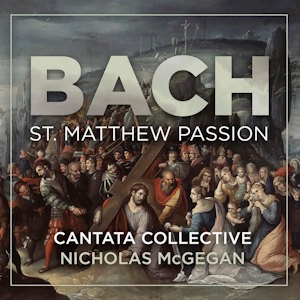
Johann Sebastian Bach (1685-1750)
St Matthew Passion
Thomas Cooley (tenor): Evangelist; Paul-Mark Tipton, (baritone): Christ; Scherezade Panthaki (soprano): Wife of Pilate and soprano arias; Reginald Mobley (countertenor): alto arias; James Reese (tenor): tenor arias; Harrison Hintzsche (baritone): Pilate and bass arias
Cantata Collective/Nicholas McGegan
rec. 2026, First Church, Berkeley, USA
Avie AV2840 [3 CDs: 169]
The first thing you notice about the new Nicholas McGegan recording of Bach’s St Matthew Passion is that it has a real sense of drama. We have grown used to period instrument-based recordings doing this of late. Dramatic, rather than more slavish and pious versions, are now a regular occurrence. This is by no means a bad thing, and to illustrate this I will be comparing this recording with the recent, excellent version by Raphael Pichon (Harmonia Mundi), as well as calling in one or two other examples when it comes to individual soloists.
Like Pichon’s, this recording is the latest in a series, also including The Mass in B Minor, the Magnificat and the Easter Oratorio. The California Bay Area-based Cantata Collective under the direction of Nicholas McGegan launched their so far very-well-received series with what Record Review on BBC Radio 3 called “a bold and beautifully constructed St John Passion.”
McGegan fields a mainly impressive and experienced group of soloists; tenor Tom Cooley as the Evangelist, bass-baritone Paul Max Tipton as Jesus, baritone Harrison Hintzsche as Pilatus, soprano Sherezade Panthaki as Pilatus’ wife, alto Reginald Mobley and tenor James Reese. These forces are completed with the Cantata Collective’s own choir and the acclaimed San Francisco Girls Choir.
I noticed several things when I began listening to these discs. First, McGegan seems to take the opposite of the old ‘blood and thunder’ approach of Karl Richter and the old school. This is a resolutely period instrument approach and this is especially brought out by the contrast between those ‘quieter’ instruments and the incredible subtlety of the chorus. As they so often are, the chorales, repeated and adapted as the drama progresses, are both the engine room of the piece and its moral conscience. The soloists too are quiet, and possibly even too quiet at times, of which more in a moment.
Having said that, the Christ, Paul-Mark Tipton, has a wonderful voice for the role. He is not as rich as the likes of Johannes Weiser, Neal Davies, Stephen Richardson or Michael George, for example, but the warmth and humanity are there in full, which begs the question ‘who on earth would hurt this man?’ In both the St John and St Matthew Passions, Bach makes Christ’s music deliberately warm and kind, which is what makes for a great contrast with the Evangelist’s more declamatory style. In a bad performance we can enjoy the interjections of one, while quietly dreading the other which either follows or precedes it. Paul-Mark Tipton is a very fine Christ, but although Paul Cooley complements him well, I find his voice occasionally a little one-dimensional. Contrast his performance with that of Julian Prégardien for Raphael Pichon, already a great Evangelist and of course the son of another. Bach’s music sounds as if it is in his blood – which it clearly is. Pichon’s Christ is wonderfully sung by Stéphane Degout and carries a firmer weight and resonance than Paul-Mark Tipton.
Other fine evangelists include James Gilchrist for Cleobury, Ian Bostridge for Jacobs and Anthony Rolfe-Johnson for Gardiner. All share with Paul Cooley the three necessary attributes of a first-class Evangelist, who is, after all, broadcasting St Matthew’s words in this ancient drama through his visceral and muscular text. An Evangelist needs clarity and diction, an engagement with the life of the text, and most importantly an ability to create a sense of empathy with the characters, especially Jesus. Cooley manages all of this, but he can occasionally sound a little effortful and piercing in doing so. His is a fine performance nevertheless.
Before moving on to the remaining four singers, I want to celebrate the work of the chorus, and Nicholas McGegan’s control of the style in which he seems to want them to sing. The only stylistic choral weakness is one that it shares with a whole series of others in the period instrument genre: a lack of attack in places. Such a powerful opening chorus, “Kommt, ihr Töchter, helft mir klagen” doesn’t exactly make an entrance as much as sidle in. Seeking to be reassured by Raphael Pichon’s opening, I found that he did more or less exactly the same thing. It seems to have become rather a theme to have chorus entries sounding apologetic, but otherwise I have no criticism to offer. Yes, the choral approach is at times even gentle, but at others it also adds an appropriate balm to the drama being played out by everyone else. Adding to this in places, is the fine work done by the St Francisco Girls’ Choir. The orchestra echoes this approach, resonant, rather than loud, only imposing itself when the music calls for it too.
Having said all that, the four soloists don’t always complement the drama enfolding around them. In general, the tenor, James Reese, and the baritone, Harrison Hintzsche come off better; both have fine moments. If his recitative duet with the chorus, “Oh, Schmerz! Hier sittert das gequalte Herr”, is a little hesitant at first, James Reese has well and truly warmed up all the way through a thoughtful ‘Ich will bei meinem Jesu wachen.’ Likewise, Hintzsche’s pleasant light baritone conveys the right feeling of a loyalty and grief in his final aria ‘Mache dich, mein Herze, rein.’
The counter tenor and alto do not fare quite so well. Reginald Mobley seems to lack vocal weight in his first aria, and although he gives a decent enough account of ‘Erbarme dich’, he is weaker in the bits in between. When set against the exemplary Michael Chance in the King’s College performance under Cleobury, Anne Sophie Von-Otter’s mezzo for Gardiner, or even Pichon’s counter tenor Tim Mead, he does rather come off second best. The same applies to Scherezade Panthaki, the soprano, whose voice seems at the least understated and at worst, below par. Like all the others, it’s clear that she gives of her best and serves the overall production well, and like the others she has her moments. Again, of course, it’s difficult not to compare her with artists such as Carolyn Sampson for Suzuki and Barbara Bonney for Gardiner. Pichon’s soprano Sabine Devieilhe, too, has an engaging, clear and fully audible voice.
It’s time to draw some conclusions. There are a great many Matthew Passions to choose from in both traditional and period instrument performances. For a neophyte, there are a few things which make it a good choice, not least the pace, chorus and orchestra and a good Evangelist/Christ pairing. It’s deficiencies in the power of two of its soloists might not matter as much to others. The truth is that there are many superior passions available very cheaply, such as Gardiner, Cleobury and the renowned performance with Nicolas Harnoncourt and Concerto Musicus Wien and as fine a crop of soloists as you would wish to assemble. If you want a more recent recording then Raphael Pichon’s much praised performance (Harmonia Mundi B09TTRRDRQ) is hard to beat.
Steve Gladwin
Buying this recording via the link below generates revenue for MWI, which helps the site remain free













