
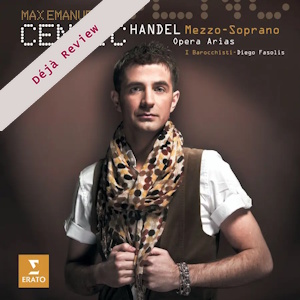
Déjà Review: this review was first published in August 2010 and the recording is still available.
George Frideric Handel (1685-1759)
Mezzo-Soprano Opera Arias
Max Emanuel Cencic (counter-tenor);
Coro della Radiotelevisione Svizzera
I Barrocchisti/Diego Fasolis
rec. 2009, Auditorium ‘Stelio Molo’, Radio Svizzera di lingua italiana, Lugano, Italy
Originally reviewed as Virgin Classics release
Erato 6945740 [65]
In addition to quips about death and taxes, one should add that if it’s a Monday, then there must be a new Handel aria disc out. The production line in this commodity is running at a frightening, depression-busting rate at the moment, and it won’t be long before my postman has his own selection ready.
That said, this is a splendid addition to the recent ranks. The music-making proves consistently elevated. The operatic arias are not commonplace, and they have selected both for relative rarity in recital disc terms and for questions of good balance. Thus the hour long disc proves to have something for everyone – everyone, that is, who admires the counter tenor in this repertoire which, as the disc’s own rubric has it, was written for the mezzo soprano voice.
Sorge nell’alma mia from Imeneo has requisite passion, the orchestra’s whip-crack and tempestuous accenting egging on the star singer. They have thrust and they have throb but though the music’s driven hard, ensemble is maintained. Cencic responds with singing of power but precision; the runs are perfectly executed; the voice is well equalized. The voice in Alma mia emerges from a harpsichord wash, floats and then rises with expressive purity. For Salda quercia, inerta balza, one of two arias essayed from Arianna in Creta, his florid singing is technically hugely impressive, and so too is its expressive potential; the orchestral strings similarly sound ‘elasticated’ in their throbbing lower string contributions, ones that add attaca and colour and rhythmic vibrancy. Where Cencic sometimes strays is in the lower register of his voice. He can be a little over-inclined to grandstand the chest register, and it can sound out of scale with the rest of his extraordinary voice, whose range is, admittedly, remarkable.
The clarion brilliance of his declamation can easily be savoured in Se bramate d’amar chi vi sdegna from Serse where the caesuri mirror the turbulence of the emotive state and where he cannily leans into the last line of the B section to anticipate the return of the A. Remarkably, given this man’s exceptional technical accomplishment and his phenomenal range, I think I caught him actually breathing during this aria. Grief and ache stalk Pena tirana which is rendered with genuine pathos and with a plangently shadowing wind line. The horns flare in Qual leon che fere irato and rhythms are tightly etched. Maybe – just maybe – the histrionics sound a touch manufactured here; I wasn’t wholly convinced, but there’s no gainsaying the musicianship. Non tardate Fauni ancora from Parnasso in festa is taken at a flowing tempo – I’m not sure I’ve ever heard it faster in fact. But for sheer virtuosity one can bask in Agrippina’s Come nube, che fugge dal vento which, with its reminders of Rodelinda’s Vivi, tiranno, offers plenty of opportunities for devastating runs and pitch perfect theatrical projection. It’s the kind of thing David Daniels does so well, but Cencic is a more powerful singer with a greater range. The final track offers a surprise – the only outing for the chorus. The trumpet sparkles, too, and Cencic feeds on increasingly florid divisions to end a disc of magnificent singing.
Splendidly recorded, honours are parcelled out between Cencic and I Barrocchisti under Diego Fasolis. Incisive, bright, colourful, rhythmically buoyant and devoid of some of the irksome mannerisms of other leading practitioners, the band and its conductor are a real pleasure to listen to.
Jonathan Woolf
Previous review: Jean-Pierre Joyce
Contents
Imeneo HWV 41 (1740): Sorge nell’alma mia
Floridante HWV 14 (1721): Alma mia
Arianna in Creta HWV 32 (1734): Salda quercia, inerta balza
Tamerlano HWV 18 (1724): Benché mi sprezzi
Serse HWV 40 (1738): Se bramate d’amar chi vi sdegna
Amadigi di Gaula HWV 11 (1715): Pena tirana
Arianna in Creta HWV 32 (1734): Qual leon che fere irato
Parnasso in festa HWV 73 (1734): Non tardate Fauni ancora
Agrippina HWV 6 (1709): Come nube, che fugge dal vento
Radamisto HWV 12a (1720): Ombra cara
Orlando HWV 31 (1733): Verdi allori
Parnasso in festa: Lunga serie d’alti eroi (1734)
Buying this recording via the link below generates revenue for MWI, which helps the site remain free













