
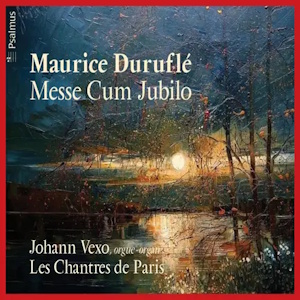
Maurice Duruflé (1902-1986)
Messe Cum Jubilo (1966)
Suite for organ solo Op.5 (1932), excerpts
Les Chantres de Paris (Blaise Rantoanina (tenor), Damien Rivière (tenor), Mathieu Le Levreur (baritone), Paul-Louis Barlet (baritone), Luc Bertin-Hugault (bass)), Johann Vexo (organ)
rec. 2023, Saint-François de Sales, Lyon, France
Psalmus PSAL050 [64]
Admirers of Maurice Duruflé will have at least one recording of his Messe Cum Jubiloin their collection, and the same can be said of the Suite Op.5 for organ. What, then, is the added value of this new disc? Quite simply, Les Chantres de Paris restore the work to “its original symbolic and spiritual meanings”. Normally encountered as a stand-alone concert piece, here the Mass is placed within “a set of other compositions that support its musical and sacred meaning and significance”. In other words, this performance approaches the work as it might be heard within the liturgical setting for which it was conceived.
The celebration opens with the Prélude of the Suite. A stylised Gregorian chant theme grows from long sombre lines into a strong climax before sinking back into recitative‑like introspection. The listener can imagine the procession of celebrants, lay ministers, servers and choir entering the church.
Liturgical proceedings begin with Salve sancta Parens, the Gregorian chant introit for Marian feasts, which draws on Sedulius’s poem and Psalm 44 (Psalm 45 in the Protestant numbering) to hail the Virgin as the Mother who bore the eternal King. It is traditionally sung at the start of Mass on Marian votive days.
The first two movements of Messe Cum Jubilo follow. Duruflé built the piece entirely on the ancient Cum Jubilo chant (Mass IX). He transforms the plainchant with his characteristic harmonic warmth while allowing the modal melodies to guide every phrase. The Kyrie and Gloria unfold with supple, chant-led momentum, and the organ provides colour and propulsion rather than mere background accompaniment.
Between the Epistle and the Gospel during the Liturgy of the Word, the choir sings the Gradual Diffusa est gratia, a scripture-based chant from Psalm 44 praising divine grace. There follows the Alleluia Post partum, a joyful chant affirming the Blessed Virgin Mary’s perpetual virginity.
During the Offertory, the organist plays Sicilienne, the second movement of the Suite, which betrays the influence of Ravel and Debussy. This is a flowing, rondo movement in 6/8 time whose seamless evolution leads to a final glowing restatement of the theme with triplets. It remains one of Duruflé’s most intimate inspirations.
The Mass continues with the serene Sanctus and Benedictus, followed by Notre Père Op.14 from 1977, Duruflé’s final published work. This French setting of the Lord’s Prayer is deeply restrained, unpretentious and moving. The heavenly Agnus Dei then brings the Mass to a close with some of Duruflé’s most tranquil writing.
After the Agnus Dei, the choir intones the Communio Beata Viscera and the Magnificat. The former is a liturgical Communion antiphon whose Latin text praises the Virgin Mary’s womb and breasts for bearing and nursing the Son of the eternal Father. The Magnificat is sometimes used at Mass during specific solemnities, such as the Feast of the Visitation (31 May) or the Assumption of the Blessed Virgin Mary (15 August), where verses or musical settings of this text may be appointed for the communion antiphon or as a seasonal hymn.
After Ite, missa est (Go, the Mass is ended), the organ explodes with the Toccata from the organ Suite. This is one of the great warhorses of the organ repertoire, standing alongside the toccatas of Vierne, Widor, Gigout and Bach. Its relentless figurations demand true virtuosity, driven by a firm pedal refrain beneath the semiquaver bustle on the manuals. Even when the tempo briefly eases, the music pushes forward with surging energy toward an ecstatic close. The Suite was first published by Durand in 1934, and duly revised in 1978.
I cannot fault anything about this new disc. The recording is exceptional, the singing perfect and the documentation in French and English ideal. The texts and translations are included, along with the specification of the Cavaillé-Coll organ at the church of Saint-François de Sales in Lyon.
In sum, this exquisite release from Psalmus is far more than just another entry in the catalogue. It is a thoughtful, brilliantly executed reimagining of how Duruflé’s music was meant to be experienced. By surrounding the Messe Cum Jubilo with its natural liturgical companions and the masterful organ Suite, Les Chantres de Paris and Johann Vexo deliver a profound artistic achievement: Duruflé’s sacred masterpiece, restored in context.
John France
Buying this recording via the link below generates revenue for MWI, which helps the site remain free
Contents
Suite – Prélude
Introïtus Salve sancta parens
Messe Cum Jubilo – Kyrie
Messe Cum Jubilo – Gloria
Graduale Diffusa est gratia
Alleluia post partum
Suite – Sicilienne
Messe Cum Jubilo – Sanctus
Messe Cum Jubilo – Benedictus
Notre Père
Messe Cum Jubilo – Agnus Dei
Communio Beata Viscera; Magnificat
Ite missa est
Suite – Toccata













