
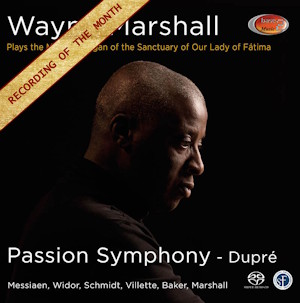
Marcel Dupré (1886-1971)
Symphonie-Passion (1924)
Olivier Messiaen (1908-1992)
‘Transports de joie’ (L’Ascension) (1934)
George Baker (b. 1951)
Evocation1; Evocation 2 (1971)
Wayne Marshall (b. 1961)
Berceuse
Franz Schmidt (1874-1939)
Variations and fugue on a theme on the king’s fanfare from Fredigundis (1924)
Pierre Villette (1926-1969)
Elévation, Op 22
Charles-Marie Widor (1844-1937)
Toccata from Symphony No.5 in F minor, Op.42 (1879)
Wayne Marshall
Improvisation on the Hymn of Fátima (SACD 5.1 layer only)
Wayne Marshall (organ)
rec. 2019, Sanctuário de Fátima, Fátima, Portugal
Base2 Music 07 SACD [79/89]
In early July a magnificent new organ, built by Nicholason & Co, was dedicated in Gloucester Cathedral. What relevance, you may wonder, does that have to a recording made on the organ of the Sanctuário de Fátima in Portugal? There are two links. Firstly, in mid-July, Wayne Marshall came to give the inaugural recital on the Gloucester organ; to my dismay, an unavoidable diary clash prevented me from attending. A couple of weeks later, at the Three Choirs Festival, held in Gloucester, I was privileged to hear a phenomenal recital by the French organist, Thomas Ospital, at which he played Dupré’s monumental Symphonie-Passion (review). So, when I learned of this disc by Wayne Marshall, I was highly motivated to review it. The label concerned, Base2 Music has been established for a while, I believe, but this is their first disc to have come my way. Quite clearly, they pride themselves on producing superior quality audio results. I listed to this recording using the stereo layer of the 5.1 hybrid SACD disc; I’m not equipped for surround sound.
I should say a word about the organ that has been used; for this information I’m indebted to Base2 Music’s comprehensive documentation. The organ is the work of the Italian firm, Mascioni Organs. Essentially, the new organ replaced an instrument that dated from 1952 but which had fallen into decay; some features of the old instrument were incorporated into its replacement, I believe. Mascioni’s instrument is on an imposing scale and is, I gather, the largest organ in Portugal. It has five manuals and over 6500 pipes. The organ is situated over the main entrance to the church, at the West end. The topmost (fifth) manual operates the Echo Organ, which is divided into two separate parts, located in the lateral galleries; Marshall uses the Echo Organ in such a way as to make me regret that I can’t play surround sound. There’s a full specification in the booklet and, unusually, plans which show how the organ is laid out within the church. If you visit the relevant page of the Mascioni website you’ll find much more information and a set of excellent photographs. I’m not entirely clear when the organ was installed; the Mascioni website has the year 2015. What I can be certain about is that this is the first commercial recording of the instrument.
Wayne Marshall begins with a bang, playing Messiaen’s ‘Transports de joie’. Messiaen wrote L’Ascension for orchestra in 1932-33. In 1933-34 he transcribed three of the four movements for organ but he felt that the third movement, ‘Alléluia sur la trompette, alléluia sur la cymbale’, was unsuitable for organ transcription; he therefore composed a replacement movement, ‘Transports de joie’. It’s an ideal choice as the opener for this recital. In the assertive opening the credentials of the Fátima organ are impressively displayed. I like the way Marshall uses the organ’s various divisions for contrast. It’s also noticeable how much definition there is in quiet passages. That’s a tribute to the engineering, of course, but even more so it’s the hallmark of a well-voiced organ. The playing and sonics are thrilling in this performance.
Then it’s on to the main pillar of the programme: Marcel Dupré’s monumental Symphonie-Passion. As is well-known, this work originated in a substantial improvisation which Dupré devised for a recital on the Grand Court Organ in what was, until recently, the Macy’s department store in downtown Philadelphia. When I visited the store some three years ago, I briefly heard the organ played – and was allowed a close-up look at the console – but the music I heard was nothing like the scope and scale of Dupré’s invention. He gave the improvisation in 1921 and when he returned home he wrote down the music and it was published in 1924; I don’t know how faithfully the published score replicates the improvisation or the extent to which the composer may have modified or adapted his original conception. The four movements of the score bear the titles ‘Le monde dans l’attente du Sauveur’; ‘Nativité’; ‘Crucifixion’; and ‘Résurrection’. I knew that each movement is based on a plainchant hymn, respectively ‘Jesu redemptor omnium’, ‘Adeste fideles’, ‘Stabat mater dolorosa’ and ‘Adoro te devote’; what I didn’t know until I read Gregg Wager’s impressively detailed booklet essay, is that these four themes were provided to Dupré by members of the audience at his 1921 recital.
Wayne Marshall’s performance is most impressive. His crisp finger work in the toccata-like passages of ‘Le monde dans l’attente du Sauveur’ is tense and exciting. I also liked very much the contrasts he offers in the subdued passages. In those passages, the engineering gives a fine sense of the acoustic and that’s even more true when loud chords resonate, especially the four massive chords at the movement’s end. ‘Nativité’ opens as a subdued, atmospheric reverie; subdued it may be, but there’s also admirable clarity. Eventually, Dupré quietly reveals the ‘Adeste fideles’ melody; hereabouts, the warm, thoughtful registrations that Marshall uses for the material in the background are especially pleasing. ‘Crucifixion’ opens in oppressive darkness; the lower reaches of the organ are used to dramatic effect. As the volume and tension mount, the church’s acoustic and its resonance (apparently, the building has a 12-second echo) really make an impact. The hushed, sorrowful appearance of ‘Stabat mater dolorosa’ is wonderfully imagined by Marshall and captured by the engineering; it’s a profound moment. I admire the way Dupré begins ‘Résurrection’. It would have been easy – and obvious – to open with an explosion of joy (as, for example, we’ve already experienced in ‘Transports de joie’); instead, Dupré makes us wait, building the music up gradually. That restraint means that when the toccata on ‘Adoro te devote’ explodes, the effect is all the more impressive. Marshall’s exciting rendition of this final movement sets the seal on a memorable account of Symphonie-Passion. One thing that readers may find interesting is that, judged solely by the clock, Marshall’s performance is on the swift side – though I never felt the music was unduly rushed; he takes 26:58. By contrast, when I got down from my shelves the 2021 recording by Tomasz Gluchowski (CD Accord 296) I noted that he takes 31:58. That’s a substantial difference and it caused me to investigate further. John Scott takes 29:11 (review), Jeremy Filsell’s recording for Guild (GMCD7162) occupies 28:48, and the version by Thomas Trotter lasts for 30:03 (review). In comparison with this company, the Polish recording excepted, the overall duration of Marshall’s performance, though on the swift side, does not seem out of line. I liked it very much.
Marshall next offers us two short pieces by the American composer, George Baker. I was intrigued to learn that he is a practicing doctor who also composes music. His two Evocations are homages to distinguished French organists and both are based on hymn melodies. Evocation 1 pays tribute to Louis Vierne. The piece comes as an excellent contrast after the rigours of the Dupré in that it is quite subdued, though there is a quite brief, warm climax in the middle. Evocation 2 honours Pierre Cochereau., This starts with music that bears an uncanny resemblance to the first movement of the Dupré, not least in its suppressed tension. The music soon opens out to become jubilant and toccata-like.
Wayne Mashall’s own Berceuse follows the precedent of the Dupré in that it originated as an improvisation which he later wrote down. It’s a short, restful interlude in this programme.
Another big work follows in the shape of Franz Schmidt’s Variations and fugue on a theme on the king’s fanfare from Fredigundis. The material for this piece originated in Schmidt’s opera which he composed between 1916 and 1921. Schmidt’s variations are such that the very considerable resources of the Fátima organ can be explored and exploited; that’s just what Wayne Marshall does. I think, though, that this piece poses two difficulties. One is that, until you know it very well, the theme itself is not sufficiently memorable; one can lose ‘sight’ of it as the variations progress. The other difficulty is the sheer length of the work. This performance lasts for 19:55 and despite Marshall’s artistry and the fascination of hearing the Fátima organ at work, the piece just outstays its welcome. I’m an admirer of Schmidt’s music, especially his four symphonies, but sometimes, as in his magnum opus, Das Buch mit sieben Siegeln, he went on at too great a length; that’s the case here, too, I fear. For all that, the piece is a real test of the player’s virtuosity and imagination and Marshall passes those tests with flying colours. The last few minutes are hugely imposing.
Another discerning contrast then means we hear Pierre Villette’s little Elévation. I’ve not been able to establish when this piece was written but I was struck by the extent to which it is reminiscent of Messiaen’s exquisite motet O sacrum convivium. The music is mainly subdued and Marshall’s performance is very atmospheric and sensitive.
Marshall then offers a conventional – though no less welcome – end-piece in the shape of the famous Widor Toccata. This is one of the swifter traversals I’ve heard, notwithstanding which the semi-quavers in the right hand are articulated with excellent definition. I’m pretty sure that Marshall uses the Echo Organ at times in this performance – oh, for surround sound! As the end of the piece approaches the sound of the pedal division is simply magisterial and the concluding chords are voiced with marvellous grandeur.
That’s it if you’re listening to this disc as a conventional CD or SACD. However, if you can access the SACD 5.1 layer you’ll get the bonus of an extra ten minutes of music; and it’s quite a bonus. In tribute to the recording venue, Wayne Marshall offers an Improvisation on the Hymn of Fátima. He presents the hymn in full and then his improvisation is resourceful, skilled and imaginative. There are two crucial differences between this and the (composed) Schmidt piece. One is that though the hymn melody is quite long, Marshall always contrives to keep it firmly in the listener’s ear. The other difference is that, unlike Schmidt, he doesn’t overcook things; his improvisation is done and dusted in half the time. You might expect that Marshall might be tempted to go for a Big Finish, wrapping the hymn tune in exotic harmonies voiced at full volume. He’s much more subtle than that, though; the close is hushed and all the more effective for that. Incidentally, if you can’t listen to this bonus track on your player then you can download it free of charge from the Base2 Music website.
Throughout this demanding and varied programme Wayne Marshall offers playing of impressive virtuosity and imagination. I understand that he selected the Fátima organ for this project after giving a recital on it. He displays great understanding, not just of the instrument but also of the acoustic in which it is set. Not only that, his interpretations of the various pieces are very satisfying.
The engineering deserves special mention. Jake Purches, who runs the Base2 Music label has acted as both producer and engineer. He has achieved results which are marvellously realistic and which convey both the power and range of the Fátima organ. His recording captures the exciting sound of the full organ but in addition we get a terrific sense of the subtle nuances of which the instrument is capable when played softly and imaginatively. The perspectives are also very well conveyed and, as I listened, I got an excellent appreciation of the building and its resonance. The sound overall has presence, definition and impact. One point is worth mentioning. In a note in the booklet, we read that the audiophile nature of the recording means that the recording may appear quieter than normal recordings; if so, you may wish to adjust the volume. I came to appreciate this point when, after one of my listening sessions, I wanted to compare the sound on the Dupré Symphonie-Passion with that on the aforementioned CD Accord disc from Tomasz Gluchowski. That’s offered on a conventional CD which is also impressively engineered. To ensure I was comparing apples with apples I put the Gluchowski disc into the same player and I found I had to make a very hasty volume reduction! That disc was recorded on the organ of the National Forum of Music in the Polish city of Wrocław. I’m aware that Base2 Music has since recorded a recital by Wayne Marshall, entitled The Breton Rhapsodies, using that very instrument; I shall be interested to experience the results.
The only thing that remains to be said is that the booklet is excellent. It’s liberally sprinkled with photographs and contains an extended, expert essay on the music by Gregg Wager, a note by Wayne Marshall and full details of the organ
Both the music-making and the engineering make this a memorable disc.
John Quinn
Availability: Base2 Music













