
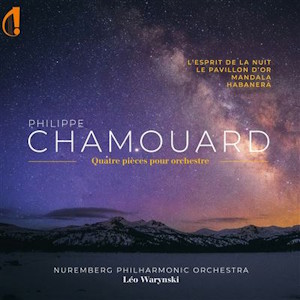
Philippe Chamouard (b.1952)
L’esprit de la nuit (1999, rev. 2024)
Le pavillon d’or (2013)
Mandala (2014)
Habanera (2024)
Mieko Miyazaki (koto, Le pavillon d’or)
Nuremberg Philharmonic Orchestra/Léo Warynski
rec. 2025, Nuremberg, Germany
Indésens Calliope IC110 [63]
Philippe Chamouard is a Parisian composer, known for writing in the “approachable” modern idiom. He has been criticised for writing rather eclectic music, loaded with new age tendencies but lacking in structural rigour.
The longest work here, L’esprit de la nuit, is in three movements. It represents three stages of human activity that destroy nature, destroy man’s own loving nature, and finally – by exerting willpower – can restore his loving nature. These images derive from the writings of the Confucian philosopher Meng Tzu (372-289 BCE).
The first track depicts a forest: cut down, starting to regrow, then eaten by grazing animals and totally destroyed. A rhythmic, repetitive motto which presumably represents motorized or mechanical destruction is interspersed with quieter moments. I found it unmemorable; it relies too much on the repetitive blaring motoric element. The second movement opens in similar mood, and Chamouard’s repetitive inspiration is again present. Climatic percussion and brass outbursts intersperse more reflective sections. That includes a repeat of the first movement motto, and nothing has the saving grace of a decent melody. In the third slow movement, the composer allows his melodic gift to expand somewhat. It is not so memorable, however, that I can see the piece becoming a concert hall or record catalogue staple.
Le pavillon d’or is for koto and orchestra. Koto, thirteen‑string plucked zither, is widely regarded as Japan’s national instrument. Chamouard wanted to compose a piece which combined the western twelve-tone system with the pentatonic scale used in ancient Japanese music. The result is a mixture of koto’s twanging and a flowing but uneventful accompaniment. The music takes as its inspiration the Golden Pavillion of the shogun Ashikaga Yoshimitsu, built in 1397, a Zen temple after his death. The first and second floors are entirely covered in gold leaf. Chamouard fails to represent the building in music, possibly because no major historical event or use is associated with it. We only have atmospheric wisps.
The booklet notes describe koto player Mieko Miyazaki’s impressive career at home and in France where she now resides.
Mandala is a diagram painted on the ground as an aid to Buddhist meditation. Let me borrow from the booklet notes: “At the entrance to Tibetan monasteries, the prayer wheel is a cylinder filled with written mantras that can rotate freely in a clockwise direction. Like the prayer wheel, the melodic curve of my score, played by the solo horn, spins clockwise consisting of four notes that also refer to the cardinal points of the mandala”. The four notes on the horn give the music anchor points (missing in the other slow and meditative music here). This is the only piece I have felt like listening to more than once.
Chamouard wrote Habanera after a visit to Buenos Aires where he attended a tango show. Sometime later a Cuban Habanera rhythm came to him one night. It became the basis for a short piano piece from which this fifteen-minute orchestral work arose. If anything, the piece is too long for its material, which does not sound to me as doing anything original with the traditional rhythms.
The recording is excellent, and – as far as I can tell – all present perform very well.
Jim Westhead
Availability: Amazon France













