
Johannes Brahms (1833-1897)
Complete Clarinet Works
Quintet in B minor for clarinet and string quartet, Op.115 (1891)
Trio in A major for clarinet, cello and piano, Op.114 (1891)
Sonata No. 1 in F minor for clarinet and piano, Op.120, No. 1 (1894)
Sonata No. 2 in E flat major for clarinet and piano, Op.120, No. 2 (1894)
Rúnar Óskarsson (clarinet)
Sigurður Bjarki Gunnarsson (cello)
Helga Bryndís Magnúsdóttir (piano)
Siggi String Quartet
rec. 2025, Salurinn, Kopvagur, Iceland
Sono Luminus SLE-70048 [2 CDs:109]
Just when Johannes Brahms believed that he had composed all that he had within him. an unexpected invitation came from his friend, the composer Hans von Bülow, to attend his Meiningen orchestra performing all of Brahms’s symphonies. Sometimes friends know better what is best for you, and so it proved. By the time Brahms had heard this performance and had been refreshed by his own music, his decision to retire had changed entirely. Brahms heard the orchestra’s famous clarinettist Richard Mühlfeld (1856-1907) perform for the first time. He was entranced and was determined to write a piece for a man who later became a life-long friend and whom he affectionately called “Frau Klarinette” due to the feminine delicacy of his playing. The piece later became four in the form of the famous quintet for clarinet and string quartet in B minor opus 115, a trio for clarinet, piano and cello in A major, opus 114, (both 1891), and the two later clarinet sonatas for clarinet and piano opus 120, with the first in F minor and the second in E flat major, (both 1894).
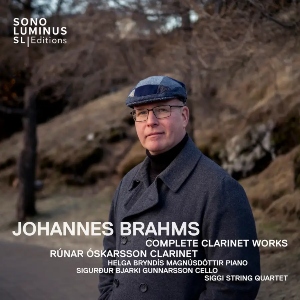
Other composers whose late works seem to take a leap into unknown territory include Wagner, with his sacred music drama Parsifal, and Sibelius with his strange, eerie and terrifying Tapiola, both of which have evolved into a completely new sound world. There are also many autumnal musical examples, such as Verdi’s at-times poignant and elegiac Falstaff; equally, Beethoven’s late string quintets and piano sonatas evince clear elements of rustling leaves and gentle sighs -indeed, the CD cover of this release shows a pile of such rustling leaves from which is emerging a patch of green moss.
There is such a thing as a Brahms sound, one of warmth and depth, the red burnished tones of alder perhaps, with more than a little of loss in it. There are many examples of this quality which makes Brahms’s music so enduringly popular; one is the gentle opening of the second symphony with its plangent, soft entry from the French horns, before the burnished strings sweep in and take gentle possession. Another example is the unexpected final refrain of his Alto Rhapsody when the solo female voice is unexpectedly joined by a male chorus that is so immediately comforting and reassuring. Finally, in the Variations on the St Anthony Chorale, one or two of the final variations evoke that same autumnal and joyful mood before entering into the final climax and ending.
Those examples pass as quickly as they appear, a snatch of the autumnal and elegiac, which, with a bit of luck, will come back again – and it often does. In these last four sublime works, those very qualities which have wound their way through so much of Brahms’s earlier work have become its permanent state, the only difference being in mood and gradation. This is music to fall into a chair after a long and tiring day, a long cosy sigh of relief.
For me any performance of the late clarinet chamber music has to be imbued with these qualities, especially if the performers chose to begin their programme with the quintet, the most beautiful of them all. A great clarinet player and accompanying players have the means before them of achieving brightness amongst melancholy, evoking nostalgia amidst memory, proclaiming a new energy. The clarinet, that instrument of so many wriggling and often delightful moods, is here centre-stage, in pieces to rank with Mozart’s.
It is clear both from hearing Rúnar Óskarsson gentle and probing technique and burnished, full sound, and from what he says about how much these works mean to him, that he has chosen to make them an important part of his life. Having said “how there are some works which just won’t let you go”, he goes on to describe this as music “that demands stillness and focus, and for me, it serves as an escape from the speed and noise of modern life. We are inviting the audience into a space where time stands still, where we are allowed to be sincere and reflective.”
The first impression of this performance is one of quiet serenity and gentle introspection. All feels in control throughout the plangent and exquisite sweeping exchanges, with a conversation which rises and falls delightfully in the allegro. The Siggi String Quartet is both tight and measured, and Rúnar Óskarsson’s clarinet entrances seem to be part and parcel, rather than a piercing intrusion. The sublimely gentle adagio is suitably hushed and almost reverent; even when the clarinet seems to shriek its anguish, it is in keeping with the mood. At times, this section has echoes of Dvořák’s New World Symphony, and of course the two composers were great friends and an encouragement for each other. After the first movement, the strings seem to walk gently by the side of the clarinet as if accompanying him home. The allegretto conveys a busy, bustling sense of a busy street broken up by longer conversations. After a gentler-than-gentle andantino, the final con moto draws all the strings together and the ensemble playing remains tight, with the clarinet’s popping pizzicato effect in the first subject one of many delights. In the end, the music simply seems to cease living, as if a final decision has been made.
The mood at the beginning of the trio is more sombre, and playing these pieces one after the other makes you wonder whether that is how Brahms intended them to be played. At times, there is more of winter than of autumn in the trio, and a marked sadness in the allegro from the start, aided of course by the desolate addition of Sigurdur Bjarki Gunnarsson’s plaintive and beautifully controlled cello. In contrast, in the adagio the piano provides a more joyful base for the clarinet’s agitated wriggling, or less often the brighter cries rising to the surface, but the mood remains sombre and introspective. Things become altogether brighter in the allegretto grazioso, where the mood is like a graceful dance with more than a little in it of both the salon and of the mannerisms and control of a nineteenth century ball. In the final allegretto, this mood extends into a different kind of dance, one full of leaps and reels, before subsiding into a gentle and courtly conclusion.
The two sonatas were written together three years later and share a similar mood, less introspective than the two earlier works, with more bounce and vigour. This is especially apparent in the joyful allegretto grazioso third movement of the F Minor sonata, where the unified dancing of Helga Bryndis Magnúsdóttir’s piano and Óskarsson s clarinet attests to a familiar and well-tested partnership. The opening two movements which precede it are full of delicacy, quiet joy and resonance, as one mood shifts, or sometimes leaps, into another. The shout of the clarinet’s first entry takes us into an ebullient vivace which both players leap into with aplomb.
The E Flat major sonata has only three movements. In the opening Allegro Anabile, Óskarsson and his pianist partner exchange moments of autumnal reflection and bursts of sublime melody. The contrasting cheer of the opening theme of the second movement and the walking piano that follows is managed beautifully, as it rises and falls. Óskarsson’s clarinet is sometimes deep and resonant and again the music dies away. The clarinet begins the final Andante con moto movement with the haunting strains of a pastoral or folk theme, while Magnúsdóttir returns to simple accompanist before finally initiating the rush to the final climax, which is one of triumph and joy.
I know three of these pieces well enough; only the trio was unfamiliar to me. Despite the quintet being so popular, there seems to be very few recordings which include all of these pieces. However, a recent one which is very fine indeed can be found in a review here by my colleague Michael Cookson. As for this version, if you feel in need of a few quiet moments of autumnal reflection coupled with fine, resonant and sensitive playing, look no further.
Steve Gladwin
Buying this recording via the link below generates revenue for MWI, which helps the site remain free













