
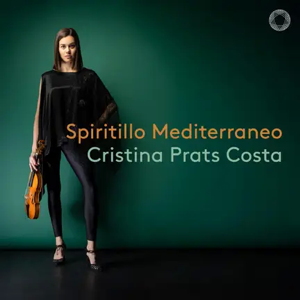
Spiritillo Mediterraneo
Cristina Prats Costa (violin)
rec. 2024, Church of St. Mary Magdalene and Trinity-St. Paul’s United Church, Toronto, Canada
Reviewed as a download
Pentatone PTC5187582 [74]
The violin has played a major role in European music life from the Renaissance until our own time. It was the first instrument which was given virtuosic solo pieces to play when around 1600 a new style emerged in Italy. Soon this style of violin playing disseminated across Europe, especially in the German-speaking world. The disc which is the subject of this review focuses on the music that was written in the Mediterranean area, as its title indicates. However, the music world was a global community, and across Europe performers and composers became acquainted with music from other parts of the continent through handwritten copies and printed editions.
Spain was not known for producing violin music; it was rather the country of the guitar. Cristina Prats Costa arranged several guitar pieces for violin. As Naples was under Spanish rule in the 17th century, it was via this city that the guitar made its way to Italy and further. The Neapolitan composer Nicola Matteis is the central figure in this recording, and when he settled in England, he published a guitar method. From that perspective it makes sense that in some of his pieces included here the violin is accompanied by the guitar.
Although the English music world had become acquainted with the modern style of violin playing through the German-born Thomas Baltzar, Matteis’ music as he performed it and then published it, was a different kettle of fish. His music was highly theatrical, as the titles of many of his pieces indicate. The global nature of the music scene also comes to the fore in the fact that composers liked to write pieces pretending to portray ‘national’ styles. In Matteis’ oeuvre we find a giga with the title ‘Al genio Turchesco’. He also refers to the English fashion of melancholy in the Aria malinconica. And although his music is very much Italian in character, he paid tribute to English tradition with a Ground in E. The ground was the English term for a basso ostinato; writing pieces over a repeated bass pattern was highly popular in 17th-century Europe. With ‘Un poco di maniera italiana’ Matteis referred to his home country.
Many pieces of his pen are character pieces. However, he and other composers also liked to write pieces with the title of ‘aria’, reflecting the importance and the influence of vocal music. During the Baroque period, the human voice was at the top of the pyramid. Instrumental works could also include recitatives, a form increasingly important in opera. An example is the middle movement of Vivaldi’s Violin concerto with the title ‘Il grosso Mogul’, one of his concertos arranged for organ by Johann Sebastian Bach. This concerto is also an example of the growing interest in the world of the Near East, which was a phenomenon of the Enlightenment.
Two other features of the 17th century are represented here. One is the writing of diminutions on pre-existing music. One of the writers on this subject was Silvestro Ganassi (1492-1550), who stated: “Diminution is nothing other than the variation of a naturally bare and simple sequence of notes”. An example of this practice are the diminutions on Alessandro Striggio’s madrigal Nasce la pena mia by the German violin virtuoso Johann Schop. The other feature is what the theorist Athanasius Kircher called the stylus phantasticus, in which a piece of several sections contrasting in tempo and meter follow each other attacca. The Bohemian-born Heinrich Ignaz Franz Biber, who for most of his life worked in Salzburg, is one of the exponents of this style, which is perfectly demonstrated in the Sonata in E minor, from a set of sonatas published in 1681.
Returning to where we started: the programme opens with four pieces by Andrea Falconieri, who was from Naples and is a perfect example of the mixture of styles, in this case Spanish and Italian. He was educated on the lute, but also played the chitarriglia alla spagnola, and wrote a book on guitar playing (which has been lost). His only collection of instrumental music which was published in 1650, is frequently explored by ensembles of our time. Many of these have descriptive titles, like those included here. Some titles suggest the influence of France, whose main contribution to the European musical culture of the 17th century was the dance. La Suave melodia is the most lyrical piece, and one of Falconieri’s most popular works.
Cristina Prats Costa is a new name to me. This may be her first recording. I am quite impressed by her technical and musical skills. She plays with passion and zest, and this recording is undoubtedly a labour of love. As she puts it in the booklet: “This project is deeply personal. As a Spanish musician, the Mediterranean has always been both my heritage and my artistic compass. Its colours – the tension of a Phrygian cadence, the pulse of a dance, the melancholy of a lament – feel like echoes of home.” The result is a compelling programme of music most of which is little-known. Unfortunately, I have to note a pretty big issue, something I used to call percussionitis: the use of percussion where it is not required.
In many pieces by Matteis percussion instruments participate. From a historical angle this is very debatable. Matteis played these pieces before an audience in England (he wanted them to be quiet when he was playing), and it is highly unlikely that any percussion may have been part of these performances. The pieces he published were intended for domestic performance, and again it is highly unlikely that under such circumstances any percussion may have been used. It could have been part of theatrical performances, but I have not found any indications that Matteis’s music was performed in the theatre.
Not everyone will be as bothered by this issue as much as I am. They certainly will very much enjoy this disc, as there is no dull moment, thanks to the music, all of which is of excellent quality, and to the engaging way it is played by Cristina Prats Costa and her colleagues.
Johan van Veen
http://www.musica-dei-donum.org
https://twitter.com/johanvanveen
https://bsky.app/profile/musicadeidonum.bsky.social
Buying this recording via the link below generates revenue for MWI, which helps the site remain free
Contents
Andrea Falconieri (1585-1656)
Il Spiritillo Brando
La Suave Melodia
Corriente dicha la Cuella
Brando dicho el Melo
Heinrich Ignaz Franz Biber (1644-1704)
Sonata No. 5 in E minor (C 142)
Nicola Matteis (I) (1650-1714)
Aria malinconica. Adagio
Ground in E
Sarabanda amorosa. Adagio
Santiago de Murcia (1673-1739), arr. Cristina Prats Costa
Fandango
Nicola Matteis (I)
Adagio in A minor
Aria in D minor
Gaspar Sanz (1640-1710), arr Cristina Prats Costa
Españoleta
Nicola Matteis (I)
Giga. Al Genio Turchesco
Aria. Adagio in C minor
Allegro. Preludio prestissimo
Diverse Bizarrie sopra la vecchia Sarabanda ò pur Ciaccona
Preludio in A minor
Passaggio rotto. Andamento veloce
Un poco di maniera italiana
Antonio Vivaldi (1678-1741)
Concerto for violin in D ‘Grosso Mogul’ (RV 208):
recitativo. grave
Nicola Matteis (I)
Aria ridicola
Johann Schop (1590-1667)
Nasce la pena mia (Striggio)
José de Nebra (1702-1768), arr Cristina Prats Costa
Seguidillas
Jean-Féry Rebel (1666-1747)
Sonata for violin and bc No. 7 in G minor:
sarabande
Nicola Matteis (I)
Aria burlesca
Other performers
Michael Unterman (cello), Joseph Phillips (viola da gamba, double bass), Lucas Harris (archlute, theorbo, guitar), Charlotte Nediger (harpsichord), Naghmeh Farahmand (daf, darbuka, tambourine), Esmeralda Enrique (castanets)













