
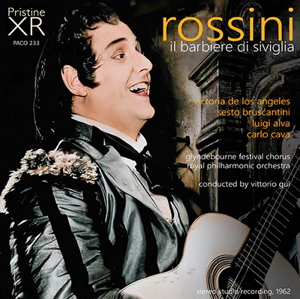
Gioachino Rossini (1792-1868)
Il barbiere di Siviglia
Figaro – Sesto Bruscantini (baritone)
Rosina – Victoria de Los Ángeles (soprano)
Count Almaviva – Luigi Alva (tenor)
Doctor Bartolo – Ian Wallace (baritone)
Don Basilio – Carlo Cava (bass)
Berta – Laura Sarti (mezzo-soprano)
Glyndebourne Festival Chorus
Royal Philharmonic Orchestra/Vittorio Gui
rec. September 1962, Abbey Road Studios, London, UK
XR remastered by Andrew Rose
Pristine Audio PACO233 [2 CDs: 141]
This was my first Barber of Seville. When I was first getting into classical music, I bought it in 1992 on a Classics for Pleasure double tape from Woolworths – oh, vanished world! – and fell for it straight away. I haven’t listened to it in decades, and once I moved on to CDs it got replaced by wonderful Barbers from Marriner (Philips), Patanè (Decca) and Humburg (Naxos). Therefore, it’s a testament to the strength of Gui’s Barber that it holds up magnificently well in this company and that it sounds so marvellous in this new Pristine remastering.
And it is, above all, Gui’s Barber. The conductor was a stalwart of Glyndebourne in the 1950s, as can be heard in his contemporaneous release of Mozart’s Figaro, also originally on EMI. He is a master both of ensemble and of pacing, the two most important components of a successful opera buffa. You get that triumphantly in the big ensemble that ends Act 1. This is so extended and so episodic that, in the hands of a weak conductor, it can spell the death of both humour and dramatic tension. Not here. Gui unfolds everything with just the right balance of affection and dramatic urgency, which can only flow from the fact that this recording came off the back of a summer of successful performances in the Glyndebourne theatre. Every character gets their moment in the ensemble spotlight, but is also built into the whole, and there is similar balance in the all-important recitatives. Several of the arias, particularly the humorous ones, may be slower than we’d expect in the theatre today, but that only reinforces the value of this set in an understanding of the opera’s performing history, and of Gui as one of those key interpreters.
He’s surrounded by a marvellous singing cast, too. They sang the opera with him at Glyndebourne, except for de los Ángeles and Alva, both of whom were stars brought in by the original EMI producers – and they’re both very good. De los Ángeles is a winning Rosina, no ingénue, but instead a knowing adult who knows exactly what she’s doing and how to get her way. Her big aria sounds mature but is light in all the right places, and she adds brightness in all the big ensembles. Alva is very much the ardent romantic lead as the Count, singing with honeyed beauty throughout. He doesn’t quite have the humour needed to pull off the disguise scenes, and he never sounds like anyone other than himself, but he croons like the best of them in the serenades of the opening scene, and his is a voice to sink into and enjoy.
Bruscantini is an ideal Figaro. The voice is vigorous, energetic and full of life, not only in his factotum aria but throughout all the ensembles where he always comes across as the organising wizard who coordinates all the action. He’s always in the midst of it all, coordinating the mayhem or laughing at it, and he justifies the character’s status as the opera’s title character. When I first heard Ian Wallace, his voice struck me as slightly eccentric, but his tonal colour bothers me much less now; in fact, he’s as rich, funny and vigorous a Bartolo as you’d hope to hear, even if his patter is slower than you’d expect to experience in a theatre nowadays. Carlo Cava’s cavernous Basilio carries as much power as the cannon blast he sings about in his calumny aria. The orchestra chatter and weave around the singers with consummate ease, and the chorus sound like the total naturals they are.
The original EMI production included some discrete staging effects and careful left/right placing of the characters in the ensembles, all of which gently but effectively enhances the drama for home listening. The early stereo sound was always perfectly fine, but Andrew Rose at Pristine has cleaned it up beautifully, removing much of the inevitable hiss, and giving it a clarity and freshness of which the original producers can only have dreamed.
It’s not a perfect Barber, not least because there are plenty of once-traditional cuts, which rule it out as a top choice for the library. Furthermore, you’ll need to look elsewhere for a libretto or even a synopsis: the discs’ essay contains instead a rundown of the recording’s history, which confirms the idea that this isn’t a Barber for first timers, more for those who know the opera and who want to explore its recorded history. I’m definitely one of those people, and if you are, too, then you’ll love this classic set, which has as much musical as historical and sentimental value, especially for a nerd like me.
Simon Thompson
Availability: Pristine Classical













