
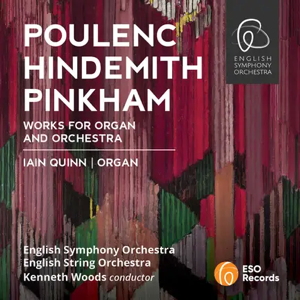
Francis Poulenc (1899-1963)
Concerto in G minor for organ, strings and timpani, FP93 (1934-1938)
Paul Hindemith (1895-1963)
Kammermusik No 7. Concerto for organ and chamber orchestra, Op 46.3 (1927)
Daniel Pinkham (1923-2006)
Sonata No 1 for Organ and strings (1966)
Sonata No 2 for Organ and strings (1966)
Sonata No 3 for Organ and strings (1987)
Iain Quinn (organ), English String Orchestra, English Symphony Orchestra / Kenneth Woods
rec. 2025, Merton College Chapel, Oxford, UK
ESO Records ESO2601 [61]
Kenneth Woods, the Artistic Director of the English Symphony Orchestra and organist Iain Quinn – no relation, I hasten to add – have put together a most interesting and varied programme which, inter alia, shows off the very fine Dobson Organ in the Chapel of Merton College. This instrument, built by the American firm of Dobson Pipe Organ Builders of Iowa, was installed in 2013. I’ve experienced it several times, both live and on disc, but to the best of my recollection I’ve not previously heard it played in a concertante role with orchestra. At the end of this review, I’ve included a link to the page about the organ on the College website where you can locate the specification of the instrument. There’s also a photograph of the organ which shows its situation at the west end of the chapel. In front of the console there’s a wide space, probably the widest in the building; I wonder if the orchestra was placed there for the recording sessions.
The work by Paul Hindemith is the only one on the programme which does not use a string orchestra: Hindemith scored his piece for an ensemble of seven woodwind and three brass instruments. In addition, Guy Rickards says in his helpful booklet essay that “a cello and double bass are included in the orchestra”; in fact, four cellists and two bassists are listed in the booklet, though I didn’t find their contributions all that easy to hear. The work, which here plays for 14:50, is cast in three movements. The first is described by Rickards as “bright and breezy”. The music is incisively played and, to my ears, has a definite air of the 1920s. The slow movement opens with an extended, calm organ solo; eventually, the flute joins in, followed by other woodwinds. The movement is tranquil throughout; here, it receives a sensitive performance. The finale is nearly as long as the preceding movements combined; it contains a lot of vigorous, toccata-like music. Guy Rickards describes the music as “ebullient”. I bow to his greater familiarity with the work but to me the ebullience seems a bit on the severe side. The busy contrapuntal music is incisively delivered by soloist and orchestra. To be honest, as with so much of Hindemith’s output, this is a work I respect rather than one that moves me. That said, the present performance is excellent.
The music of the New England composer, Daniel Piunkham is too little known. I’ve heard a number of his pieces on disc: I bought a couple of CDs of his choral music in the USA some years ago and since then I’ve experienced a few pieces on mixed recitals; I’ve liked what I’ve heard. Pinkham certainly didn’t lack for distinguished teachers; Guy Rickards lists Samuel Barber, Nadia Boulanger, Aaron Copland, Arthur Honegger and Walter Piston. In addition, he studied the harpsichord with Wanda Landowska and organ with E Power Biggs. I was amused to read, though, that Pinkham “came to music after attending a concert given by the Trapp Family Singers in 1939, before their immortalisation in The Sound of Music”. That’s a ‘fun fact’ if ever I read one. The three Sonatas, for organ and string orchestra, were all new to me. In all cases, the organ effectively functions as primus inter pares rather than as a conventional soloist.
The Sonata No 1 is a little bit curious. It consists of a single movement, marked Andante e molto semplice. It plays for just 3:27 and Rickards says that it sounds “rather like the central span of a moderately sized sonata, the outer movements of which have been lost”. I wonder if that’s exactly what has happened. I fear that the brevity of Sonata No 1 will count against it when people are planning programmes. That would be a shame. It is indeed ‘semplice’ in style but it’s beautifully constructed. The piece is most attractive and here it receives a performance which has an ideal flow to it. Sonata No 2, which was written in the same year, is slightly more substantial: it consists of two movements and plays for 7:36. The first movement (Andante sereno) is a little more austere than Sonata No 1; it’s somewhat restrained, but it’s still a pleasing piece. The second movement (Allegro scherzando) begins with music which Rickards justly observes is “reminiscent at times of the lighter Shostakovich”. The music, which is in triple time, is waltz-like and playful. Between 1:40 and 3:30 the pace slows and the music becomes more pensive. I just have a nagging concern that perhaps too much momentum is lost; if so, that’s emphatically not down to the performers. The Shostakovich-like perkiness returns for a brief coda. The Sonata No 3 is not only later than its predecessors]; it’s also longer, playing for 12:40. It has four movements. The most impressive of the four is, I think, the third movement (Andante dolente). It’s quite intense, though in an introspective way. The finale (Vivace) provides, in Guy Rickards’ view, “a modestly sparkling conclusion to the whole”; it’s deftly played. Right at the end, we hear, very briefly, the fullest organ sound in any of these Pinkham works. The Sonata is a good piece though it strikes me as a bit earnest in tone. I wondered if any of these three works had been previously recorded. I can’t speak for the first two Sonatas but I found a review by Rob Barnett of a 1994 disc, devoted to Pinkham’s orchestral music, which includes the Sonata No 3. From Rob’s appraisal I learned that the score exists in two versions: for chamber orchestra or for strings; it’s the latter scoring that Kenneth Woods uses.
The major work on the programme is Poulenc’s Concerto in G minor for organ, strings and timpani. The background to this composition is interesting. It was commissioned by Princess Edmond de Polignac, an American heiress who had made her home in France. Over an extended period of time, she commissioned a wide range of composers to write works for performance at the concerts which she promoted in the (substantial) studio adjacent to her Paris home. She was an amateur pianist and organist and had had a relatively modest organ – I believe it had two manuals, pedals and just 17 stops – installed in the studio in the late 19th century. She may have hoped for a concerto that she herself could play but in fact the premiere was given in December 1938, in her studio, by the composer/organist Maurice Duruflé with Nadia Boulanger conducting. The concerto was long in gestation: Poulenc wrote it between 1934 and 1938. It’s pretty much unique in his output: his only other published work involving the organ is the Litanies à la Vierge noire (1936) for female choir. Though the score presents challenges to the soloist, it is far from a conventional concerto. Much of the music is serious, even austere, and opportunities for display are limited. If the princess expected something more light-hearted, along the lines of, say, the Concert Champêtre for harpsichord (1927-28) or the Piano Concerto (1932), Poulenc did not oblige. It’s surely no coincidence that, as Guy Rickards reminds us, during the period of composition, Poulenc was greatly distressed by the sudden death of a close friend, Pierre-Octave Ferroud in 1936; this event brought the composer back to his religious faith and directly sparked the creation of his profound Mass in G major (1937).
The concerto plays continuously but has seven clearly defined sections: these are tracked separately. I’ve often read that the opening organ flourish is not just a homage to Bach but evokes a particular organ composition, the Fantasia and Fugue, BWV 542, a work which, like Poulenc’s concerto, is in the home key of G minor. What I did not know until I read it in Guy Rickards’ essay, is that the opening of Bach’s piece was printed at the top of the Princess de Polignac’s headed notepaper. This flourish by Iain Quinn heralds a very impressive performance of the concerto. The opening Andante section contains austere music – we’re a long way from the gaiety of tone that we often encounter in Poulenc’s music. The following Allegro giocoso receives a performance that is full of energy and no little drama. At the heart of the concerto lies the longest section, Subito Andante moderato. Here, Poulenc is thoughtful and subdued; the austere beauty of the music is very well brought out in this performance. Hereabouts, and indeed throughout the concerto, the performers and engineers achieve an ideal balance between the orchestra and the solo instrument. Later, the section marked Très calme. Lent is sensitively done; as this episode comes to its end, Iain Quinn builds powerfully to what Guy Rickards describes as the “stark organ chorale”. In the Tempo de l’allegro section which follows Poulenc displays surface good humour – the organ part has a whiff of the exuberant pieces of Lefébure-Wély and even, dare one say, of fairground merriment. But Rickards is right to note the presence of darker sub-surface currents, especially in the moments leading up to the dramatic return of the work’s opening flourish. This tension between gaiety and darker emotions is well realised in this performance. The concluding Largo, which is characterised by gravity and restraint, is most effectively handled by Quinn and Woods before the concerto ends with one last dramatic flourish. This is a very fine account of Poulenc’s eloquent concerto. I think its effectiveness is heightened by the choice of venue. Nowadays, the work is often performed in large concert halls or churches. Merton College Chapel, while far from small, is a rather more intimate space; Poulenc’s masterpiece was first heard in a relativity small concert hall. Incidentally, the Merton organ is not a French-sounding instrument such as one hears, for example, on the famous recording by Maurice Duruflé and Georges Prêtre. I don’t think that matters at all; the Merton instrument is very well suited to the concerto, as it is to the other music on this programme.
I enjoyed this disc very much. The performances are highly accomplished. Furthermore, they have been most sympathetically recorded by producer/engineer Phil Rowlands. As I’ve already indicated, the notes by Guy Rickards are excellent. The programme contains one established masterpiece of the organ/orchestra repertoire and other pieces which are less familiar but no less worthy of your attention.
You can find the specification for Merton College’s Dobson Organ by clicking here.
John Quinn
Buying this recording via the link below generates revenue for MWI, which helps the site remain free













