
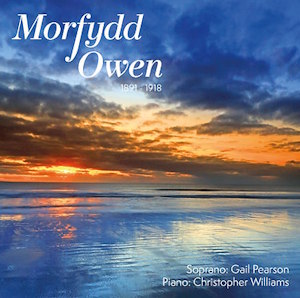
Morfydd Owen (1891-1918)
Songs and Piano Works
Gail Pearson (soprano)
Christopher Williams (piano)
rec. 2026, Acapella Studios, Cardiff, UK
Private release [75]
John Quinn has already reviewed this disc at considerable length – this includes much valuable biographical information – so I feel justified in offering a very brief review that reflects the thoughts of one who was previously unfamiliar with Morfydd Owen’s songs, and in fact had only encountered a couple of her orchestral works. I’ve also shamelessly appropriated JQ’s contents’ list with its dates of compositions.
Of the twenty-eight songs here, sixteen are heard in premiere recordings and the dates of composition range from 1911-18, the year of her tragically early death, following an operation for appendicitis, still short of her 27th birthday. The songs show quite clearly the various influences on her, whether folkloric, Edwardian, Baroque-touched or late-Romantic, or indeed others that infiltrate her music from time to time. Gweddi Y Pechadur with which the disc starts shows, for instance, chromatic density and offers a powerful example of her art, even so early in her development: she was only 19 when she wrote it. I’ve not heard a competing recording by Elin Manahan Thomas and Brian Ellsbury on the Ty Cerdd label but will note that they take a much more lingering tempo, something that generally recurs when there is competition between the pairings, as it does in To Our Lady of Sorrows, for example.
Some of the songs are grouped by poet but this only happens in the case of William Blake and Ethel Newman. Owen treats Blake’s The Lamb with little discursive, unexpected lines along with the more wan, charming elements perhaps to be expected. The three Newman settings vary from parlour warmth to the capriciously whimsical The Goldfish which has a coquettish humour redolent of the Music Hall. Its unbridled spirit offers one of the few chances for her to set her spirit free. There’s only one setting of her own poetry, in A Mother’s Lullaby, and it’s suitably straight-forward and sweet. Once again, Manahan Thomas takes greater time over it but to what effect I can’t say.
Many composers of the time set Robert Herrick and To Violets clearly appealed to Owen as it did to, say, Gurney, Quilter, Fritz Hart and after them Britten. For Owen the approach is deft and glancing with the merest whisp of antique cadences but no imitation of lute or harpsichord. La Tristesse draws from her a setting of some sensitivity, the voice and piano alike deftly characterised, with some hints of Spanishry in the vocal line. Mister Rain, a setting of Richard Aldington, confirms her talent for light, humorous settings whilst April is another example of earnest Edwardiana and The Fairies’ Wedding offers a sliver of Mendelssohnian exuberance.
The songs are interspersed with some attractive piano pieces. Maida Vale offers a rather quixotic mood study – the veiled, the quietly melancholy and the exuberant. The Rhapsody in C sharp minor opens stormily and in Brahmsian fashion but has an attractive ‘B’ section to contrast. The most extended piano piece is the Four Welsh Impressions, a less successful work with a vapid opening panel, a richer, more evocative second, a chordal third and a dancing finale. It’s notable that pianist Christopher Williams is, like Gail Pearson, a more energetic, and faster exponent of the piano pieces, in general, than Brian Ellsbury.
This recital is clearly a labour of love for the two performers, who are convincing interpreters of the music. Occasionally I found Gail Pearson a little overbearing – her voice is surely too insistent in God Made a Lovely Garden – but more than not she is assiduous and communicative.
The disc has a track listing and a booklet with a useful biographical introduction but there are no texts. A demerit is that the gap between tracks is absurdly short. This disc gives eloquent service in its expansion of Morfydd Owen’s music on disc.
Jonathan Woolf
Previous review: John Quinn
Availability: Oriana Publications
Contents
Gweddi Y Pechadur (1911) (words: Thomas Williams)
Suo-Gân (1913)* (Robert Bryant)
Slumber Song of the Madonna (1913) (Alfred Noyes)
To Our Lady of Sorrows (1912) (Wilfred Hinton)
Orbits (1911)* (Richard de Gallienne)
Foredoomed (1913)* (Philip Bourke)
The Nightingale (1911)* (Jean Ingelow)
Piano Prelude in E minor (1914)
Infant Joy (1912)* (William Blake)
The Lamb (1914) (William Blake)
Spring (1913) (William Blake)
Maida Vale (1912)
A Mother’s Lullaby (1914) (Morfydd Owen)
A Noontide Lullabye (1917)* (Ethel Newman)
Dear Home in The Hills* (1914?) (Ethel Newman)
Goldfish* (1914?) (Ethel Newman)
The Year’s at the Spring (1912)* (Robert Browning)
‘God Made a Lovely Garden’ Four Flower Songs: No. 4 (1914) (Mabel Spence)
‘Speedwell’ Four Flower Songs: No. 1 (1918) (Atwyth Eversley)
‘To Violets’ Four Flower Songs: No. 3 (1914) (Robert Herrick)
‘Daisy’s Song’ Four Flower Songs: No. 2 (1911) (John Keats)
La Tristesse (1914) (Alfred de Musset)
Chanson de Fortunio (1913)* (Alfred de Musset)
Rhapsody in C sharp minor (1914)
If I Had But Two Little Wings (1913)* (Samuel Coleridge Taylor)
Mister Rain (1916)* (Richard Aldington)
April (1914)* (William Watson)
Sunshine Town (1918)* (P J O’Reilly)
Four Welsh Impressions (1914/15)
The Land of Hush-a bye (1916) (‘Eos Gwalia’ (J J Cadwaladr))
(January 1916)* (‘Eos Gwalia’ (J J Cadwaladr))
The In Cradle Land Fairies’ Wedding (1913)* (‘Eos Gwalia’ (J J Cadwaladr))
* First recordings













