
Ondřej Kukal (b. 1964)
Symphony No. 1 “With Glockenspiel”(Op. 15) (1999)
Jiří Teml (b. 1935)
Labyrinth of Memory (2018)
Jan Fišer (violin), Czech Philharmonic /Jakob Hrůša, Tomáš Netopil
rec. 2024/2025, Dvořák Hall of the Rudolfinum, Prague, Czechia
Reviewed as a digital download
Animal Music 8594211850773 [45]
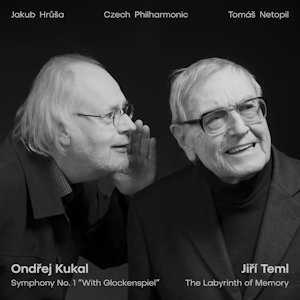
I doubt that I was the only listener who went into this album expecting something a bit more ‘whimsical’. From the album cover, which, I’m sorry to say, forcibly reminded me of Statler and Waldorf from The Muppets, to the name of the first and longest work here: Symphony No. 1 “With Glockenspiel”, I was anticipating something more in the style of Poulenc, Milhaud, or even some of Malcolm Arnold’s English / Scottish Dances. It’s not as though glockenspiels are never used in more serious works (e.g., Mahler’s Sixth Symphony) but my instinctual associations with the instrument are pieces like Die Zauberflöte or Dukas’ L’Apprenti sorcier. So I imagined that a Glockenspiel Symphony would probably be on the witty side.
But names and impressions can be deceiving, and if one of the purposes of writing a review is to help ensure that an album falls into the hands of those who would best appreciate it, then I am delighted to have the opportunity to let any prospective listeners know what they’re really getting into. This is not an especially whimsical disc, but it is a brilliantly intense and engaging one.
First, a biographical sketch, courtesy of Vlasta Reittererová in the booklet notes. Ondřej Kukal is a “veritable triple threat”, a violinist, conductor, and composer, who has played with the Vlach Quartet and been concertmaster of the Prague Chamber Orchestra. Before this symphony, one of his early successes in the field of composition was a single-movement concerto for clarinet and strings called Clarinettino (Op. 9) which I looked up after hearing this album. It’s an expressive, lyrical, varied piece that shows off the range and tonal palette of the clarinet. I think it would make a lovely contemporary pairing to any of the Classical and Romantic clarinet concertos.
Kukal began work on his first symphony in 1999, and it was debuted in 2000 by the South Bohemian Chamber Philharmonic. Soon after, however, Kukal collapsed with viral meningoencephalitis, and was forced to withdraw from the world of professional music for a few years. One of the symptoms he struggled with as a result was amnesia. In fact, Kukal credited his life as a musician with helping him to fully recover his memory.
In a 2025 interview, Kukal talked about this Symphony No. 1 in terms of a “foreshadowing”. I’ve read the passage several times over, and I’m not completely certain in what way he means this, but I’d like to make an educated speculation. I think that Kukal feels that this work could almost depict the emotional journey of that pivot in his life: the devastation and confusion of illness, and the struggle towards healing and recovery; and, even if he didn’t intend that at the time, the symphony has picked up all of these resonances, at least for him, after the fact.
The first movement, marked “Andante Spiritoso”, begins ominously enough, with a deep, chthonic drone and melancholy bassoons in an ambiguous tonal space. The phrase they outline will be one of the major themes of this movement. We hear a few glimmers of percussion in the distance while the strings widen and expand; for me, I can best describe this opening as rather submarine. The combination of fast, thudding timpani and slow everything else is very effective at creating a sense of panic and doom–you could sort of compare this with the opening of the first Brahms’ symphony, although, of course, the differences are important. A little over halfway through this movement we start getting stronger, piercing rhythms in the strings and muted trumpet accents which I must say sounded strikingly Mahlerian. The glockenspiel really gets its first moment in the sun during the quiet, elegiac coda, where it serves to add little glimmers of light to the strings.
This coda flows seamlessly into the second track, marked “Gradazione”, which runs all of 85 seconds (compared to the ten minutes of the first movement). It is almost entirely constructed around a particular four-note rhythm which swiftly builds to a climax…
…which is continued at the start of the second movement, “Allegro Energico”. At the beginning, we’re in something like Rite of Spring territory, with these furious staccato chords leading into a falling, sighing motif on the strings. A word used in the booklet is ‘catharsis’, particularly intended in the Ancient Greek theatrical sense, and I must say that to my ears, that is a very good description of how Kukal’s symphony works. The first section builds to a furore, and then all the tension is released. A long, still, contrasting section follows, where the glockenspiel is, again, allowed to shine. There is an “Epilog” which follows, which has something of the character of a sombre funeral march.
This is an electrifying symphony, exhausting in the best way possible. In only 27 minutes, I felt like I had been on a Mahler-sized emotional journey. One wonders if the Czech Philharmonic were particularly primed for this, having just finished recording an acclaimed Mahler cycle under Bychkov (review), but surely Jakub Hrůša deserves much of the credit as well. I can’t compare his account with anyone else’s, as I believe this is a first recording, but Hrůša’s having a banner year with a Martinů symphony cycle on Deutsche Grammophon that I thought was splendid.
It is worth noting that both works are ‘live’, but I couldn’t spot a single audience intrusion anywhere, even in the quietest moments. To my ears, the sound is excellent, and the details are very clear and transparent throughout.
For the second work on this disc, we turn to another Czech contemporary composer, Jiří Teml, and another conductor, Tomáš Netopill. Teml’s Labyrint parměti, symfonický obraz (“The Labyrinth of Memory, Symphonic Image”) was composed in 2018, but the premiere was postponed to 2025 due to COVID. It is a sort of orchestral memoir, as Teml describes it, with “motifs representing toys from my childhood, but also unpleasant and difficult memories, such as illness.” No great surprise as to what it’s doing on this disc, then.
Teml first encountered music by playing the organ at a Redemptorist monastery, where he spent part of his childhood following the death of his parents. As he grew up, he taught himself composition, incorporating jazz and other styles into his own voice.
Interestingly, Teml starts out with a low, hypnotic rumble rather like Kukal’s. He diverges fairly quickly, though, with lots of pitched percussion and little melodic ideas that float in and out. I can understand what he was doing, of course: this is an image of how memory ‘works’, the free-association, abrupt changes, and contrasting elements. I’m afraid that this makes it a bit difficult to describe, though. If you are familiar with the Boston Modern Orchestra Project, this is the kind of work I felt that they would love.
If I were being critical, I would say that after Kukal’s, Teml’s feels “a bit random”, but on repeated listenings I found myself warming to it. I might have sequenced the disc with this piece first, because it is ultimately both lighter and more improvisatory, so I felt that it never quite ‘hit’ with the same force as Kukal’s symphony. Still, taken on its own merits, I find the Labyrinth of Memory to be a colorful, varied place expertly brought to life by the Czech Philharmonic.
It is not unheard of for a reviewer to complain that a Classical CD only ran 55 minutes or so – “you could have included another work!” is the refrain. I am sympathetic to this, of course, and it must be pointed out that this present disc has a runtime a hair under 45 minutes, which is a drawback. Given the paucity of recordings of either composer featured here, I actually might have liked another contrasting orchestral piece (by preference, one of Kukal’s) – but I cannot really complain. Both works are serious, engaging, and emotionally intense: that’s more than enough for me.
Aidan Gray
Buying this recording via the link below generates revenue for MWI, which helps the site remain free













