
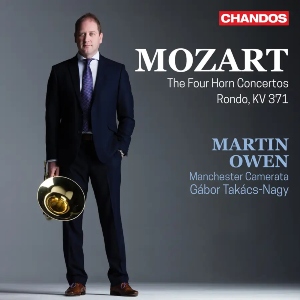
Wolfgang Amadeus Mozart (1756-1791)
Horn Concerto No. 1 K.412 and K.514 (1791-1792)
Horn Concerto No. 2 K.417 (1783)
Horn Concerto No. 3 K.447 (1787)
Horn Concerto No. 4 K.495 (1786)
Rondeau K.371 (1781)
Martin Owen (horn)
Manchester Camerata/Gábor Takács-Nagy
rec. 2025, The Stoller Hall, Hunts Bank, Manchester, UK
Chandos CHAN20377 [60]
Mozart’s horn concertos are entertainment music, certainly for the listener and possibly for the composer. These short and simple pieces often appeal to newcomers to classical music. But for the soloist it is another matter. They are core repertoire for horn players, and bring many challenges. Not only is the horn a difficult and treacherous instrument at best; in Mozart’s day, it also suffered from deficiencies in its mechanical construction.
The horn began as a long cylindrical tube, with a mouthpiece at one end and a flaring bell at the other, coiled into a circle. In that form, it could produce only the notes of the harmonic series. Two inventions helped in Mozart’s time. One is the introduction of interchangeable crooks, short pieces of tubing which could alter the fundamental note and so the notes available. The horn could then be put into most of the keys likely to be used, though it took time to change crooks. The other invention was the use of handstopping, using the right hand in the bell to modify the note. Care had to be taken over intonation and tone, but this increased the range of notes available. These instruments are now called natural horns.
The great deliverance came in the nineteenth century with the invention of valves. They added several crooks, changeable instantly by the press of a piston or lever. Finally, the horn could produce a complete chromatic scale over the whole of its compass, reasonably reliably – though players still sometimes crack.
Mozart wrote for the natural horn without valves. He most skilfully employed the available notes in such a way that one would be hardly aware of the restrictions whih the defective mechanics imposed. He wrote these concertos for an old friend from his Salzburg days, Joseph Leutgeb (1732-1811), who was also, like Mozart, a Freemason. As well as playing the horn, and apparently very well too, he took over his father-in-law’s cheese and sausage business in Vienna. Mozart obviously liked him and teased him by writing rude remarks into the scores.
Recent research has found that the numbers given these works in Köchel’s catalogue, the K numbers, do not correctly show the sequence of composition. Mozart may have written, or at least started, as many as seven concertos for Leutgeb, though some of these are fragmentary. This is true of the so-called No.1, which in fact consists of a first movement, written in 1791, Mozart’s last year, and a sketch of a Rondo. There is no slow movement, and the Rondo was worked up from Mozart’s sketch by Süssmayr, best-remembered as the original completer of Mozart’s Requiem. This is also the only work in the key of D; the others are all in E flat, a good key for the horn. The orchestra for these works is mostly strings plus oboes and two orchestral horns – with much simpler parts than the soloist. Occasionally, Mozart uses bassoons, but he puts clarinets only in K.447. The Rondeau which completes the disc, the earliest work here, may not have been written for Leutgeb.
These concertos have been party pieces for horn players for generations. English listeners may have long been attached to the version by the legendary Dennis Brain, made in 1953 with Karajan conducting. Other English players who have recorded them include Alan Civil and Barry Tuckwell, both of whom I remember well. There are also, of course, many fine players from the Continent and elsewhere. Martin Owen is a worthy successor to all of these. He has played in and with many orchestras, and has a flourishing solo career. He offers absolutely reliable playing, a lovely tone and excellent phrasing, and a spirit of fun for the faster movements and of sentiment in the slower ones. Of course, he plays a modern valve horn, as there is no point inbeing constrained by the limitations of the earlier instrument.
The Manchester Camerata, an experienced Mozart orchestra, have recorded all the piano concertos with Jean-Efflam Bavouzet as soloist. Their conductor is Gábor Takács-Nagy. He began as a violinist, in which capacity he founded the celebrated Takács Quartet. He turned to conducting in 2002 and has made a success of that too. The recording is clean and clear, the booklet very informative. If you want Mozart’s horn concertos, you will not go wrong here.
Stephen Barber
Buying this recording via the link below generates revenue for MWI, which helps the site remain free













