
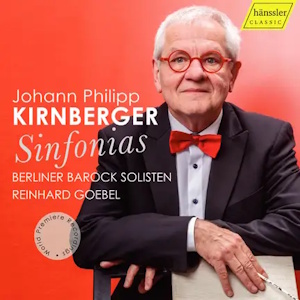
Johann Philipp Kirnberger (1721-1783)
Sinfonias Nos. 1-8
Berliner Barock Solisten/Reinhard Goebel
rec. 2025, Teldex Studio, Berlin
World premiere recordings
Hänssler Classic HC25039 [62]
A new name to me, German performer, composer and music theorist Kirnberger falls between the late Baroque and early Classical eras. He may be unfamiliar to most, but he was in the company of genius, studying composition and keyboard with Johann Sebastian Bach, who was thirty-six years older.
He served as violinist in the Prussian royal chapel in Berlin and as harpsichordist for Prince Heinrich of Prussia in Rheinsberg and in 1758, became music director for Princess Anna Amalia of Prussia, sister of Frederick the Great, a prestigious post he held until his death.
The conductor here is Baroque violinist and early music specialist Reinhard Goebel, who has served as the director of the award-winning Berliner Barock Solisten since 2018. He founded the legendary Musica Antiqua Köln in 1973, a period instrument ensemble that disbanded in 2007. Around the time of the millennium, his approach extended to conducting modern chamber and symphony orchestras.
The Berliner Barock Solisten was established in 1995 by Rainer Kussmaul, Raimar Orlovsky and other members of the Berliner Philharmoniker plus leading figures in Berlin’s early music scene. Employing aspects of period performance practice, it plays works of the 17th and 18th centuries on modern instruments, or period copies with modern set-ups. On these Kirnberger performances, their strength varies between thirteen players (Nos. 1 & 5) and seventeen (No. 8). A string section of just a dozen is used throughout, and there is a cembalo (harpsichord). With a pair of well-focused flutes No. 8 sounds especially impressive and all the symphonies bar No’s 1 and 5 have a pair of beautifully played horns.
Regarding inventiveness, technical excellence and level of emotional depth it comes as no surprise that Kirnberger is way behind his teacher; nevertheless, these works are worth hearing and will appeal to the inquisitive early music listener. The freshness and energy of these symphonies is immediately apparent. All but one of the symphonies is cast in three movements, the exception being No. 2 which has four, including a Largo introduction.
The opening movements, mainly Allegros, are agreeably upbeat and not too quick and both the Symphonies No. 1 and No. 4 having an extra uplifting appeal. The slow movements, mostly marked Andante,have a pleasingly stately manner; in No. 4 I hear nocturnal suggestions with the Symphony No. 1 the pick of the bunch. In Goebel’s hands the closing Allegros feel fresh and breezy, and the Prestos are afforded plenty of energy.
The recording benefits from excellent sound. The booklet contains several short paragraphs about Kirnberger from various sources, one of which is by Reinhard Goebel.
Although well performed, this release is really one for the curious collector.
Michael Cookson
Other review: David Barker
Buying this recording via the link below generates revenue for MWI, which helps the site remain free













