
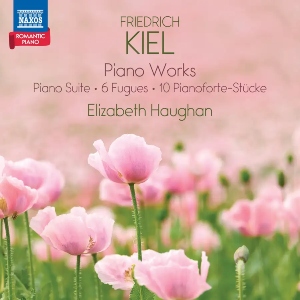
Frederick Kiel (1821-1885)
Piano Suite, Op.28 (published 1864)
Six Fugues, Op.2 (1850)
Ten Pianoforte-Stucke, Op.18 (1860)
Elizabeth Haughan (piano)
rec. 2024, Bradshaw Hall, Royal Birmingham Conservatoire, UK
Naxos 8.574703 [72]
Until I received this disc, the only works by Kiel I had ever heard were his piano concerto (in the now very sadly, apparently defunct, Hyperion Romantic Piano Concerto series, reviewed here) and his piano quintets and quartets – all of which I thoroughly enjoyed. However, Naxos have recently begun a series of Romantic solo piano music and this, the fourth volume of this endeavour, includes what appear to be world premier recordings of works by Kiel. The only previous volume of this series that I can find that has been reviewed so far is the one of music by Sir Julius Benedict, here. Further volumes will include works by Theodor Kullak, Robert Volkmann, Wilhelm Taubert and Anton Urspruch. Kiel was essentially self-taught but ultimately ended up being very much in demand as a teacher. Sadly, he died aged only 64, following an accident with a coach that forced him to retire and which hastened his death.
This disc begins with the Piano Suite, published in 1864 as his Op.28. The first movement (of four) is a rather interesting and compact little work in strict sonata form, entitled appropriately, “Sonate”. Its opening theme is unremittingly cheerful and occurs at numerous points throughout the work. It reminds me slightly of a Christmas carol but I can’t place which (this may be more or a reflection on the time of writing than my memory!) A more agitated section occurs about half way through with lots of finger twisting required in both hands but this leads neatly back to the opening material, then some more development and then a rather splendid ending. The following “Impromptu” is again very charming throughout but contains some darker hints, especially near the opening. The third of the set is a bouncy “Scherzo”, full of unexpected pauses and interesting modulations and it’s wonderful. The final work of this little suite is also the shortest by some margin – it’s only 1’49’’ and is a restrained little “Notturno”. It’s full of lovely tunes that will stick in your head, just like the remainder of the set.
For the next few tracks, we find Kiel in Bachian mode with a set of six short fugues. These are in various keys, of various lengths and are all very well constructed. There is some difficulty in the first of these in C# minor with the tune predominantly in the bass, here projected very clearly and nicely by Ms. Haughan. The following fugue is interesting and sounds as if it starts half way through a bar before the right-hand joins in and makes the piece sound whole. This is also the shortest of the set and is of a generally sunny disposition. The third of the set is my favourite from the six works; it is described in the notes as “…exuberant canvass” and I feel that is a good and accurate description. Despite the generally rousing nature of the piece, the ending is dreamlike and rather peaceful. The fourth of the set (in B major) is the longest of the set and is full of harmonic and melodic interest, especially the way that the main theme interleaves neatly with the counterpoint, starting very early on in the work. There is some decidedly un-Bach like writing in the middle and the very strange final section all of which is beautifully pedalled and controlled. The penultimate fugue is in F minor and is marked “Moderato” and seems to wander from one key to another quite a lot from the start. Unlike most of the other ones in the set, there are some trills in the bass that add a more Baroque feeling to the work. Despite the minor key this piece is generally light hearted and cheery. The final fugue, in C minor and marked “Allegro moderato” is a busy little piece with plenty of opportunities for the pianist to tangle their fingers around the clever keyboard writing. Naturally, Ms. Haughan doesn’t do this. Overall, this is an interesting little set of fugues, however, perhaps best listened to separately rather than in one sitting. The piano writing is assured and the playing is superbly controlled throughout.
The remainder of the disc is taken up with a set of ten small pieces, divided into three books and published as Kiel’s Op.18, in 1860. Book one, perhaps logically starts with a “Praeludium”. This is, rather like the suite that started this CD, a rather jolly happy little work, slightly Bach-like but obviously less so than the Fugues. The following Scherzo is just as entertaining. There is a change of pace for the third work; it’s a rather yearning “Duett” which is really rather splendid. The last piece in book one is a short “Andante”, lasting just over two minutes. Book two begins with a short piece in the Hungarian style (“Hongroise” – sounding completely unlike a friss from any of Liszt’s Hungarian Rhapsodies), followed by another “Scherzo” and then a “Melodie”. The following “Scherzo” is equally memorable with a cheerful little tune that bounces around happily with a nice contrasted central section. Lastly, is the “Melodie” which is slightly less interesting but still very charming. All are interesting and worth hearing – especially the “Hongroise” which will probably stick in your head. The third and final book consists of three short pieces: a “Ballade”, a “Lied” and a “Hymne”. These three make a nice contrast to one another, the “Ballade” is a strange piece, very much sounding as if it is telling a story and is full of unexpected pauses and key changes. It’s also quite dark in places, leading me to wonder what the story is about. The following “Lied” is full of tied notes and hung over harmonies giving a blurred sound world. The overall effect is lovely and it is a shame that this particular work isn’t longer. The disc draws to a close with a Schumannesque “Hymne” which is slightly pompous but still fun.
Overall, this is an interesting release. None of these piano works sounds especially difficult but there are some clever key changes. Kiel obviously had a gift for melody, as the works throughout are stuffed with good tunes and are very interesting and pleasant to listen to. I can’t really think of a composer that his sound world reminds me of, perhaps a little Bach (especially in the fugues), maybe some Clementi, Mendelssohn or Schumann here and there but nothing strikes me as particularly obvious. This is perhaps a reflection of the fact that he was mostly self-taught and absorbed influences from far and wide. The recorded sound is excellent, the notes are useful and the pianist Elizabeth Haughan makes a fine and convincing advocate for the neglected piano works of Frederick Kiel. Incidentally, there is a companion recording, available as a download, of Kiel’s Six Impromptus (Op.79) with the same pianist that I shall probably have to buy. I hope that further recordings of his other works will follow, too.
Jonathan Welsh
Buying this recording via the link below generates revenue for MWI, which helps the site remain free













