
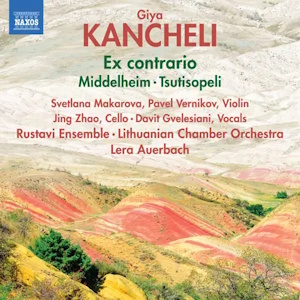
Giya Kancheli (1935-2019)
Ex contrario, version for two violins and string orchestra (2006)
Middelheim, version for piano trio and string orchestra (2016)
Tsutisopeli, version for two violins, singer and men’s choir (2019)
Svetlana Makarova (violin), Pavel Vernikov (violins), Jing Zhan (cello), Davit Gvelesiani (vocals), Rustavi Ensemble, Lithuanian Chamber Orchestra / Lera Auerbach
rec. 5-6 June 2023, Concert Hall, Lithuanian National Philharmonic, Vilnius, Lithuania (Ex contrario and Middelheim), 22 August 2021 (live), Cathédrale Notre Dame de Sion, Valais, Switzerland (Tsutisopeli)
No text or translation
Naxos 8.574453 [63]
Giya Kancheli grew up in the Soviet Union, as did, among others, the Estonian Arvo Pärt and the Ukrainian Valentin Silvestrov. Each of them discovered European modernism, and afterwards went his own way. Kancheli, born in Tbilisi in Georgia, moved after the breakup of the Soviet Union to Berlin and then to Antwerp, where he settled. In his home country, for many years he earned a living by writing theatre and film music. After he left for the West, his fame became such that he could support himself through composition, and many famous names took up his work.
His oeuvre falls into two groups. In Georgia, his chief achievement was the cycle of seven symphonies. In the West, he preferred smaller forms, often including voices. Those later works have divided opinions. They have attracted a cult following among some, but others have considered them a decline after the symphonies.
We have here three late works; Tsutisopeli is in fact Kancheli’s last composition. Ex contrario is for two violins and string orchestra, though a sampler is also required and there is a ‘performance CD’ which provides a background. The listener will hear sounds that gradually emerge from silence and form wisps of melody, which occasionally cohere and lead to a plaintive melody and even a dance-like section. The whole is intensely quiet and evocative in a way which enthusiasts will find hypnotic, while others may wonder what the fuss is about. The work lasts just under half an hour.
Middelheim may be named after the Middelheim Open Air Sculpture Museum near Antwerp. It started as a piano trio but this version adds a string orchestra. It is shorter and more vigorous than Ex contrario. A series of overlapping episodes seem as if they are going to build to a climax but in the end do not do so.
Tsutisopeli (this transient life) is for two violins, a singer and a men’s choir. It draws on traditional Georgian music. You will notice the Phrygian mode, best known perhaps from its use in klezmer music. I assume that the words deal with the shortness of life, but I cannot confirm: I cannot find a translation anywhere.
These are all premiere recordings in extremely good performances. The moving spirit behind the first two works is composer Lera Auerbach. She conducts them, operates the sampler in Ex contrario and plays the piano in Middelheim. Tsutisopeli was recorded separately. The recordings were made at two different venues, but they match well. The booklet provides a lot of information in a small space. It is a shame that the words of Tsutisopeli are not included, but the work was performed from manuscript and has not yet been published. Kancheli enthusiasts will not be disappointed.
Stephen Barber
Buying this recording via the link below generates revenue for MWI, which helps the site remain free













